

Killed in Action - Two Confederate Generals Who Died too Young
Ms. Rebelle is down south again at Charleston and Columbia, South Carolina. What absolutely beautiful cities they are, full of Southern gentility, ornate beautiful old houses, gorgeous flowers, good Southern food, and many monuments. Charleston is a lovely city to walk around and enjoy the sights. The porches/piazzas are definitely part of its charm with many houses having their entrance on a side porch. Charleston loves General Beauregard. We saw a beautiful painting and his sword in one of the city buildings. See earlier Patch article dated August 23, 2013.
General Micah Jenkins, CSA
Find out what's happening in Centrevillefor free with the latest updates from Patch.
Micah Jenkins was only 28 years old when he was killed from friendly fire at the Wilderness on May 6, 1864. He was born on December 1, 1835 on Edisto Island, South Carolina, located between Charleston and Beaufort. His father was a wealthy cotton grower and sent his 15 year old son to the South Carolina Military Academy now called The Citadel. The Citadel looks very much like the Virginia Military Institute in Lexington, VA. Micah graduated at the top of his class in 1854. In 1855 he founded the Kings Mountain Military School in Yorkville, South Carolina. He stayed at the school until 1861 when the Civil War began. He began his Civil War service by recruiting the 5th South Carolina Infantry Regiment on April 13, 1861. Jenkins fought at the First Battle of Bun Run under Confederate General David Rumph Jones. He made brigadier general on July 22, 1862 becoming one of the “boy” generals of the Confederacy assigned to General Richard H. Anderson.
Jenkins was extremely religious. He took his bible and prayer books with him everywhere and could be found reading them on the battlefield frequently.
Find out what's happening in Centrevillefor free with the latest updates from Patch.
At the Battle of Seven Pines in May, 1862, Jenkins incurred a knee wound, the first of four wounds he would incur. Captain W.B. Smith of the Palmetto Sharpshooters said of him at Seven Pines: “After we had driven back four fresh lines of battle General Jenkins drew his lines back a short way and formed a new line, someone said to him ‘just look at them coming at the double quick’. Jenkins replied: ‘We shall meet them at the double quick.’” Leading his men on horseback through the entire battle, Jenkins fought five lines of charges and whipped every one.
At Gaines Mill in June, 1862 Jenkins unit engaged the 16th Michigan, captured their colors, and a large number of men. Jenkins presented the flag to the Governor of South Carolina. Also in June, 1862 at Frayser’s Farm with General James Longstreet, he was wounded by shrapnel after his horse was shot out from under him, his personal aide shot beside him, his saddle shot, his horse’s bridle cut in half, and his sword hit three times.
At the Second Battle of Bull Run in August, 1862, he was wounded in the abdomen. He was sidelined for two months recuperating and missed being with his unit during the Battle of Antietam in September, 1862. Jenkins was assigned to General George Pickett at the Battle of Fredericksburg in December, 1862 but was not engaged. He fought in the Siege of Suffolk with General Longstreet in 1863 and became a favorite of the general. In the fall of 1863 he was assigned to the First Corps of the Army of Northern Virginia and sent to Tennessee in command of General John Bell Hood’s division. Here he fought at the Battle of Chickamauga on September 20, 1863. Jenkins led his brigade to victory against Federal cavalry at the Battle of Kimbrough’s Crossroads. He fought at Campbell Station and the Siege of Knoxville. His health deteriorated in the spring of 1864 with carbuncles between his shoulder blades attributed to undernourishment.
His health was still suffering when the Wilderness began on May 5, 1864 but he insisted being present. An ambulance transported him to the battlefield. Later while riding at the head of the column with General Longstreet near the Brock Road trenches, men from the 12th Virginia under General William Mahone, mistook them for Federal troops and opened fire. Both generals were wounded, and Jenkins mortally with a shot to the head. The ball lodged in his brain. He lived for about six hours and died on May 6, 1964. General Longstreet suffered with his wounds for the rest of his life.
Jenkins was married to the former Caroline Jamison, daughter of General D.F. Jamison, who was one of the founders of The Citadel. He left four young children. Originally buried in Summerville, South Carolina, he was moved to Magnolia Cemetery in Charleston in 1881. Jenkins Hall is named after him at The Citadel.
General Longstreet said of Jenkins: “He was one of the most estimable characters of the army. His taste and talent were for military service. He was intelligent, quick, untiring, attentive, zealous in discharge of duty, truly faithful to official obligations, abreast with the foremost in battle, and withal a humble, noble Christian. In a moment of highest earthly hope, he was transported to serenest heavenly joy; to that life beyond that knows no bugle call, beat of drum or clash of steel. May his beautiful spirit, through the mercy of God, rest in peace! Amen!
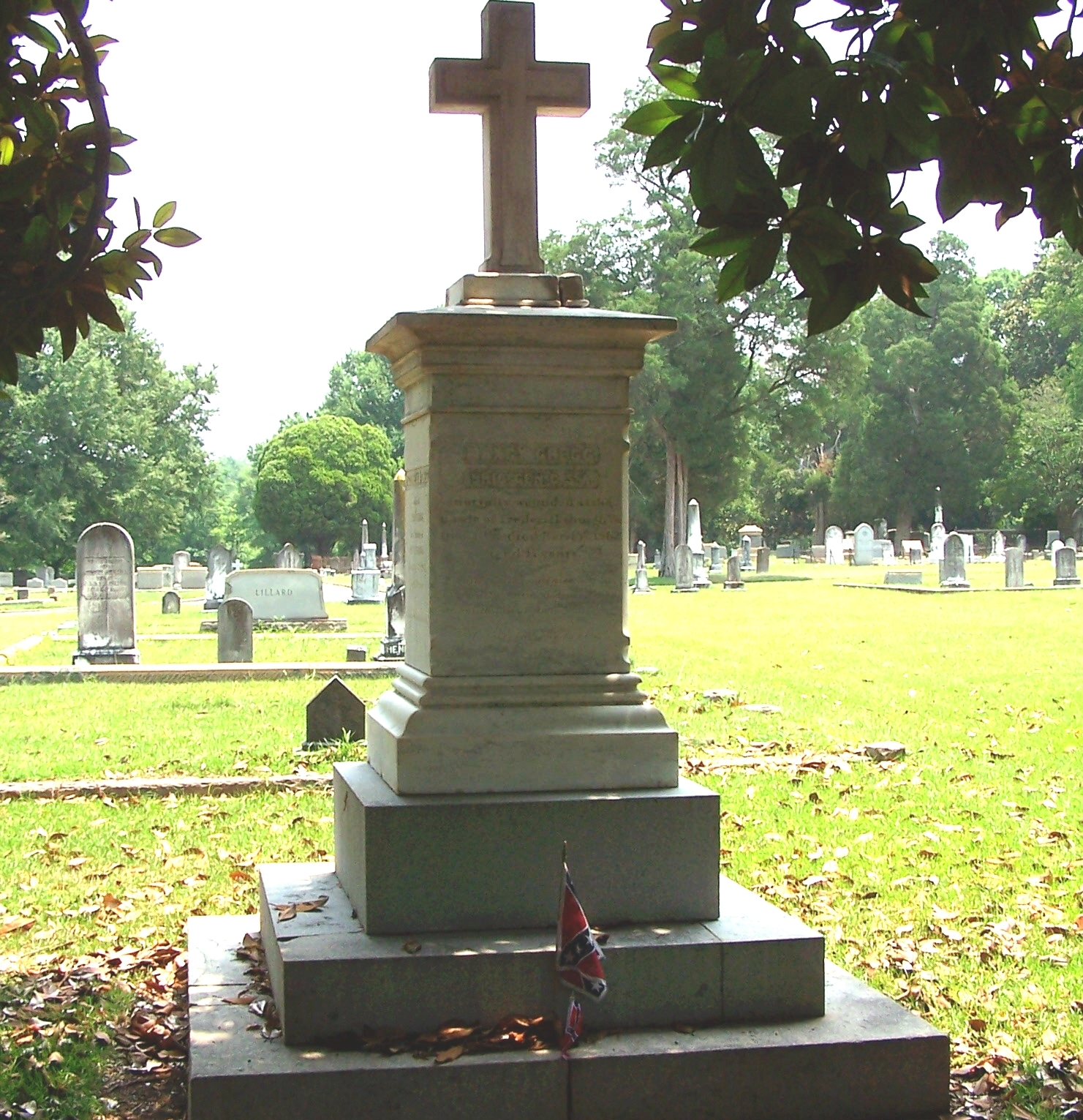
General Maxcy Gregg, CSAWe now venture to Columbia, South Carolina to find the grave of General Maxcy Gregg. Columbia being the capitol of South Carolina has a magnificent state house with six bronze star markers denoting where the building was hit by artillery on February 19, 1865. Thirty monuments are located on the lawn, including General Wade Hampton, with twelve bronze plaques commemorating the battles Hampton fought in at the bottom of his equestrian monument.
General Gregg was mortally wounded at the battle of Fredericksburg on December 13, 1862, and died two days later on December 15, 1862. General Gregg is buried in Elmwood Cemetery in Columbia.
Maxcy Gregg was born August 1, 1814 in Columbia, South Carolina. His father was Colonel James Gregg, a distinguished attorney in Columbia. He was the grandson of Esek Hopkins, a commodore in the Continental Navy. Gregg graduated from South Carolina College, now known as the University of South Carolina, with a degree in law. He practiced law with his father for a time and then went into the army and fought in the Mexican-American war as a major in the 12th U.S. Infantry. Gregg had many interests including botany, ornithology, languages, astronomony, and even owned his own private observatory. He carried an antique scimitar from the Revolutionary War.
In 1858 as an ardent supporter of secession, he wrote a pamphlet entitled, “An Appeal to the States Rights Party of South Carolina.” In 1860 when South Carolina seceded from the union, Gregg helped organize the 1st South Carolina Volunteers and was made their first colonel. He became a brigadier general and served in A.P. Hill’s Light Division. He fought at the battle of Gaines Mill, Second Bull Run, and Lee’s Maryland Campaign. Prior to Second Bull Run, he was stationed at Centreville, Fairfax Courthouse, and commanded infantry in Vienna. He also fought at the battle of Ox Hill – another local connection.
When fighting at Antietam he was wounded in the thigh by the same bullet that killed General Lawrence O’Bryan Branch. He discovered the ball in his handkerchief the next morning at breakfast. His unit reached the field in time to save the Confederate right.
At the battle of Fredericksburg, both Confederate Generals Gregg and Thomas Cobb were killed. Gregg was hit with a rifle ball that entered his side and passed through his spine. He lingered in agony for two days and then died on December 15, 1862. General A.P. Hill in whose command he served during the entire war stated: “A more chivalrous gentleman and gallant soldier never adorned the service which he so loved.” Prior to General Stonewall Jackson’s death, he said of Gregg: “General Gregg was a brave and accomplished officer, full of heroic sentiment and chivalrous honor. He had rendered valuable service in this great struggle for our freedom, and the country has much reason to deplore the loss sustained by his premature death.”
NOTE: Ms. Rebelle’s hobby is travelling the country finding and honoring the graves of our 1,008 Civil War generals. So far she has located and photographed 385….169 Confederate and 216 Union.
Ms. Rebelle is a member of the The Bull Run Civil War Round Table which meets every second Thursday of every month at 7 p.m. at the Centreville Regional Library. The public is invited to attend at no cost and visit the website www.bullruncwrt.org for additional activities (tours, etc.)