Politics & Government
A Step Backward? Virginia Leaders Divided on Supreme Court Voting Rights Decision
As Virginia officials react to Supreme Court decision, Gov. Bob McDonnell said he will work to review voting laws and ensure they comply with federal standards.


By Erica Hendry
The Supreme Court on Tuesday voted down the section of the Voting Rights Act of 1965 that mandated federal oversight of voting in a handful of states, including Virginia.
The court ruled that the formula used to determine which states must get special approval of certain voting changes with the U.S. Department of Justice was unconstitutional. The requirement applies to changes like redistricting, along with new laws like a photo identification requirement that will be in place in July 2014 for all Virginia voters.
Find out what's happening in Clarendon-Courthouse-Rosslynfor free with the latest updates from Patch.
And as the commonwealth approaches a November marked by a heated governor's race — which has captured national dollars and attention, in part because of its potential impact on the 2016 presidential race — the state's leaders are divided on how the ruling will affect Virginians in the future.
When the law was enacted in 1965, it targeted places where voter turnout was below 50 percent, and in some cases, where devices like literary tests were used to discourage voting.
Find out what's happening in Clarendon-Courthouse-Rosslynfor free with the latest updates from Patch.
The majority in the 5-4 court decision said Congress had “not provided adequate justification” for still subjecting certain states to the law, according to he New York Times.
While the court upheld the section of the act that says changes must be pre-cleared, it killed the section that spells out which states to which that applies.
Congress can choose to create new legislation to determine which states are covered, but the chances of a compromise aren’t great, the Times reported.
Some jurisdictions in Virginia — like Prince William County and the cities of Fairfax, Falls Church and Manassas Park — already had been exempted from preclearing voting changes by the federal government. But other Virginia localities were until Tuesday still held to the standard.
The Arlington County Office of Voter Registration, following the Supreme Court's decision, posted on its Facebook page:
"WOW! in a 5-4 decision, the Supreme Court rules that the formula used in Sec. 5 of the Voting Rights Act is unconstitutional. Jurisdictions such as Arlington should not be subject to preclearance on all election matters. This is not to say the law is unconstitutional - just that the formula used is outdated."
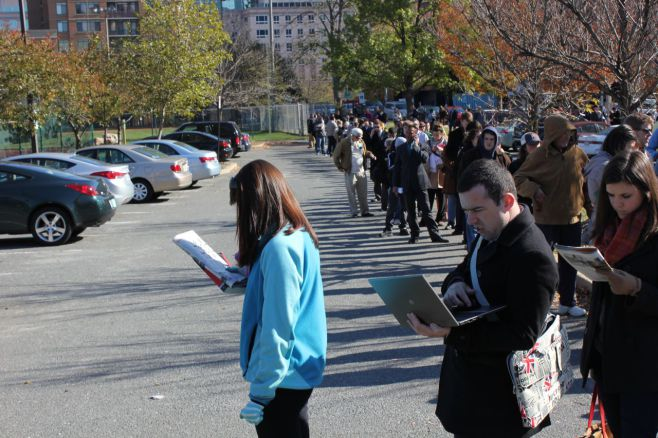
Virginia saw voters across the state wait for hours to cast a ballot in November 2012.
Some didn’t vote until 10 p.m., three hours after the polls closed. Anyone in line at closing time (7 p.m.) is allowed to stay in line until they vote.
But that shows problems at polling places still exist, said Democratic Party of Virginia Vice Chairwoman Louise Lucas, who called the Supreme Court’s ruling “a step backward for voting Virginians.”
Virginia Gov. Bob McDonnell, on the other hand, said in a statement the ruling “maintains the portions of the Voting Rights Act that prohibit discriminatory practices and procedures.”
He said he will work with Attorney General Ken Cuccinelli — the gubernatorial candidate on this year’s GOP ticket — to review voting laws to ensure they comply with federal standards.
"Virginia is committed to fair elections, fair voting districts, and ensuring everyone's vote counts,” Cuccinelli said in a statement. “Regardless of the court's decision, legal mechanisms remain in place to safeguard the vote of Virginia's citizens.”
Democratic U.S. Sen. Tim Kaine said he wasn't sure "how voting rights will be protected in the interim in places where discrimination still exists."
“While we have made progress, protections are still necessary to ensure that Virginians are allowed to exercise their right to vote without the risk of disenfranchisement,” said Democrat Terry McAuliffe, Cuccinellis’ opponent in November's election.
Tuesday’s decision means Virginia won’t have to earn federal approval for a recent bill that would require all voters in this state to have a photo ID when they're heading to the polls beginning in July 2014.
Voters had mixed reaction to the new law, with some calling it common sense and others calling it voter suppression.
Before Tuesday’s decision, the new requirements would have needed Justice Department approval.
McDonnell spokesman Tucker Martin said the voter identification legislation likely won't be delayed as a result of the Supreme Court’s ruling, though much depends on whether Congress decides to create new legislation to identify states where special approval is needed.
A statement issued by 13 Virginia advocacy groups, including some chapters of the NAACP and Virginia Organizing, said the decision "means that Virginians must now take responsibility for holding our elected officials accountable to ensure new legislation allows our elections to remain free, fair, and accessible."
Tell us: Do you agree with the Supreme Court's ruling? What affect do you think it will have in Virginia? Let us know in the comments.
Get more local news delivered straight to your inbox. Sign up for free Patch newsletters and alerts.