Community Corner
The History of the Cherry Blossoms
Daniel Stone's book on plant hunter David Fairchild and DC's cherry blossom trees will be published by Berkley/NAL (Penguin) in 2017.

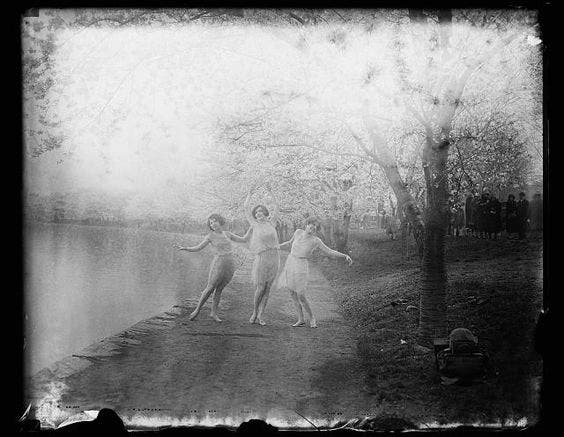

PHOTOS: Black and white photo: Dancers and cherry blossoms at the Tidal Basin in Washington, D.C. Ca. 1923-29. Harris & Ewing Collection, Library of Congress Prints and Photographs Division. Color photo by William Neuheisel/flickr
____________________
By Daniel Stone
Find out what's happening in Del Rayfor free with the latest updates from Patch.
There's an exciting moment in Washington each year as the cherry blossom trees reach peak bloom. Cold weather complicates when it happens, as does warm. After several revisions, National Park Service gardeners have identified that this year, it's March 23 and 24.
It's easy to see the allure of the fluffy pink blooms. But when you look at the cherry blossom trees around the tidal basin, you might consider just how much work it took to get them there. In fact the trees, known in Japanese as “sakura,” might have stayed exclusively in Japan if not for two enterprising Americans.
Find out what's happening in Del Rayfor free with the latest updates from Patch.
One was Eliza Scidmore, a well-known Washington journalist in the 1880s and 90s. Scidmore's brother was a consular officer in Japan, and each time Scidmore went to visit her brother, she was more and more enthralled by the sakura. Each time she returned to Washington, she told everyone she could about the wonderful trees. People often asked her, what was the point of cherry trees that didn’t actually produce cherries?
The other person was David Fairchild, a hunter of plants and a special agent for the Department of Agriculture. By the early 20th century, Fairchild had traveled around the world three times, investigating every continent for plants useful to America. When he stopped in Yokohama, Japan, he, like Scidmore, was also drawn to the blossoms. So much that when he returned home to Washington, he ordered more than 100 sakura trees for his own yard in Chevy Chase, Maryland.
Catching a glimpse of Fairchild's trees in bloom in 1909 was all that anyone needed to see to understand what Scidmore had been talking about. And when word got to the new president, William Howard Taft, he saw the trees as an opportunity to bridge diplomatic divides with the Japanese. His wife, Helen, also thought the sakura could be helpful to beautify Washington. President Taft dispatched Fairchild to negotiate a shipment of several thousand trees from the Japanese. The first shipment of trees arrived diseased and rotten with pests, but when Fairchild arranged for a second shipment, the trees found their way into the soil between the Potomac and the Washington Monument.
Only a handful of people were around on March 27, 1912 when the first trees were planted—among them Scidmore, Fairchild and Helen Taft. Most of those original trees don't exist anymore. But about 3,800 of their descendants do. It's a tiny number when you consider the thousands more people who come every year to see them.
Daniel Stone is a staff writer for National Geographic. His book on the life and adventures of plant hunter David Fairchild, and the exchange of the cherry blossom trees, will be published by Berkley/NAL (Penguin) in 2017.
Get more local news delivered straight to your inbox. Sign up for free Patch newsletters and alerts.