Schools
Fairfax County Public Schools: Benchmarking Data For Students At The Start Of The 2021-22 School Year
iReady assessments measure students' reading ability and math ability. FCPS uses this data primarily to identify students in need of int ...
December 14, 2021
Summary
iReady assessments measure students’ reading ability and math ability. FCPS uses this data primarily to identify students in need of interventions. iReady assesses student performance according to the level they should meet by the end of the school year. Students are not expected to meet these expectations at the beginning of the school year.
Find out what's happening in Falls Churchfor free with the latest updates from Patch.
iReady is given in the fall and again in the spring. This practice provides a growth measure. The goal is to have all students at or above the grade-level expectation by the end of the school year.
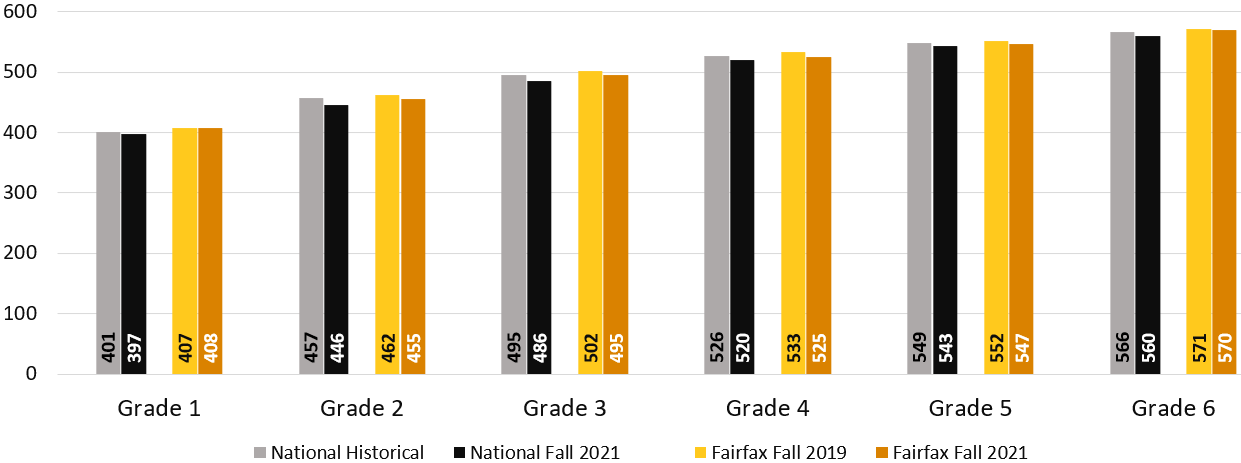
Given the 18 months of disrupted learning caused by the pandemic, FCPS expected to see a decline in performance across all grades. While this proves true when looking at iReady mean scaled scores in grades 2-6, declines in FCPS are generally less substantial than were seen nationwide pre- and post-pandemic.
Find out what's happening in Falls Churchfor free with the latest updates from Patch.
Even after the pandemic, FCPS showed more students performing on grade level on the fall iReady assessment than the pre-pandemic national averages in both reading and math in all grade levels.
Data included in this report reflects student assessment results from the first few weeks after they returned to school for the 2021-22 school year. iReady was administered from early September through mid-November. This is not an assessment of Quarter 1 progress.
Also, be aware that iReady is only one type of academic data used to understand student learning progress and division performance.
FCPS is directing significant ESSER funding aimed at supporting our students in reading and math to ensure gaps are addressed. These include after-school tutoring, individualized tutoring during the school day, and English Language Development time.
February 2022: The baseline ESSER accountability report is scheduled for a Board Work Session regarding ESSER III monitoring. The focus of this baseline report is to understand identification of students for intervention and supports in reading and mathematics and the extent to which there is alignment with ESSER III fund allocation.
Fairfax County Public Schools and National Comparisons
Students Performing On-Grade Level in Fall, iReady Pre- and Post-Pandemic Outcomes
Mathematics
Grade 1
Grade 2
Grade 3
Grade 4
Grade 5
Grade 6
Mathematics
National Historical
Grade 1
12%
Grade 2
15%
Grade 3
18%
Grade 4
29%
Grade 5
33%
Grade 6
33%
Mathematics
National Fall 2021
Grade 1
10%
Grade 2
13%
Grade 3
13%
Grade 4
19%
Grade 5
23%
Grade 6
25%
Mathematics
Fairfax Fall 2019
Grade 1
19%
Grade 2
28%
Grade 3
29%
Grade 4
46%
Grade 5
52%
Grade 6
58%
Mathematics
Fairfax Fall 2021
Grade 1
19%
Grade 2
23%
Grade 3
25%
Grade 4
34%
Grade 5
40%
Grade 6
47%
Reading
Grade 1
Grade 2
Grade 3
Grade 4
Grade 5
Grade 6
Reading
National Historical
Grade 1
18%
Grade 2
29%
Grade 3
44%
Grade 4
31%
Grade 5
30%
Grade 6
31%
Reading
National Fall 2021
Grade 1
16%
Grade 2
24%
Grade 3
40%
Grade 4
29%
Grade 5
29%
Grade 6
29%
Reading
Fairfax Fall 2019
Grade 1
27%
Grade 2
34%
Grade 3
50%
Grade 4
33%
Grade 5
31%
Grade 6
34%
Reading
Fairfax Fall 2021
Grade 1
27%
Grade 2
32%
Grade 3
46%
Grade 4
32%
Grade 5
32%
Grade 6
37%
Data Notes: In these graphs and tables, on-grade level performance is defined using iReady’s nationally normed placement levels. This value reflects students performing in the “Early On-Grade” or the “Mid On-Grade or Above” placement level during fall testing. The pre-pandemic “National Historical” data represents a pooled average across fall 2017, fall 2018, and fall 2019 for the same cohort of schools nationwide. All data are compliments of Curriculum Associates, the designer of the iReady assessment.
Fairfax County Public Schools and National Comparisons
Mean Scaled Score in Fall, iReady Pre- and Post-Pandemic Outcomes
Mathematics
Grade 1
Grade 2
Grade 3
Grade 4
Grade 5
Grade 6
Mathematics
National Historical
Grade 1
375
Grade 2
401
Grade 3
425
Grade 4
447
Grade 5
465
Grade 6
477
Mathematics
National Fall 2021
Grade 1
371
Grade 2
395
Grade 3
418
Grade 4
439
Grade 5
456
Grade 6
469
Mathematics
Fairfax Fall 2019
Grade 1
376
Grade 2
407
Grade 3
433
Grade 4
461
Grade 5
479
Grade 6
498
Mathematics
Fairfax Fall 2021
Grade 1
376
Grade 2
401
Grade 3
426
Grade 4
449
Grade 5
467
Grade 6
488
Reading
Grade 1
Grade 2
Grade 3
Grade 4
Grade 5
Grade 6
Reading
National Historical
Grade 1
401
Grade 2
457
Grade 3
495
Grade 4
526
Grade 5
549
Grade 6
566
Reading
National Fall 2021
Grade 1
397
Grade 2
446
Grade 3
486
Grade 4
520
Grade 5
543
Grade 6
560
Reading
Fairfax Fall 2019
Grade 1
407
Grade 2
462
Grade 3
502
Grade 4
533
Grade 5
552
Grade 6
571
Reading
Fairfax Fall 2021
Grade 1
408
Grade 2
455
Grade 3
495
Grade 4
525
Grade 5
547
Grade 6
570
Data Notes: In these graphs and tables, the mean scaled score reflects average student performance on iReady’s nationally normed scale. Fall scaled scores provide a baseline for calculating growth between test administrations, such as from fall to spring or one year to the next. The pre-pandemic “National Historical” data represents a pooled average across fall 2017, fall 2018, and fall 2019 for the same cohort of schools nationwide. All data are compliments of Curriculum Associates, the designer of the iReady assessment.
Next Steps and Use of Federal Pandemic Relief Funding (ESSER)
$188.6 million of ESSER Funds allocated to FCPS for expenses related to the pandemic.
The grant funding requires the spending be focused in four areas. A portion of the federal aid must be spent tackling learning loss:
The majority of the ESSER III spending (82%) will address learning loss and student academic, social, emotional, and mental (wellness) health needs, which students need in order to learn.
FCPS, like many school divisions, will be offering proven strategies(link is external) like targeted intensive tutoring, which works well for younger students and increasing the number of hours of instruction students receive each day during nonacademic class periods.
It also includes additional financial support for special education teachers whose scheduled daily work hours have been increased to support the additional workload they have been required to carry during the pandemic.
Funds have also been set aside for an additional year of enhanced summer school in the summer of 2022.
School-Specific Strategies and Supports
Each school has received funding allocations as well as stipends, for academics and wellness. The academic and wellness allocations are to be used to directly support students. The amount each school received is based on its enrollment and need, determined by the number of students eligible for free and reduced meals; percent of English Learners; percent of Students with Disabilities; reading and mathematics achievement reverse index; and graduation and Completion Index (for high schools).
The funding will be used to support academics and wellness, including:
All school “at-a-glance” plans have been posted to their school websites.
This press release was produced by Fairfax County Public Schools. The views expressed here are the author’s own.