Community Corner
Falls Church Honors Martin Luther King Jr. With View On Passing Voting Rights Bill
Political leaders gathered in Falls Church on Monday to honor Martin Luther King Jr. and to highlight the protection of voting rights.


FALLS CHURCH, VA — U.S. Sen. Mark Warner and Rep. Don Beyer joined Edwin Henderson II, founder of the Tinner Hill Heritage Foundation, on Monday to celebrate the birthday of Martin Luther King Jr. with nearly 100 other people at the Tinner Hill Civil Rights Monument in Falls Church.
The annual event was organized to recognize the great work of King who fought to advance civil rights in the United States and around the world and to urge the crowd to keep fighting today to protect voting rights in Virginia and across the nation.
“We are here today to honor Dr. Martin Luther King,” Henderson, the grandson of Dr. E. B. Henderson, said in a speech at Monday’s event.
Find out what's happening in Falls Churchfor free with the latest updates from Patch.
In his speech, Henderson also emphasized the importance of voting, especially in midterm elections, and advocating to keep laws in place in Virginia that were passed to make it easier for all Virginians to vote.
“If they put roadblocks in our way, we have to overcome them, and we have to get to the polls,” Henderson said. “We have to be ever-vigilant, and we have to get people out to vote in November."
Find out what's happening in Falls Churchfor free with the latest updates from Patch.
Henderson’s grandfather, Dr. E.B. Henderson and grandmother, Mary Ellen Henderson, teamed up with Joseph Tinner and a small group of African Americans in 1918 to form the Colored Citizens Protective League in Falls Church, which transitioned into the first rural branch of the National Association for the Advancement of Colored People.
Falls Church Mayor David Tarter described the arch erected by the Tinner Hill Heritage Foundation in 1999 at the corner of South Washington St. and Tinner Hill Rd. as a monument in honor of the men and women who refused to accept the racist laws in Virginia and successfully challenged them.
“But this arch is not just about the past, it’s about our future. It’s about ordinary people doing extraordinary things. And it can teach us how we as a nation can continue to change for the better,” Tarter said.
In his speech, Tarter emphasized that Martin Luther King Jr. and his fellow civil rights leaders from the 1950s and 1960s stand in stark contrast to many political leaders today.
“Dr. King appealed to this country’s highest ideals, not its base instincts,” the mayor said. “Through his rhetoric and his actions, he inspired to something better. He categorically rejected violence, not incited it.”
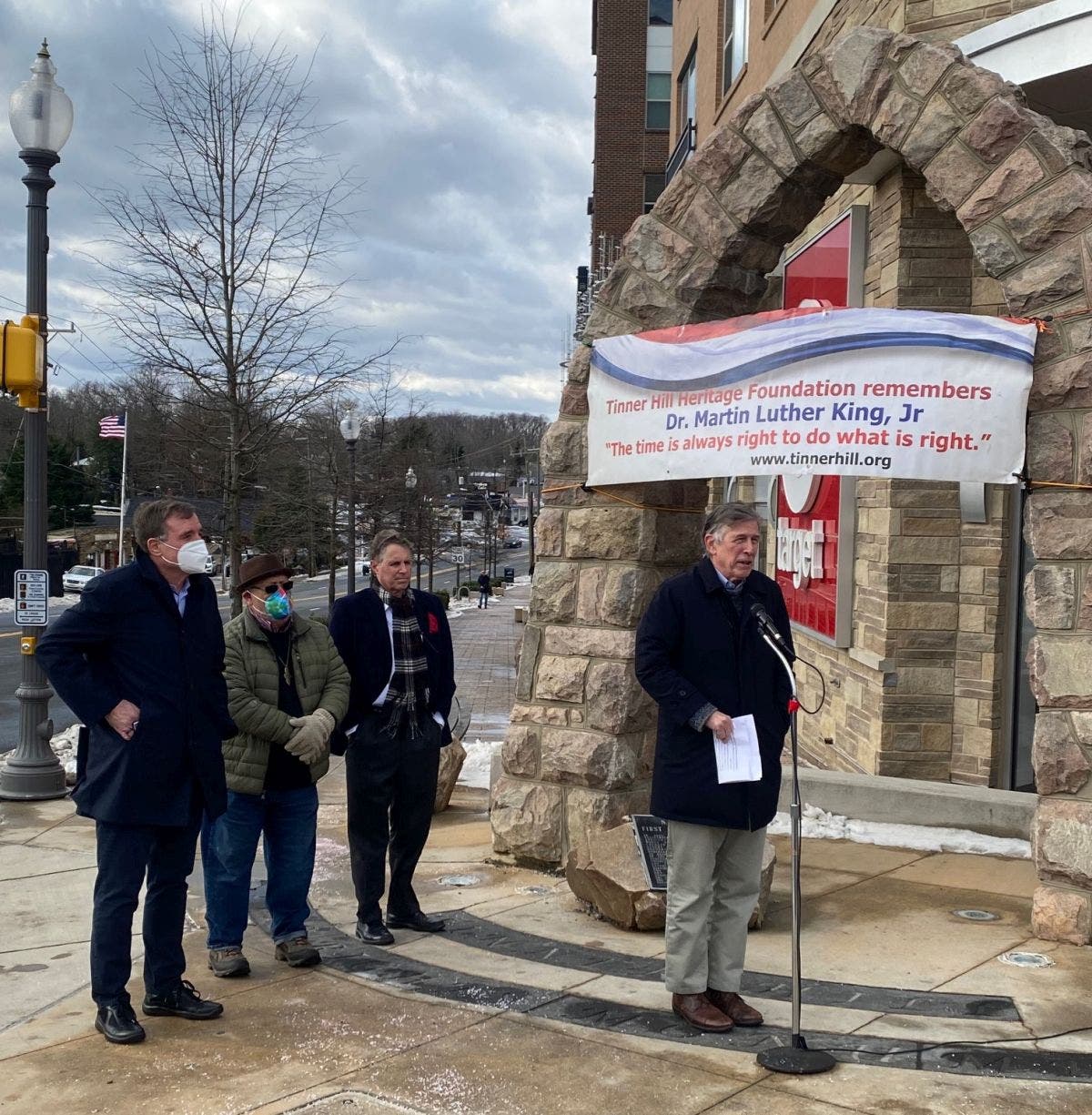
Beyer, a Democrat who represents Virginia’s 8th congressional district, reminded attendees at Monday’s event that Martin Luther King Jr. was standing right behind President Lyndon Johnson when he signed the Civil Rights Act of 1964 and was integral to the passage of other major pieces of civil rights legislation in the 1960s.
“We’ve come a long way in terms of the laws, but there’s a different type of oppression against our democracy that’s happening right now,” Beyer said.
The attacks on voting rights might be more subtle today than they were in the 1950s and 1960s, when Beyer was growing up in Virginia. “But the goal is still familiar,” he said. “It’s to keep people of color from voting. They shut down polling places. They restrict hours. They make it so you have to wait in long lines.”
Beyer stressed the importance of the passage of the “Freedom to Vote: John R. Lewis Act,” which combines the Freedom to Vote Act and the John R. Lewis Voting Rights Advancement Act into one bill.
The bill would expand voter access with guidelines for mail-in voting and early voting, establish Election Day as a federal holiday. It would also restore the Justice Department’s authority to police election laws in states with a history of discrimination, a key component of the 1965 Voting Rights Act the Supreme Court stripped away in 2013.
The House of Representatives passed the bill last week. The bill is now before the Senate, where it faces an uncertain future due to the filibuster.
Warner said he supports changing the rules on the filibuster in the Senate in order to pass the voting rights bills.
"I will vote this week for both of those bills and, as necessary, to change the rules because we've got to make sure that the promise of America becomes the reality of America," Warner told the crowd.
Get more local news delivered straight to your inbox. Sign up for free Patch newsletters and alerts.