Sports
Merrifield Basketball Gym Cranks out Regional Stars
Manning, Schoof and Ziegler among Evolution Basketball's success stories

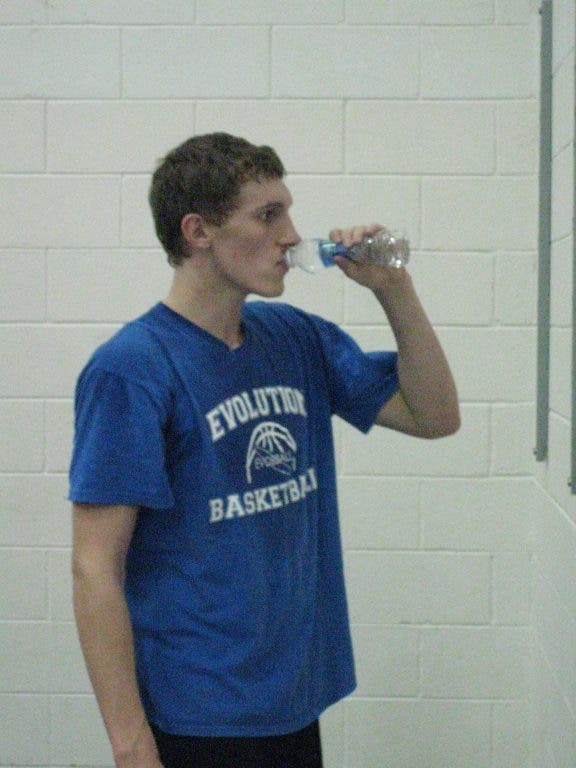


Take a look at John Schoof today. He grabs a rebound on defense and starts the transition to offense for the W.T. Woodson Cavaliers. He’s confident and strong, the leader of a solid team in the Patriot District.
And look at John Manning today. He’s a towering presence for the always-strong Chantilly Chargers, capable of scoring with either hand and at 6 feet 11 inches, a defensive force.
Each team is a contender to win its district tournament and possibly qualify for, and go deep in, the Northern Region playoffs. Schoof and Manning will be keys to their success.
Find out what's happening in Falls Churchfor free with the latest updates from Patch.
But those players, one (Manning) bound for St. Louis University next year and another (Schoof) headed to American University, didn’t get to be among the top seniors in the region without help.
Rewind to 2005. Manning, 6-8 as an eighth grader, was pegged as a basketball star due to his height. But he was scrawny.
Find out what's happening in Falls Churchfor free with the latest updates from Patch.
“I was pretty weak. I didn’t have much strength down low,” he said.
Plus, he wasn’t used to moving his body with the grace required of a top-level high school basketball player. Coordination was a problem.
Schoof, who plays nearly every minute of Woodson’s games these days, wasn’t even a starter on his AAU team.
“Definitely not one of the best players on the team,” he said when asked to critique his younger self. “Until maybe eighth grade, I was one of the slower, weaker guys on the team.”
Today, he shoots with confidence. Then, he was reserved, on and off the court.
“A shy little kid,” he says.
Under the wing of Harris
How did Schoof and Manning get to where they are today?
Yes, hard work and practice. Those are the obvious answers. Hundreds of shots a day in the summers and on weekends during the season. But he also had help.
The help came in the form of Alex Harris, a former player at LeMoyne College in Syracuse, N.Y. who went on to play a little pro ball overseas. He runs Evolution Basketball Training, a private basketball gym in the Merrifield neighborhood of on the border of Falls Church, Fairfax and Vienna.
When Harris’ playing career ended, he knew he wanted to be a coach, and he got into that career the traditional way, as a part of the staff at St. John’s Prep in Frederick, Md. But he transitioned into private coaching – the refining of players’ skills one-on-one and in small groups -- that has become the trademark of his academy.
“I always knew this was the part of the game I enjoyed most – the developmental part,” he said one January Sunday morning in Springfield, where he rents a gym to run practices when he has more than just a few players at a time. “When you’re coaching a team, you’re developing, but it’s not quite the same. That’s the part I really love and truthfully, I’m best at.”
The session brought out some of the best players in the Northern Region – Manning even came to watch though he had been out of action due to a hard fall a few games earlier. Thomas Jefferson’s Richard Kuzma, one of the top free-throw shooters in the entire D.C. area, was there. So was Karl Ziegler, a key presence for the hot Annandale Atoms, along with a handful of other dedicated high school players.
Most of them had played a game that weekend, either Friday night or Saturday, yet here they were, working on ball-handling, putting up jumpers and shooting bushels of free-throws.
“Here we’ll break it down to individual parts,” Schoof said. “We also do a lot of stuff that will help me in the next level, in the college game. A little more higher-level stuff.”
It’s not just repetition either, it’s game management. Harris is part taskmaster, part philosopher.
“He teaches a lot of why you do things,” Schoof said.
Keeping it Simple
In eight years, Harris has learned a style of teaching that maximizes the impact of the time he has with his disciples.
“One of the things I’ve really done is kept it a little bit (simpler) with what we’re doing,” he said. “Slowing things down and forcing them to get the simple concepts.”
Those teaching moments are important, he says, especially in an era where playing four games in a weekend at an AAU summer tournament is the norm.
So while you’re in the stands over the next couple weeks, watching these players, remember they didn’t get to where they are by accident. Sure, growing to almost 7 feet or even 6-foot-6 is a genetic gift, but smaller players like Kuzma and Ziegler have put up 20, 25, 27 or 30-point games this season. Repetition has been the key.
“Ziegler is a good example of that,” Harris said. “He really worked his way into the success he’s had. Going to Woodson vs. Annandale and seeing them on the court together is a lot of fun.”
Manning, too, saw his skills improve during his sessions with Harris.
“Probably the summer between my eighth-grade year and my freshman year,” he said when asked about a time when his game grew to match his height. “We worked almost every day. We were either lifting weights or shooting because he knew I had a lot of work to do to be on high school varsity.”
Manning said it was also important to find a big man as a coach. Harris is 6-8.
Schoof, though you might not know it because of his recent success, is perhaps Harris’ prized pupil.
“I don’t want to say he was bad as a fifth grader, but he definitely wasn’t too good,” Harris said, a smile breaking as he remembered the player as a youngster. “He was tall and lanky. He still had the goofiness in him. … From the seventh grade over the next couple of years, he really worked hard. His body started to develop and his coordination started to get better. He went from not a starter to being a sophomore and starting on the varsity team. That’s a quick turnaround. He’s a kid who has worked his way into being good.”
Harris’ sessions give some of the top players in the area the chance to work out with each other. It’s no secret that pairing the first team against the second team in a scrimmage during a high school practice isn’t always going to make that first team better.
“When we get in here, we get six or seven guys who are pretty much the best players on their high school teams. They’re all competitive. They all love the game and are in here working just as hard as you,” Schoof said.
Work pays off
The extra work hasn’t gone unnoticed by Schoof’s coach at Woodson, Doug Craig.
“John doesn’t have a lot of wasted movement in his game. He’s very efficient with what he does, and that just comes from repetitive drill work,” Craig said. “And John is very much a gym rat, whether it’s at Evolution or our gym, he just works so hard.
It’s not like he’s the naturally best athlete on the floor or the strongest kid on the floor, or even the most talented, but he just has worked himself into a very good player.”
That seems to be a common thread among the players Harris works with.
“When I first started, I didn’t always want to come, but I definitely saw the results that it was producing,” Manning said, remembering those days when he didn’t feel like getting out of bed to shoot free throws for an hour. “I guess that alone just motivated me to keep coming and keep working.”
One of Manning’s breakthroughs was in free-throw percentage. He went from 50 percent to 75 percent between his freshman and sophomore seasons.
“You don’t really come here and not want to work,” Manning said. “Because one, you’re paying for it, and two, no one would want to go through this and not want to be doing it.”
Schoof said he’d recommend Harris to today’s version of his seventh-grade self.
“I wouldn’t be where I am in my basketball career without Alex,” he said.