Politics & Government
Fredericksburg Cancels Meeting To Discuss Protesting At Homes
The Fredericksburg City Council canceled a planned special session for Monday at the request of City Attorney Kathleen Dooley.


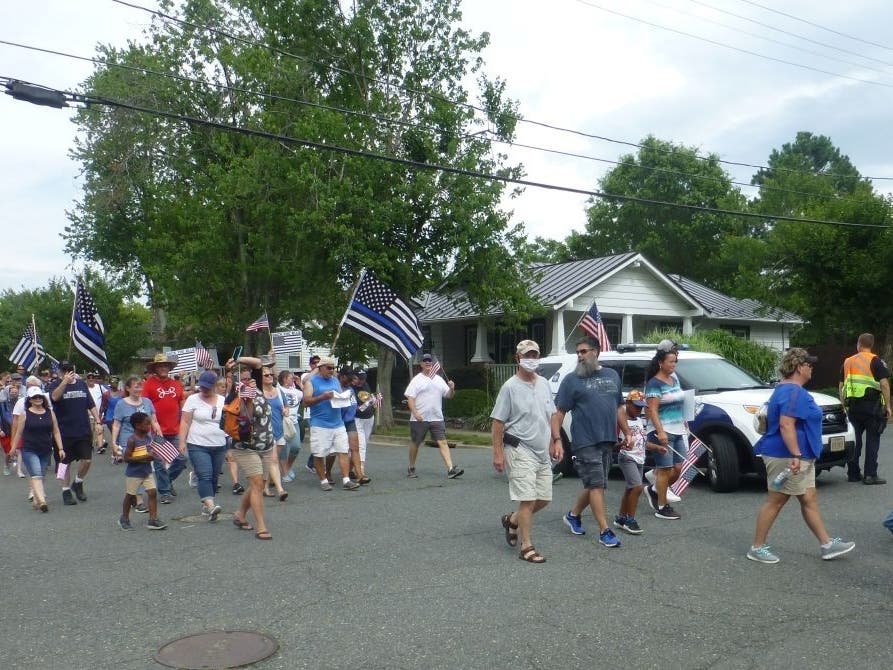
FREDERICKSBURG, VA — The Fredericksburg City Council canceled a planned special session for Monday evening to discuss protests against racial injustice held last week outside the homes of City Manager Timothy Baroody and Mayor Mary Katherine Greenlaw. The special session was canceled at the request of City Attorney Kathleen Dooley, who cited a Virginia law that makes it illegal to engage in "picketing before or about the residence or dwelling place of any individual."
The city council scheduled the special session after a group of about 15 people calling for racial justice demonstrated outside the home of Baroody last Wednesday, with a person using a bullhorn to lead chants, according to the city. On Thursday afternoon, another group of demonstrators calling for racial justice gathered outside Greenlaw's home, with a person leading chants using a bullhorn. The mayor was at home and had been at home on two previous occasions when people protested outside her residence, the city said.
City leaders accepted Dooley's reference to the two laws "in lieu of a report at the planned special session, and determined that the special session was not necessary," the city council said Sunday.
Find out what's happening in Fredericksburgfor free with the latest updates from Patch.
Section 18.2-418 of the Code of Virginia states “the protection and preservation of the home is the keystone of democratic government, that the public health and welfare and the good order of the community require that members of the community enjoy in their homes a feeling of well-being, tranquility, and privacy."
"The practice of picketing before or about residences and dwelling places causes emotional disturbance and distress to the occupants; that such practice has as its object the harassing of such occupants; and without resort to such practice, full opportunity exists, and ... will continue to exist, for the exercise of freedom of speech and other constitutional rights," the code states.
Find out what's happening in Fredericksburgfor free with the latest updates from Patch.
Dooley also cited Section 18.2-419, which states: “any person who shall engage in picketing before or about the residence or dwelling place of any individual, or who shall assemble with another person or persons in a manner which disrupts or threatens to disrupt any individual’s right to tranquility in his home, shall be guilty of a Class 3 misdemeanor."
The Virginia law applies to targeted picketing at a particular residence, not to marches through a residential neighborhood.
In response to the protests outside Fredericksburg leaders' homes, the city defended its racial justice record. The City Council has adopted resolutions in support of calls for racial equality and a response plan that directs specific actions to be taken in support of the nationwide call to address racial inequality, the city said.
"While respecting everyone's freedom of speech, we also will endeavor to preserve peace at the safe haven that we each call our home," Vice Mayor Charlie "Chuck" Frye Jr. said Friday in a statement.
Residents of the Fredericksburg area have been holding protests over the past several weeks in the wake of the death of George Floyd in Minneapolis and against police brutality. On May 31, Baroody issued a curfew for the city in response to the protests. At a May 31 protest, Fredericksburg police fired tear gas on a group of protesters.
On June 3, Baroody issued a state of emergency for Fredericksburg and extended the curfew until June 8. Under the curfew, no person was authorized to be in public between the hours of 8:30 p.m. and 6 a.m. through Monday. The city manager lifted the curfew two days early, on June 6.
With the rise of the anti-abortion movement in the 1970s, protesters would often target the homes of doctors who perform abortions. In 1995, though, the U.S. Supreme Court let stand a New Jersey court order that banned peaceful picketing near the homes of doctors who perform abortions.
Across the country, the homes of corporate leaders and politicians have been targeted by demonstrators. In New York City, for example, the home of JPMorgan Chase executive Jamie Dimon has been the site of protests. The city's police department generally allows protests outside the homes of politicians and corporate leaders as long as the demonstrators do not block sidewalks or streets.
Get more local news delivered straight to your inbox. Sign up for free Patch newsletters and alerts.