Community Corner
The History of Herndon's Volunteer Fire Department
Remembering Herndon's History. By Barbara Glakas


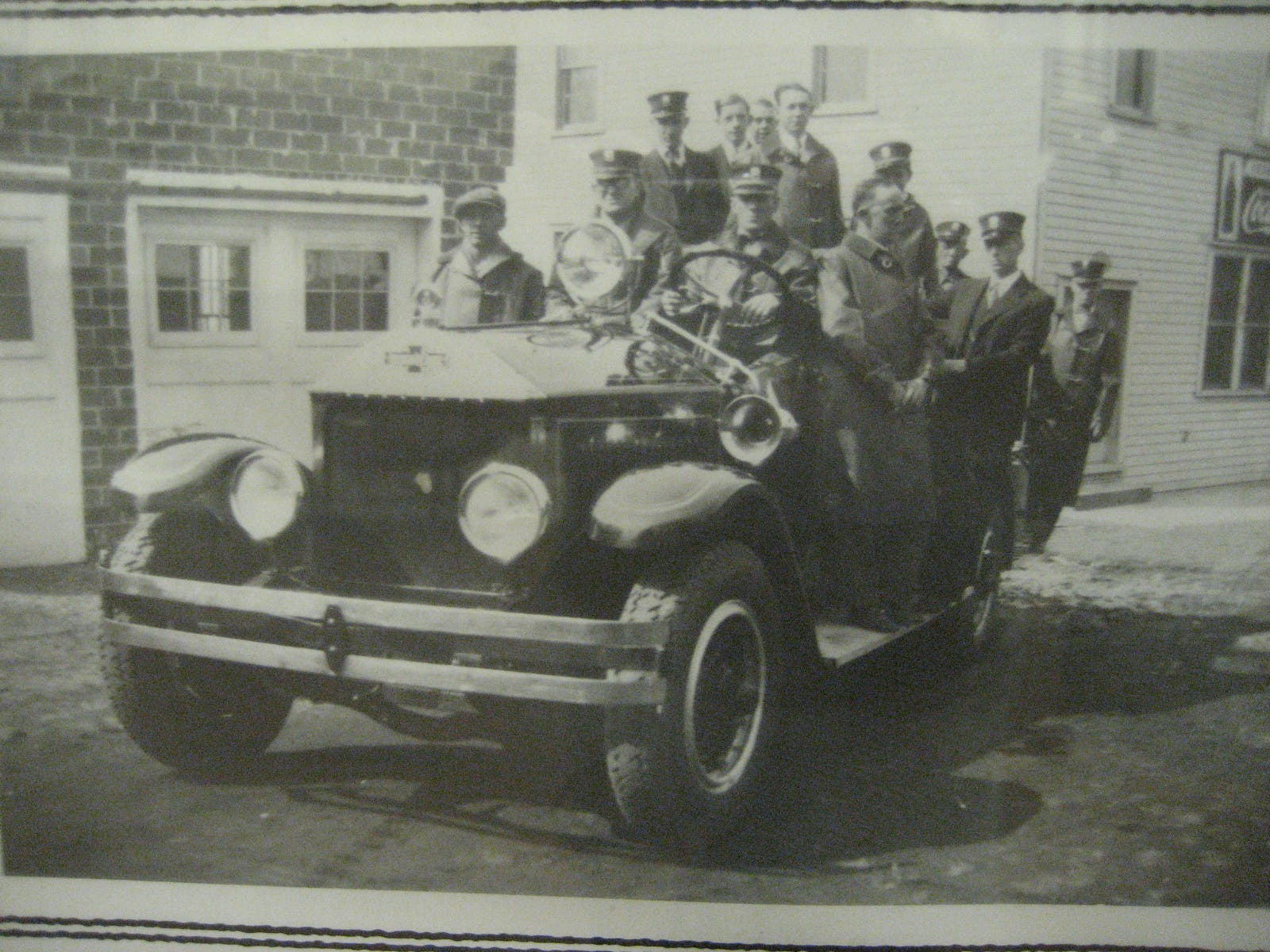


- A Herndon Volunteer Fire Department crew, c. 1930. Courtesy Herndon Historical Society.
- A fire truck parked at a gas pump on Elden Street, c. 1932. Courtesy Herndon Historical Society.
- Herndon Volunteer Fire Dept. building, built in 1929 on Station Street, c. 1948. From the J. Berkley Green Photo Collection.
- Herndon Fire Fighters, c. 1955. From FairfaxFirefighters.org.
- The Herndon Fire Station built in 1950 on Spring Street.
By Barbara Glakas
One March evening in 1917 a fire broke out in Harrison’s livery stable on Station Street in downtown Herndon. The hot blaze not only spread along Station Street, but also quickly jumped across the road and started igniting the wood frame buildings along the north side of Pine Street. The fire continued to march eastward on Pine Street, heading straight for the Congregational Church that stood at the corner of Pine and Monroe Streets.
Herndon residents tried to control the fire by pouring water out of windows at an effort to protect the buildings, but to no avail. The Town of Herndon had no fire service.
Find out what's happening in Herndonfor free with the latest updates from Patch.
The decision was made to save the Congregational Church by dynamiting the home next to the church in order to stop the fire from advancing to the church. That was done and the church was saved. Chemical apparatus from places like Clarendon and Cherrydale arrived to help extinguish the fire. In the end, the fire destroyed a significant portion of downtown Herndon, destroying fourteen homes and businesses. Residents called it a nightmare. Today we refer to it as “The Big Fire.”
This event was the impetus for Herndon starting to make serious fire prevention plans. The Herndon Town Council quickly went to work, holding special meetings to talk about rebuilding the town, establishing new building construction regulations and buying fire apparatus.
Find out what's happening in Herndonfor free with the latest updates from Patch.
The Town Sergeant reported to the Town Council that he had found 50 fire buckets but could find no fire ladders. Two councilmen were appointed to a committee to procure fire ladders. (It was later discovered that a ladder and some buckets were being used by someone to paint his house). The council started developing building codes that would involve using fire proof materials. The clerk was ordered to notify representatives of fire engine manufacturing companies, as the town council wanted to meet with them in April.
Four manufactures came before the council to describe the merits of their particular chemical fire engines. Mayor Ayre appointed three councilmen to select a fire engine. By January 1918, the town council agreed to a maximum budget for the purchase of two trucks and ten three-gallon chemical fire extinguishers.
The town council minutes remained silent on the matter until October of 1920. By this time Mayor Wrenn was in office. The town government and a group of town residents called The Citizens Association collaborated to fund the fire department’s needs.
At a Town Council meeting the Citizens Association extended a vote of thanks to the Council for its payment of $500 on the initial payment of its fire-fighting apparatus. The town council then expressed its regrets to the Citizen’s Association that the town was not able to pay anything on the cost of the fire-fighting engine. The town council then accepted an offer from the Citizen’s Association to pledge a sum of $500 as the initial payment on a chemical fire engine, which would cost approximately $2,000. The council agreed to a covenant for assuming the obligation for the fire apparatus, providing that the Citizen’s Association would agree to furnish the money, or the balance to be paid, on the fire apparatus. Three councilmen were then appointed to a committee to cooperate with the Citizen’s Association to investigate the merits and price of different fire engines.
In December of 1920 the fire engine committee reported progress on a location for a fire house. “The Park” had been offered as a site for the new fire house, but no decisions had yet been made. They preferred to own the lot and building for the prospective station house.
The Council then unanimously elected Mr. R. S. Crippen as Herndon’s first Fire Chief, “with full power to appoint all his aids.” Roscoe Swan Crippen, a stout man of medium height with grey eyes and brown hair, was born in 1877 and grew up in Herndon. Born to a farming family, he worked in the farming industry for most of his life. However in 1920, he was living with his wife and two teenage children on the south side of Pine Street, earning his wage as an auctioneer. Although his home survived The Big Fire, there were two other “Crippen buildings” on Station Street that burned alongside the livery.
By February 1921 the Fairfax Herald reported that Herndon had its new fire engine, a chemical pump on a Model T chassis that was touted to have enough capacity to take care of any blaze. The Town Council authorized a $1,300 note to pay for a fire engine from the American La France Fire Engine Company. A lean-to type of structure was attached to the side of the Murphy and Ames Lumber Company building on Station Street across from the Depot as a temporary shelter for the new vehicle. The fire engine would reside there until a fire house could be built.
The Citizen’s Association devised a fundraising plan whereby school children would sell bricks at a price of $.30 each to help pay for a new building. Those who sold the most would receive a handsome prize. Fireman’s carnivals were also organized in the park next to the Depot to help raise money to pay off the fire department’s debts.
In 1923, the year Clarence Mills was the Chief, a one-garage wood frame fire house was erected. The location of this first fire house was on Elden Street on the west side of the Herndon Theatre (now The Upholstery Shop). The lot now has a pizza shop on it at 761 Elden Street. The land belonged to the family of Thomas Reed.
The year 1927 was another particularly difficult year for fires. Herndon’s school on Locust Street burned down during the 1927-28 school year and shortly afterwards another fire occurred downtown.
An editorial in a 1927 Observer newspaper characterized the mood and doled out some advice to the people of Herndon:
“It has been truthfully said that fire is a faithful servant but a terrible master. No locality in the county has had more opportunities to observe this fact than Herndon. Some years ago the business section was pretty well wiped out. Only a few months ago the high school was burned and on Tuesday night fire again menaced the town and but for the fact that there was no wind and the account of ready assistance from neighboring towns, appalling catastrophe might have occurred. In view of these facts and the ever present possibly of another Herndon holocaust, the citizens of the town should take the matter of adequate fire protection under careful and intelligent consideration.”
Another new Fire Chief, Walter Farr, was appointed in 1927 and served until 1942. Farr, with the assistance of George Harrison, reorganized the firefighting volunteers. In 1929 a new American La France 500 pumper was purchased. Its large size required a larger fire house. That same year a new fire station was built on Station Street, next to the former Murphy and Ames Lumber building, behind the train depot. Local newspapers reported that the new fire house was to have two stories and measure 35 by 42 feet. However, once built there was not a second story, other than an attic. The Herndon Volunteer Fire Department was officially chartered with the Commonwealth of Virginia in October of 1929.
Soon after, the Herndon Volunteer Fire Department’s Ladies Auxiliary group was formed with Mrs. Armfield acting as President. The ladies were responsible for fundraising in order to pay off the debt for the new fire house and its equipment. For many years social activities in the town revolved around the activities that were planned by the Ladies Auxiliary. The funds they raised not only paid for fire trucks and large equipment, but also for things such as helmets and boots. In addition to the carnival, the Ladies Auxiliary sponsored other town events such as dances, vaudeville shows, plays, card parties, dinners and food sales.
The Ladies Auxiliary was not only appreciated for their fund raising efforts but also for their care of the firefighters. When the ladies became aware that the firemen were out on a long-term call, they would go the site of the fire and provide the fire fighters with sandwiches and drinks.
In 1936 another serious fire occurred in downtown Herndon. The Herndon Milling Company, near the northwest corner of Elden and Station Streets, was destroyed by fire as well as a nearby house and barn. Luckily, Herndon’s Volunteer fire Department, and other nearby fire companies, kept it from spreading further.
For many years Herndon Volunteer Fire Department was the only fire department between Leesburg, Fairfax, McLean and Vienna. In 1937 Chief Farr reported that the Herndon fire department had responded to five fires in Loudoun, five fires in Herndon and fourteen fires elsewhere in Fairfax County. An average of ten men responded to each call.
Early fire fighters recall that the doors to the fire station were often left open. When fires occurred the fire fighters got a call and the siren on the building would blare, which would bring all the volunteers in. The siren would frequently be activated by the telephone operator who was located on Pine Street. When residents picked up their phones to report a fire the operator would be on the other end of the phone. The operator would flip a switch in her office to active the siren at the station and then would call the fire house to report where the fire was located.
In 1940 the Ladies Auxiliary presented the fire department with its first ambulance. The volunteers had been trained in first aid.
During the years of WWII, from 1941 through 1946, the volunteer fire department suffered a shortage of manpower, as many of the men were called into the armed services. As a result the fire department lowered the minimum age to become a volunteer fireman from eighteen to sixteen years old. They continued to operate, albeit with a smaller crew.
After the war in 1947, Oscar Costello – one of the volunteers – was hired as the first fill-time paid fireman. His salary was paid by the Town of Herndon and by Fairfax County. Another new fire truck was purchased that year. By 1949 the Volunteer Fire Department had approximately 150 members.
In 1950 a new fire department was built on a lot at 680 Spring Street, between Elden and Locust Streets. The land was purchased from Mr. and Mrs. Printz who lived nearby on Elden Street. Individuals and businesses from all around the greater Herndon area contributed to the effort. The Herndon bank would not finance the loan, presumably because they had already made too many loans after the war for people to build houses. Therefore, the loan was financed by a bank in Manassas.
The new brick building on Spring Street had two stories and fit all of the firefighting equipment and ambulances. For the first few years the second floor was rented by Fairfax County Public Schools. Herndon’s school on Locust Street was overcrowded so four elementary classes were held in the upstairs of the fire station. Later, the second floor was sometimes used for Town Council and Fairfax County District Court meetings. The second floor was also used for dinners and Bingo sponsored by the fire department to raise money. The space was also rented out for dances and other social events.
In 1977 the Herndon Volunteer Fire Department was incorporated into the Fairfax County Fire Department. An agreement was made between Jack Herrity (Chairman of the Fairfax County Board of Supervisors) and Howard Nachman (President of the Herndon Volunteer Fire Department). The county was to receive the land and all the other assets of the volunteer fire department except for the cash. The cash was maintained by the volunteer fire organization to help pay for fire station needs that the county might not finance. The agreement also stated that should the fire department ever leave the Spring Street location the title to the land would revert to the Town of Herndon. The county also agreed to provide a certain amount of equipment and personnel at the station to ensure that the town was adequately covered. The second floor of the building was now used as sleeping quarters for the County’s paid firefighters. The volunteers remained active, conducting fund raisers for Herndon’s Fire Department, Station #4.
Once again the Herndon Fire Department eventually out grew its building and needed to be updated. In the early 2000s, studies and searches were conducted for a location for a new Herndon fire station. Many public meetings were held. Potential alternate sites included next to the Police Station on Herndon Parkway, or near Stanton Park on Third Street. Each location had its difficulties, whether it was space, cost or public discontent. It was ultimately decided that the old fire station would be torn down and the new fire station would be re-built on the same lot on Spring Street.
In 2014 a temporary fire station was erected in a parking lot located at the corner of Center and Locust Streets. In 2015 the old fire station was torn down, although the 1950 corner stone was saved. Many townspeople wanted a piece of history and requested individual bricks from the old station to save as souvenirs. Once the old fire station was torn down, construction of the new fire station began. The completion date is estimated to be in 2016.
The plans for the new fire station show a larger footprint of approximately 14,500 square feet. The station will have two stories with underground parking, larger facilities for female fire fighters, increased space to accommodate larger ladder trucks, decontamination facilities, fitness facilities for the firefighters, and upgrades to meet all the standards of the Americans with Disabilities Act. The new fire station is also expected to display artifacts having to do with the history of Herndon’s Fire Department.
One of the oldest fire departments in Fairfax County, the Herndon Fire Department is steeped in history, starting as a volunteer force out of need, with many Herndon residents allowing themselves to be called upon day and night to help protect their neighbor’s lives and property.
----------
About this column: “Remembering Herndon’s History” is a regular Herndon Patch feature offering stories and anecdotes about Herndon’s past. The articles are written by members of the Herndon Historical Society. Barbara Glakas is a member. A complete list of “Remembering Herndon’s History” columns is available on the Historical Society website at www.herndonhistoricalsociety.org.
The Herndon Historical Society operates a small museum that focuses on local history. It is housed in the Herndon Depot in downtown Herndon on Lynn Street and is open every Sunday from noon until 3:00. Visit the Society’s website at www.herndonhistoricalsociety.org, and the Historical Society’s Facebook page at https://www.facebook.com/HerndonHistory for more information.
Note: The Historical Society is seeking volunteers to help keep the museum open each Sunday. If you have an interest in local history and would like to help, contact HerndonHistoricalSociety@gmail.com.
Get more local news delivered straight to your inbox. Sign up for free Patch newsletters and alerts.