Neighbor News
Remembering Herndon's History: Aaron Lewis’s Country Life
A remembrance of a well-loved early Herndon resident.
Aaron Lewis’s Country Life
By Barbara Glakas
Aaron A. Lewis (1883-1945) was an African American man who lived in Herndon all his life. Aaron was the son of Catherine Lewis, and he had 12 siblings. By the year 1900, only 11 of Catherine’s children were still living. Catherine, nor her older children – including Aaron – could read or write. However, the 1900 census indicated that her youngest children were in school.
Find out what's happening in Herndonfor free with the latest updates from Patch.
Catherine was a washwoman and stayed in that occupation through the years. By 1910, Aaron, then 27 years old, was the only child still living with Catherine. His occupation was listed on the 1910 census document as “laborer, odd jobs.” Catherine died in 1918.
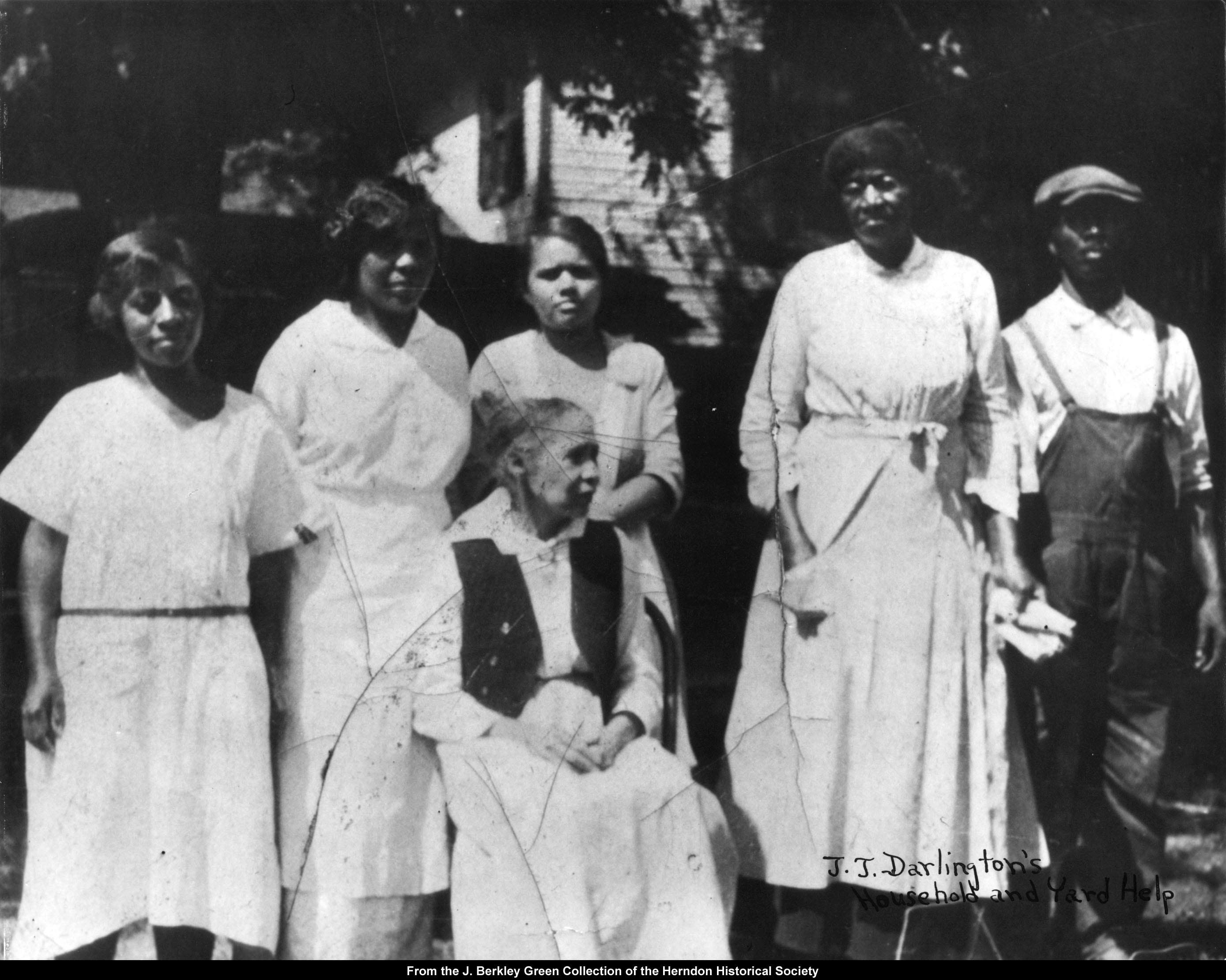
The employed staff at the Darlington Estate, showing Aaron at right. (J. Berkley Green Photo Collection of the Herndon Historical Society).
Find out what's happening in Herndonfor free with the latest updates from Patch.
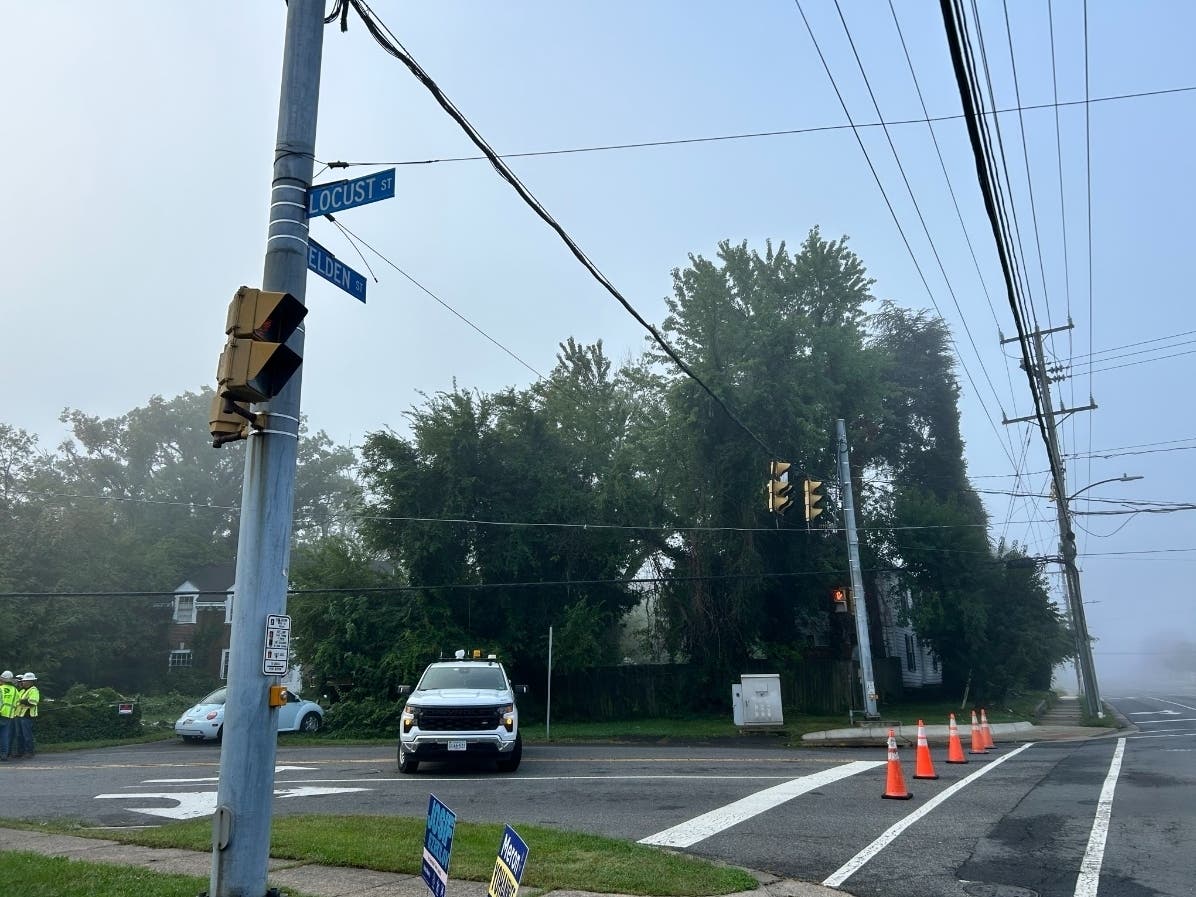
At some point in time, Aaron came to work for the Darlington family in Herndon. Joseph J. Darlington (1849-1920) was a prominent and wealthy attorney who lived in Washington, D.C. Local lore says that Darlington boarded a train one day, looking for a location for a summer residence for rest and relaxation. He found what he was looking for in the town of Herndon. Darlington bought over 160 acres of land around Herndon in the 1890s and the early 1900s.But the property that made Darlington the most remembered was the nine-acre triangular lot he bought from A. J. Downing in 1893. This property was in the general area that is now surrounded by Elden Street, Monroe Street, the W&OD trail, and Van Buren Street (now the general location of Walgreens and the Ananda Bhavan Indian Restaurant).The property included a large Victorian house that had been built by A.J. Downing. Darlington added on to the existing house. According to Charles Mauro’s book, Herndon, A Town and its History, the house would eventually boast 25 rooms, five baths and several sleeping porches. The surrounding property had a grove of oak trees and many out buildings, including a wood shed, barns, carriage house, smoke house, well house, caretaker’s house, and servant quarters. The land also included a section of Sugarland Run from which stone was quarried. The kitchen was set apart from the main house. Close by was the laundry area and a water pump.
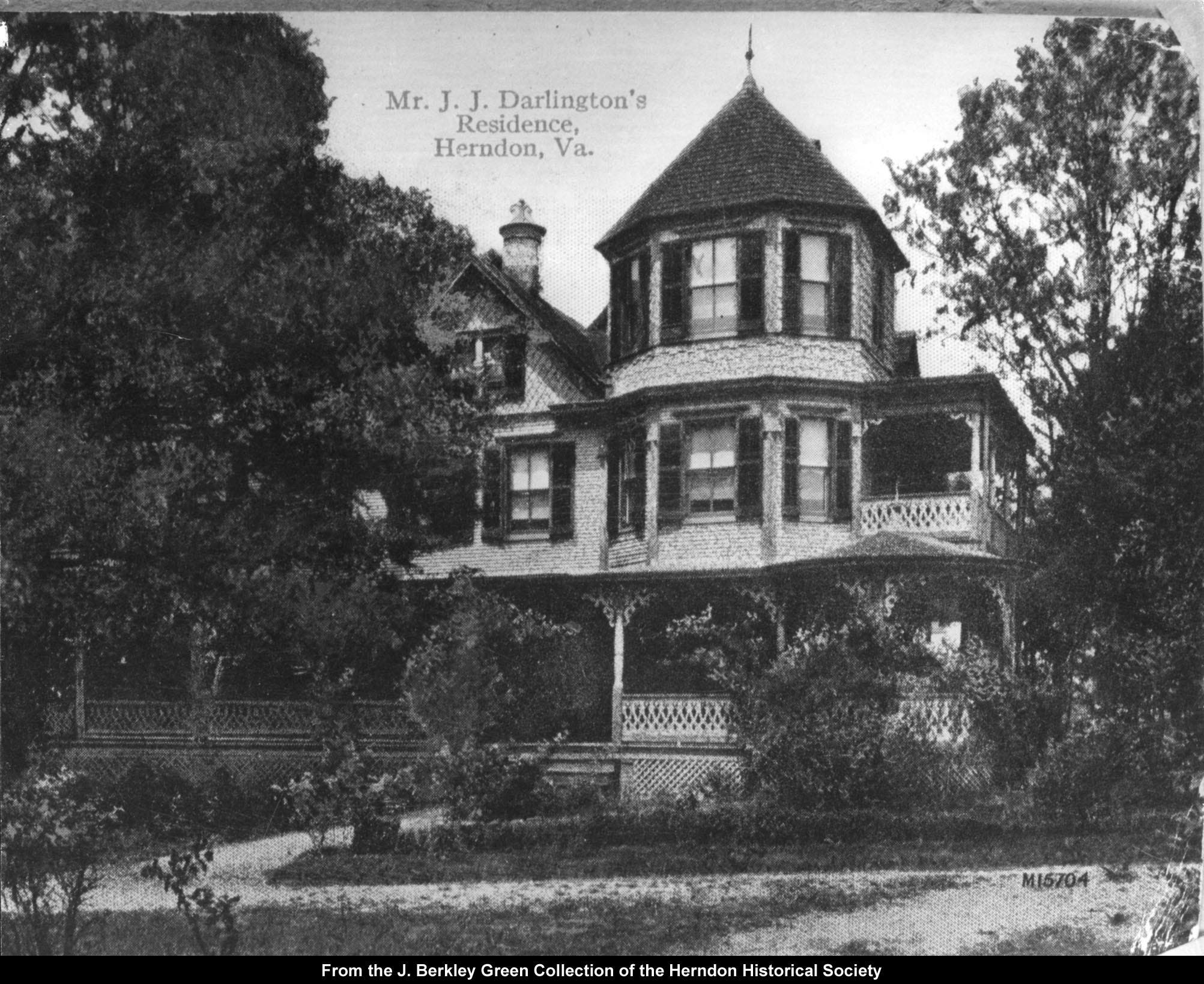
The Darlington Estate house in Herndon. (J. Berkley Green Photo Collection of the Herndon Historical Society).
The Darlington family spent their summers at their new summer estate in Herndon. Darlington hired a staff to work at his estate, one of whom was Aaron Lewis. Aaron was the caretaker of the estate, and was also remembered for driving the Darlington’s horse and buggy.
We learn about Aaron’s life in the town of Herndon from two different sources – Joseph J. Darlington’s granddaughter, Frances Darlington Simpson (1914-1998), and a former Herndon resident, Frederick Washington (1926-2016).
In her book, Virginia County Life and Cooking, Simpson recalled Aaron working at her grandfather’s summer estate:
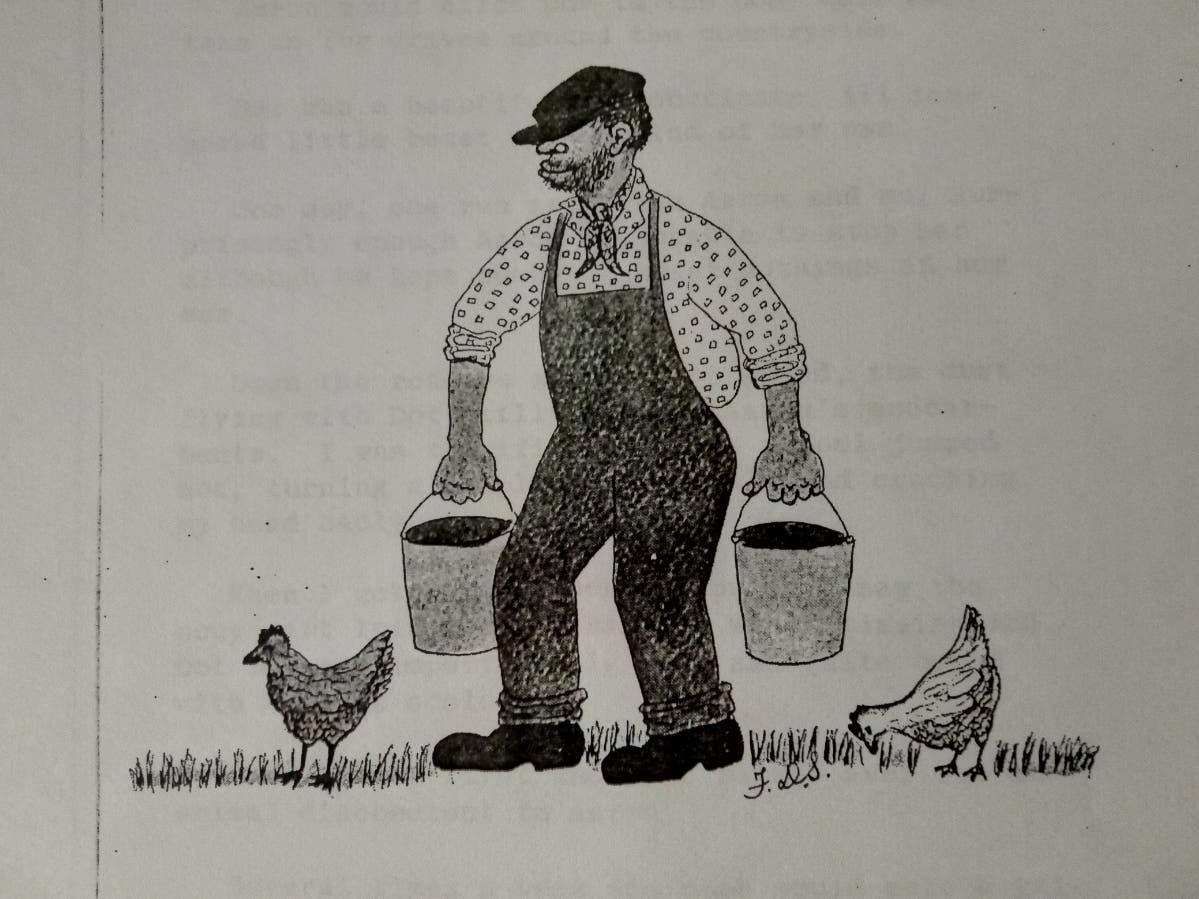
“Aaron was a permanent fixture. Nobody seems to know exactly when he came to work on the place. He was there when Mother was very young and until I was grown. In all these years he never seemed to look any older, in fact nobody knew his age. All that was known of this fine old man was that he came from somewhere ‘down the back road,’ but had been dropped on his head as a baby and subsequently spoke incoherently… but everyone who knew Aaron understood him perfectly.
“He had a way with animals. He talked to them as if they were people and they loved him. Aaron would hitch Dot to the pony cart and take us for drives around the countryside. Dot was beautiful but obstinate, an ill-tempered little beast with a mind of her own. One day, she ran away with Aaron and me. Surprisingly enough, Aaron was unable to stop her, although he kept mumbling sweet nothings to her.
“Down the road we shot at top speed, the dust flying with Dot still ignoring Aaron’s endearments. I was terrified and like a fool jumped out, turning a complete somersault and cracking my head badly. When I got up and looked around, I saw the pony cart lying on one side, a wheel missing and Dot looking imperturbably smug and quite bored with Aaron’s scolding. The was the first and last time I ever saw an animal disobedient to Aaron.”
Although Aaron was not the estate cook, Simpson remembered,
“Several times a week, the cook would make a gallon of custard and Aaron would sit on the back porch, freezing it into ice cream, packing it with ice and salt.
“Aaron took care of the large vegetable garden next to the main barn. It was fun to go with him to gather up string beans, peas, lima beans, corn, cabbages, tomatoes, and whatever was to be cooked for dinner. And while he worked, Betsy [Simpson’s sister] and I would look for the biggest, reddest, juiciest tomatoes we could find, wipe off the earth and eat them, so delicious and still warm from the sun.”
Aaron also had other jobs around the estate:
“One of Aaron’s jobs was keeping the saddles polished and the carriages greased and in shape. The carriage house was filled with all kinds, wagon, buckboard, basket cart, pony carts, two victorias [elegant, four-wheel, doorless open carriages], one for one horse and one for two horses, the trap, my aunt’s carriage, also called a trap, very high and perfectly devilish to get into. We children usually rode in the bumpy wagon with Aaron which was thrilling at high speed.
“The victorias were used for going to church and to the [train] station to meet guests. For these occasions, Aaron changed from overalls to a dark suit and an impressive, tall straw coachman’s hat. In spite of the fact that he seldom, if ever, shaved, we thought he looked very fine.”
Other recollections of Simpson include,
“I nearly stepped on a snake in the apple orchard. I screamed loudly for Aaron who came running at his usual slow speed and killed it before my horrified eyes. Although the snake was obviously dead, Aaron hung the miserable thing over the pasture fence to ‘die.’ According to him, no matter what time of day a snake is killed, it is never really dead until its tail stops wiggling, and that only happens at sundown.”
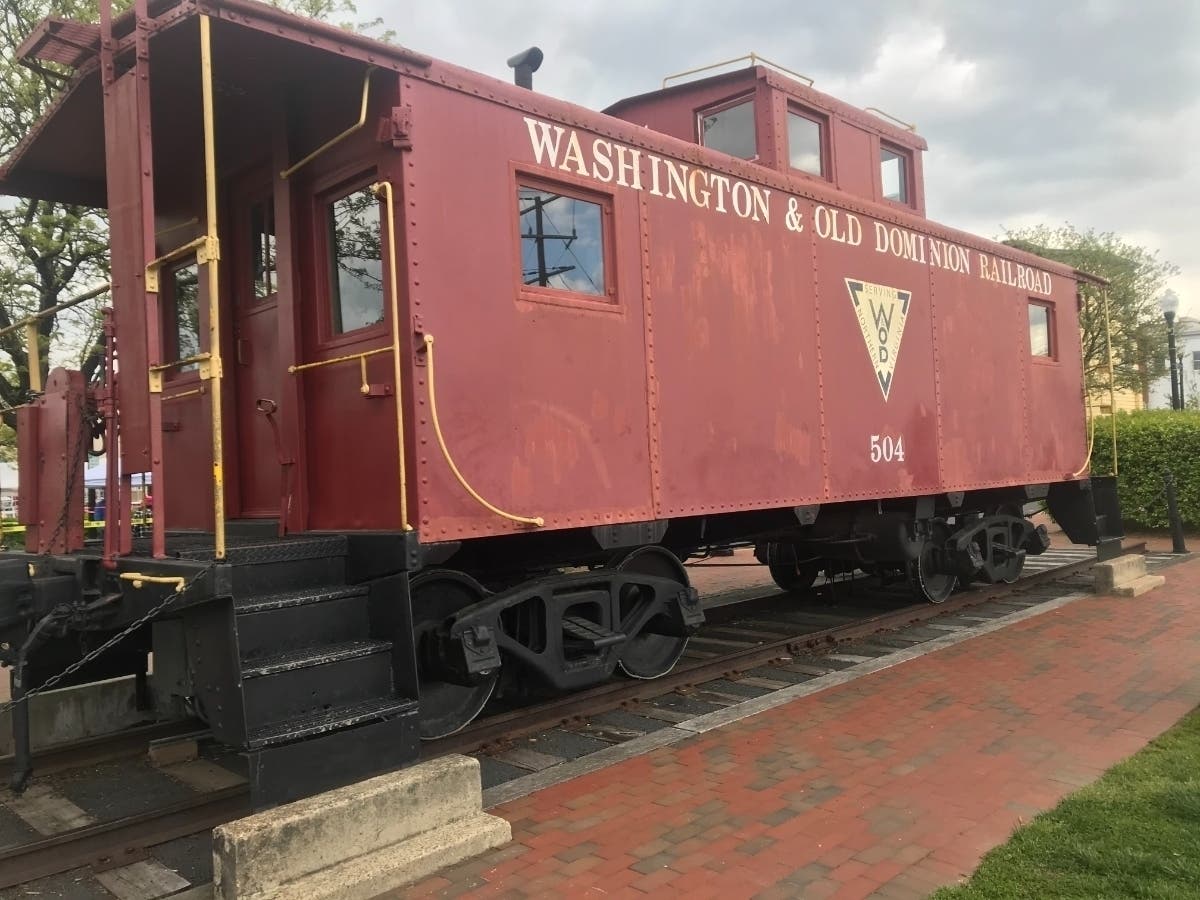
Simpson recalled another antic that Aaron participated in with her father. Apparently, near the Washington and Old Dominion Railroad track and the Darlington property was an old W&OD tool shed which had deteriorated over the years. It became an eye sore and was no longer used except as an overnight stopping place for drunks and tramps. Simpson explained,
“My father had finally got fed up with the sight of this shed, as well as the comings and goings of its sometimes boisterous inhabitants, and since the Washington and Old Dominion did nothing about it, he decided to take action. One evening, he and Aaron, armed with old rags and large can of kerosene, crept over to the tool shed, disappeared inside for a few minutes, and then emerged at top speed, making for the house. I never saw Aaron move so fast! Hardly had they cleared the tracks when the shed billowed into flames, burned ferociously, for a few minutes, and collapsed into smoldering ashes. Daddy sat on the front porch, enjoying the spectacle immensely. Aaron too stood by, his face impassive as usual, but the spirit of adventure was certainly in him.”
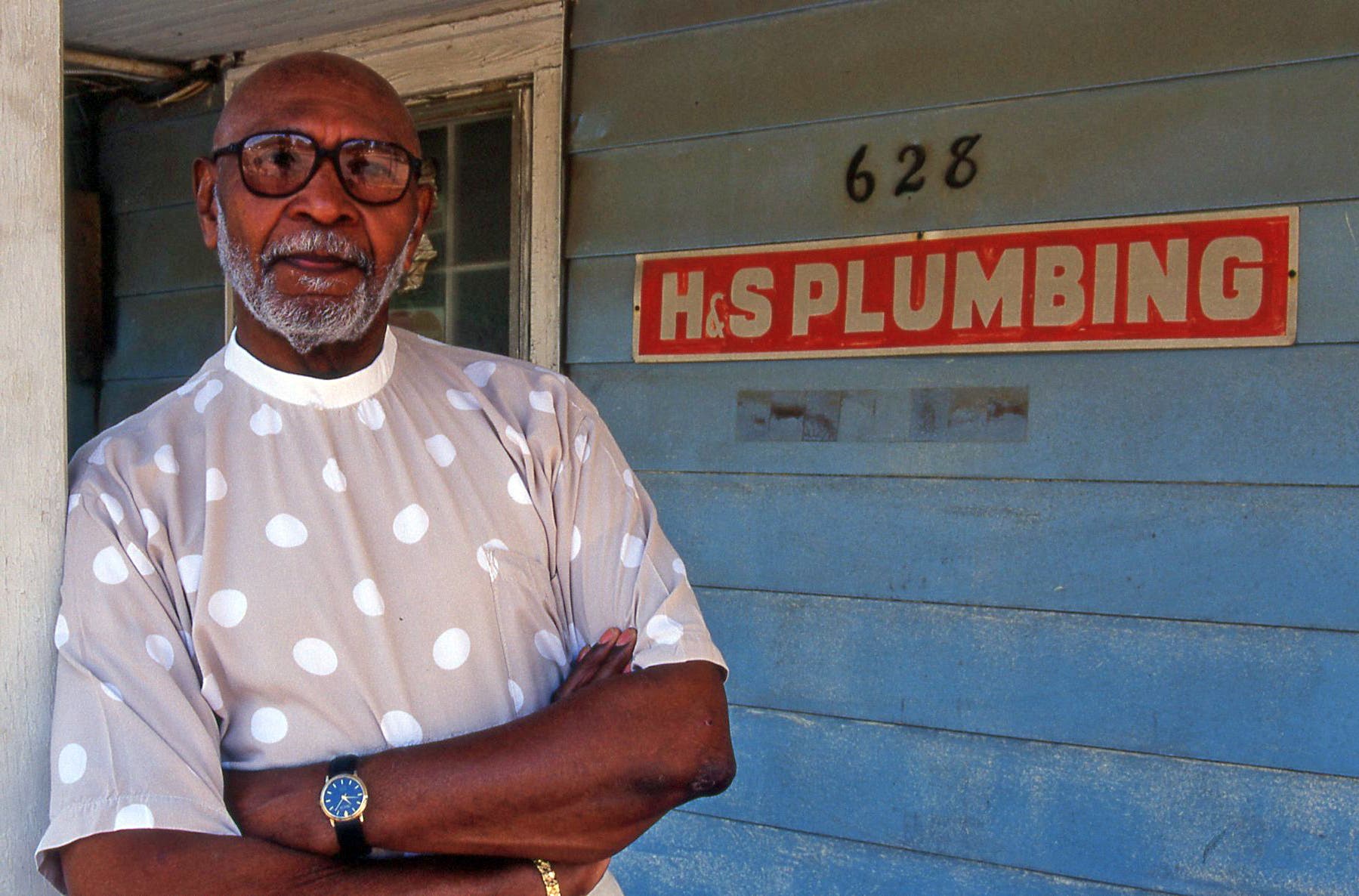
Frederick Washington by his former home in Herndon. (Courtesy Charles Mauro).
Frederick Washington (b. 1926) was also a Herndon resident and was a nephew of Aaron Lewis. He lived nearby in a house that later became the original H&S Plumbing building, formerly at the corner of Grant and Grove Streets. Washington, who would have been a boy when Aaron was working for the Darlington’s, was interviewed in 2001 by Charles Mauro. He described the location of Aaron’s house this way:
“Mr. ‘Pete’ Simms lived where Jiffy Lube is [at Elden and Jackson Streets].And right across from him, just about where Van Buren goes down, is where Uncle Aaron used to live. There used to be a small house there.”
Aaron lived in the caretaker’s house on Darlington’s property. The 1930 census showed that Aaron and his wife, Matilda Lewis, were living in a rental house. He was working as a “caretaker of a private house,” and she was working as a “cook for a private family.”
Washington continued:
“All of my life, I can remember Aaron Lewis. My Uncle Aaron lived there [at the Darlington’s] all of his life.And when he died, he was there. My Uncle Aaron used to take care of the Darlington’s when the Darlington’s came up from Washington, one of his jobs was to hook up the horse and buggy. He’s the one that used to chauffeur with the buggy and horse around Herndon with the Darlington’s. And he would put on his jacket and sit very erect. Oh, we used to get a kick out of him doing that. Mr. Darlington would be in the back. They had the buggy and he would polish that horse down, get him all cleaned up, and he’d ride them all around Herndon. But he would be up front in the buggy and they would be in the back. We’d say “That’s Uncle Aaron!” He was really something. That is beautiful.”
Although the 1930 census listed a wife, Matilda, living with Aaron that year, Washington said,
“All of my life and long before, he worked for the Darlington’s. As far as my mother’s concerned, she had never known him to hold any other job. He was never married. He never got married. He was a little slow in learning. He stayed there on the property in the little house, my mother used to do all his laundry. Uncle Aaron never cooked a day in his life. He ate at our house all the time.”
Joseph Darlington was famous for having large groups of guests out to his summer home on the weekends, sometimes over 100 people. He also hosted an annual Labor Day party as well, to which he invited all the town residents. Washington said,
“When the Darlington’s… finished with the big festivities, Uncle Aaron would gather up all the trash and everything that was left, and they dumped it down in the woods. And we’d go down there and find more goodies!”
Washington continued,
“The Darlington’s loved that man, they loved my Uncle Aaron. And they took care of him totally. He didn’t have to want for nothing.”
Aaron Lewis died in 1945 and is buried in the Oak Grove Baptist Church Cemetery, a historic African American cemetery located on the border line between the town of Herndon and Sterling.
---------------------------------
About this column: “Remembering Herndon’s History” is a regular Herndon Patch feature offering stories and anecdotes about Herndon’s past. The articles are written by members of the Herndon Historical Society. Barbara Glakas is a member.A complete list of “Remembering Herndon’s History” columns is available on the Historical Society website at www.herndonhistoricalsociety.org.
The Herndon Historical Society operates a small museum that focuses on local history.It is housed in the Herndon Depot in downtown Herndon on Lynn Street and is open every Sunday from noon until 3:00. Visit the Society’s website at www.herndonhistoricalsociety.org, and the Historical Society’s Facebook page at https://www.facebook.com/HerndonHistory for more information.
Note: The Historical Society is seeking volunteers to help keep the museum open each Sunday.If you have an interest in local history and would like to help, contact HerndonHistoricalSociety@gmail.com.