Community Corner
Remembering Herndon's History: The Caboose Comes To Herndon!
In this edition of "Remembering Herndon's History," we tell the amazing story of the red caboose that sits on Lynn Street.


Above: The Herndon Caboose. Photo courtesy Floyd Wellershaus
By Barbara Glakas
One popular point of interest in downtown Herndon is the red caboose which sits on Lynn Street, adjacent to Herndon’s Railroad Depot and the Washington and Old Dominion trail — formerly the W&OD railroad line.
Find out what's happening in Herndonfor free with the latest updates from Patch.
The idea to procure a caboose for the Herndon Depot was originally raised by Herndon Historical Society member George Moore in January of 1989. At the time the Norfolk Southern Corporation started selling and donating their caboose fleet as they were being replaced by modern electronic "End of Train Devices.” The Herndon Historical Society membership voted to acquire a caboose for Herndon.
Through the efforts of the Historical Society’s Caboose committee, which Moore chaired, the Society was able to successfully persuade the rail company to donate a 1949 Class 8 center style cupola caboose, a design used on many U.S. railroads after World War II. The all-steel caboose was built by the Wheeling & Lake Erie Railway (W&LE) in their shops at Ironville, Ohio. It weighed 45,300 pounds and measured about 37 feet long, 10 feet wide and almost 14 feet high. Had this 40 year old caboose not been acquired by the Historical Society, it would have surely been taken to the scrap yard.
Find out what's happening in Herndonfor free with the latest updates from Patch.
After a series of railroad company mergers, the caboose became NW 557748 when the Norfolk & Western Railroad acquired the New York, Chicago & St. Louis Railroad Company (or “Nickel Plate Road”) in 1964. After another merger in the 1980s, Norfolk and Western teamed up with the Southern Railway forming the Norfolk Southern Corporation, which later became the Norfolk Southern Railway.
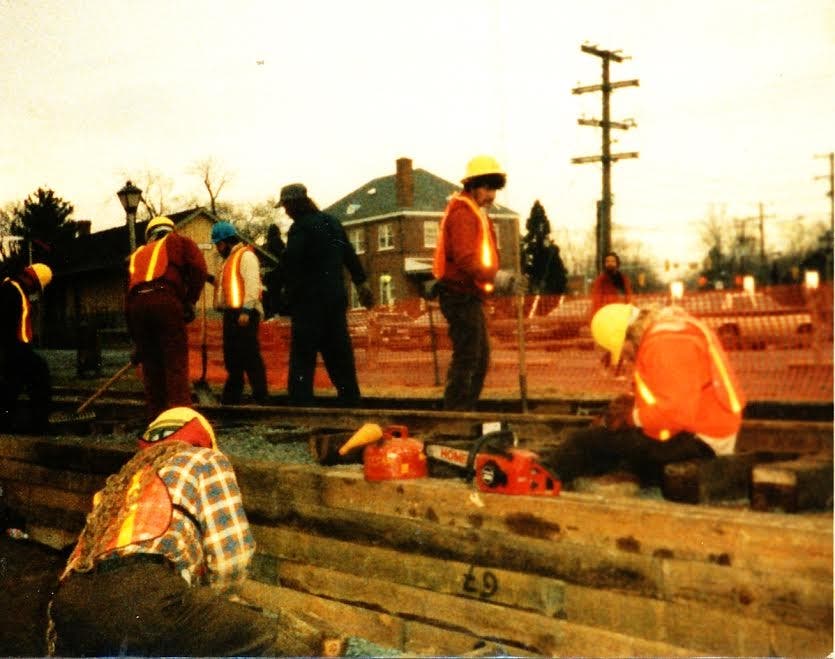
Members of the Herndon Dept. of Public Works prepares the track bed.
Interestingly, the original caboose that Norfolk Southern was going to donate to the Herndon was NW 557547, a different style caboose that did not have a cupola. However, Moore insisted that "a real caboose has a cupola on top!” As a result he was able to effect a change and got a caboose with a cupola instead.
Cabooses are manned railroad cars coupled at the end of a freight train. The purpose of a caboose is to act as an operating headquarters and office for the train. A conductor would spend time sitting at his desk in the caboose, filling out waybills and wheel reports having to do with the ownership, content, mileage and weight of each car of his train. Brakemen would also ride in the caboose, keeping look out to spot any trouble that might appear on the rail ahead. The brakemen would also take care of routine tasks such as switching, flagging and signaling. The caboose had bunks as well as lockers for the trainmen to store their food. Using the caboose stove they would cook their meals or make a hot cup of coffee.
The Caboose Committee of the Historical Society worked to plan the many logistics associated with the procurement and arrival of the caboose. In addition to their many communications with the Rail Company, they: discussed possible locations for the caboose to be displayed, coordinated with Town officials, obtained approval from the Town’s Heritage Preservation Review Board, obtained permission from the Virginia Power Company to place the caboose on their transmission right of way, coordinated the transportation arrangements for the caboose, and did research on what color the caboose should be painted. The plan was to place the caboose near the Depot museum and have it be a focal point of Town, a static display that would be open on select days.
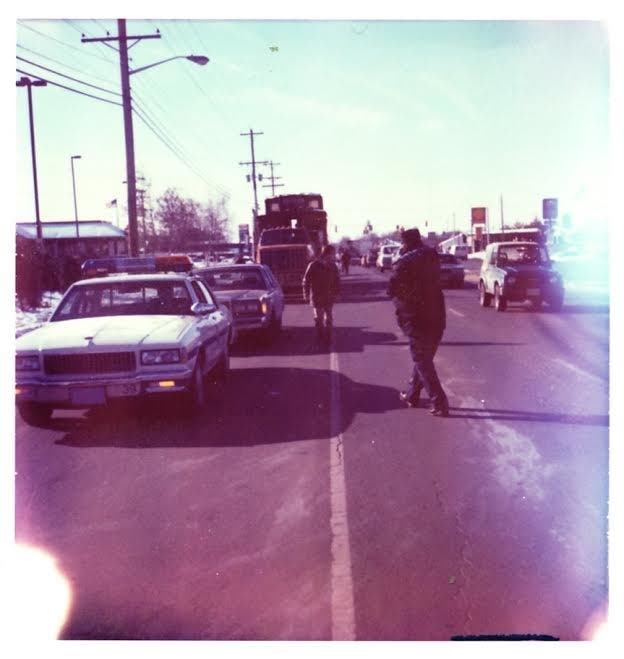
The caboose traveling down the roadway. Photo courtesy Richard Downer.
Many entities assisted with the move and placement of the donated caboose. Gordon and Associates, along with the Town Engineer, prepared a site plan for the caboose. The caboose was delivered from Norfolk to Manassas at no charge by the railroad company. Once the caboose arrived in Manassas, the Herndon Public Works Department and the McGee Crane Rental Company loaded the caboose onto a flatbed truck for transport to its new home. The Manassas, Prince William and Herndon Police Departments assisted with the move. The efforts of the McGee Crane Rental Company were donated to the caboose effort. The Manassas Fire Marshall and Chief Inspector also assisted. Public Works prepared a small section of track bed with iron rails which would serve as the resting place for the newly arriving caboose. Chantilly Crushed Stone Company donated the stone used on the track bed. Once in Herndon the caboose was unloaded onto its new track bed.
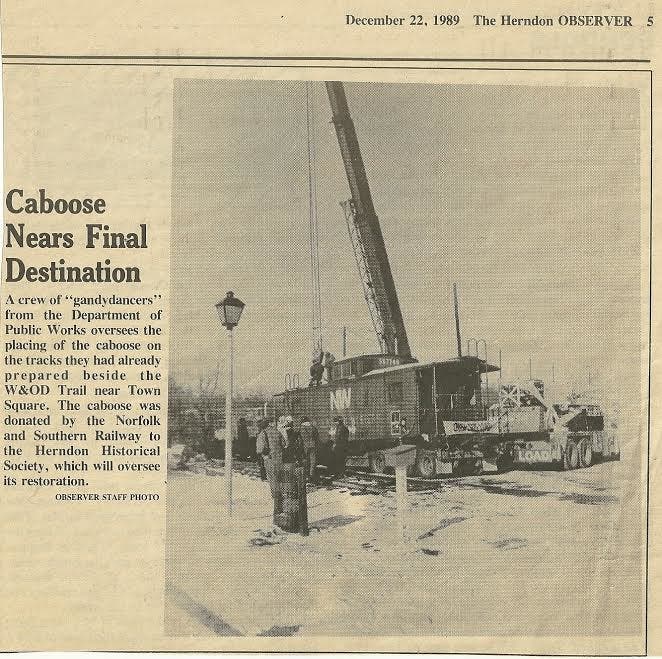
A crane lowering the caboose on the track bed. Photo from The Herndon Observer.
The caboose arrived in Herndon on a cold November day with snow on the ground. It was carried on a flatbed truck and travelled on a route from the Manassas rail yard, north along Route 28 and into Herndon via Sterling Road. Some motorists honked their horns to welcome the caboose. Historical Society members helped warm up both observers and workers alike, serving free coffee and donuts in the Depot. Soon after, restoration work began.
Although the Town of Herndon would own the caboose and pay for its insurance, the Herndon Historical Society was responsible for its restoration, inside and out. Once in Herndon, the caboose exterior was power washed, primed, patched and painted. The paint job cost $1,600. Some windows were replaced, locks were installed and it was fitted with ladder guards. Later, interior painting was completed and a caboose stove was installed. The W & O D lettering was painted on the exterior, even though the caboose never served on the Washington and Old Dominion Railroad. The caboose was re-numbered #504 by the Herndon Historical Society to honor the 500-series cabooses that formerly served Herndon on the Washington & Old Dominion Railroad. In 2008, with a generous grant to the Herndon Historical Society by the Nelson and Katherine Post Foundation, the interior was further restored and the windows were improved to make them water tight.
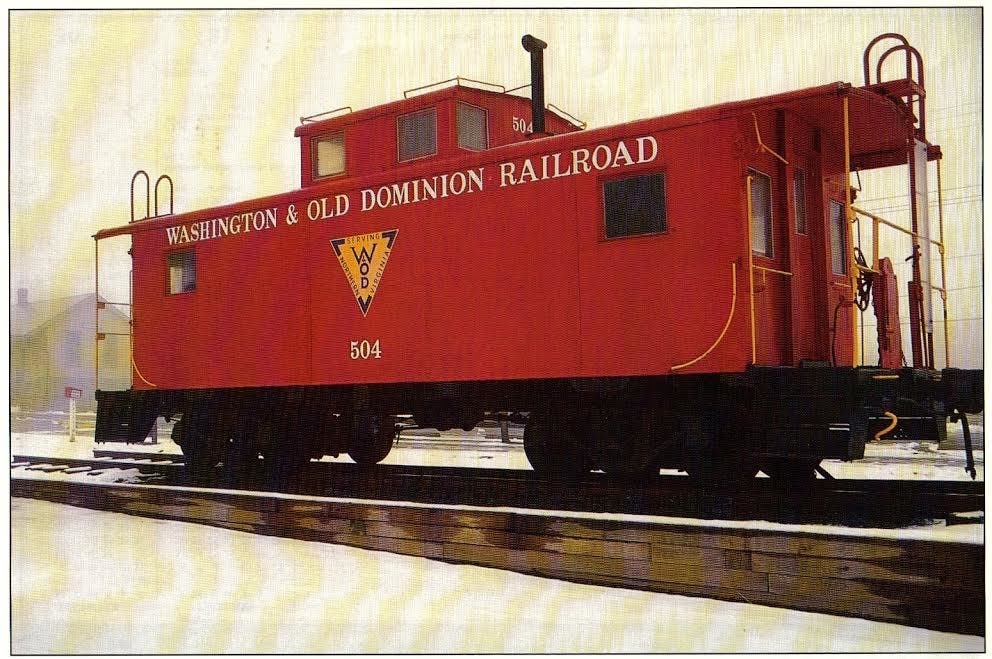
The re-painted Caboose in 1994. Photo from the Herndon Town Calendar.
On April 21, 1990, the Historical Society organized a dedication ceremony for the Herndon Caboose. The Society went on to organize various fundraising events, with proceeds going toward the restoration of the caboose. Fundraisers included yard sales and a benefit concert at the Industrial Strength Theatre. Many Town residents and non-profit organizations also made contributions toward the restoration of the caboose.
Following the death of George Moore in 2003, the caboose was dedicated in his memory. A memorial plaque was placed next to the caboose in his honor.
Today the Herndon Historical Society continues to monitor the caboose’s condition and to fund the interior maintenance. The caboose and the adjacent railroad Depot are reminders of the Town’s rail history. The Depot museum includes a room with rail artifacts, many original to the Washington and Old Dominion railway. The caboose is a popular stop for locals and tourists alike. On any given day you can see wedding parties taking pictures next to the caboose or children peering into its windows.
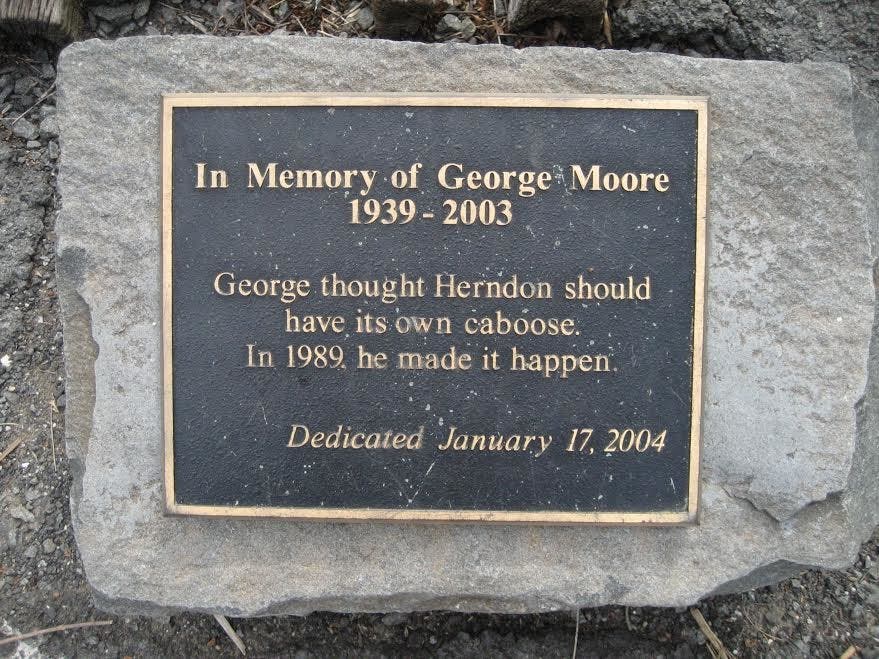
A memorial plaque to George Moore. Photo by Barbara Glakas.
--------------------------------------------------------------
About this column: “Remembering Herndon’s History” is a regular Herndon Patch feature offering stories and anecdotes about Herndon’s past. The articles are written by members of the Herndon Historical Society. Barbara Glakas is a member. A complete list of “Remembering Herndon’s History” columns is available on the Historical Society website at www.herndonhistoricalsociety.org.
The Herndon Historical Society operates a small museum that focuses on local history. It is housed in the Herndon Depot in downtown Herndon on Lynn Street and is open every Sunday from noon until 3:00. Visit the Society’s website at www.herndonhistoricalsociety.org, and the Historical Society’s Facebook page at https://www.facebook.com/HerndonHistory for more information.
Note: The Historical Society is seeking volunteers to help keep the museum open each Sunday. If you have an interest in local history and would like to help, contact HerndonHistoricalSociety@gmail.com.
Get more local news delivered straight to your inbox. Sign up for free Patch newsletters and alerts.