Community Corner
Father Of The Herndon Parkway Used A Compass To Draw His Vision For The Road
Edward N. Stirewalt's vision for the Herndon Highway was to provide an alternate route so drivers could avoid driving through downtown.


By Barbara Glakas
Edward N. Stirewalt (1918-1995) had a vision. That vision was a transportation circle around the town of Herndon that would later become the Herndon Parkway.
Find out what's happening in Herndonfor free with the latest updates from Patch.
Stirewalt was born in Hartsville, South Carolina. He attended High Point College and later the University of North Carolina, where he graduated with a master’s degree in chemistry. Soon after he joined the Navy where he worked in Tennessee as a chemist on the Manhattan Project. In 1945, during the latter part of the World War II, he was assigned to a ship in the Philippines that bombarded the coast of Japan.
After the war, Stirewalt went to work as a chemist and became a supervisor at the Naval Nuclear Research Lab in Washington, D.C. He later transferred to the Atomic Energy Commission, working there from 1948 to 1953. After he left the Navy in 1957, he began working as a defense consultant and as a contracted planner. He retired in 1986.
Find out what's happening in Herndonfor free with the latest updates from Patch.
In 1954 Stirewalt and his wife, Marcia, moved from Falls Church to Herndon and lived at 762 Monroe St., a stately historic home that still stands today at the southeast corner of Monroe and Madison streets. The couple's three children – Jim, Lyn and Marcia – went to Herndon schools. Both Ed and his wife became active residents of Herndon. Marcia became a teacher at Herndon High School in 1960. Ed was an elder and trustee of Trinity Presbyterian Church in Herndon, a president of the Herndon Rotary Club and a member of Herndon Masonic Lodge.
Mayor William Enderle (mayor from 1955-1957) asked Stirewalt to serve on Herndon’s Planning Commission, which he did for many years. They were tasked with coming up with a general master plan for the town of Herndon.
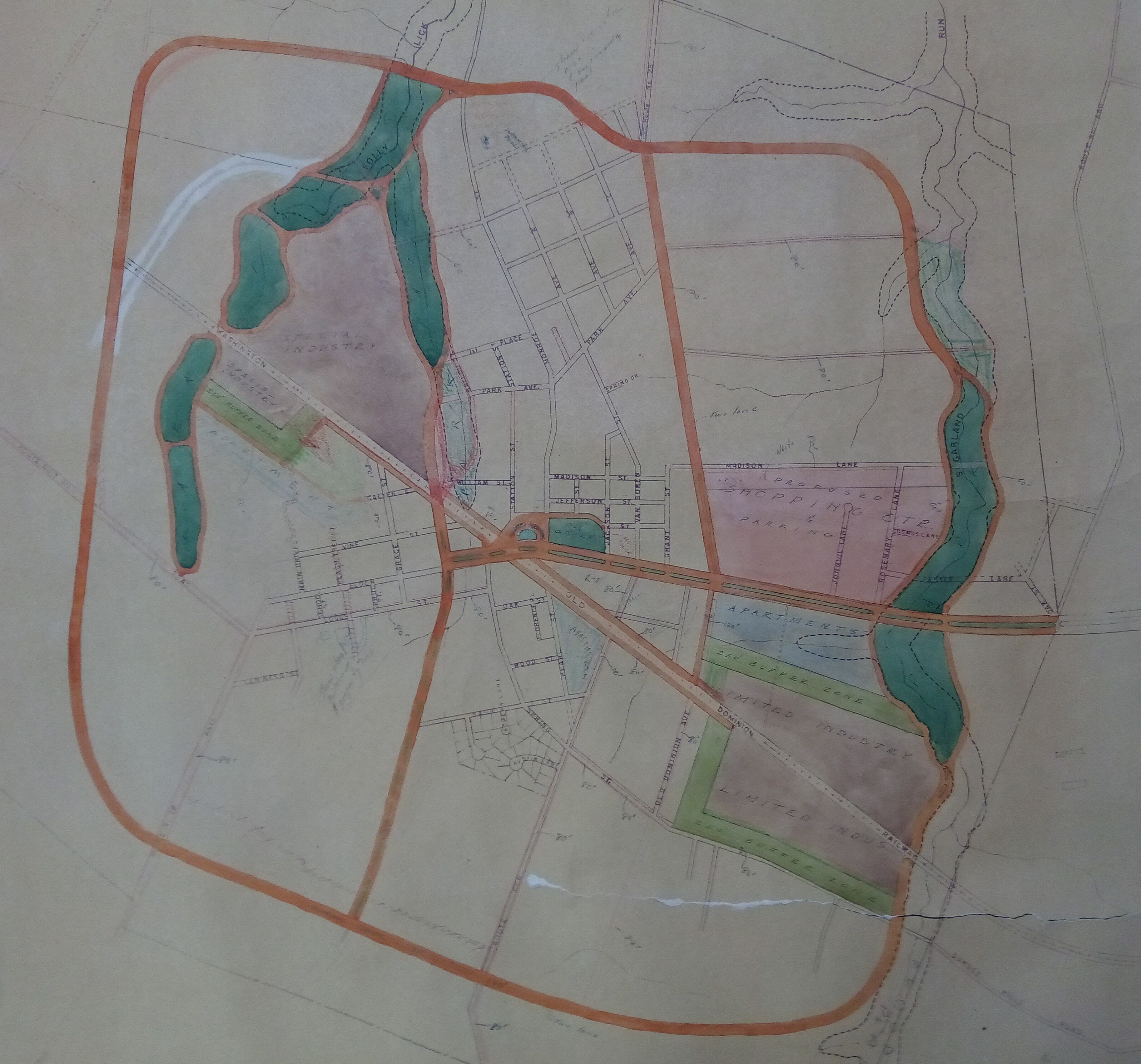
Given his experience in living in Falls Church — and also being familiar with the transportation issues in Fairfax City — Stirewalt had always wondered why planners in those two cities had not figured out a way to direct traffic around the center of their cities. Traffic was forced to the center of these cities, causing traffic jams. Stirewalt knew that there were seven entrances into the town of Herndon and each of them led right to our town hall in the center of town.
As the story goes, Stirewalt first came up with the idea for the Herndon Parkway in his dining room in 1957. He was quoted as saying,
“One night I brought a small map of Herndon from the Town Hall home and laid it across the dining room table. I grabbed one of my kid’s compasses and, with a blue pencil, I drew a perfect circle around the downtown of Herndon. I was looking properly at the future of our little town. I looked at transportation. Then I had to get a larger map.”
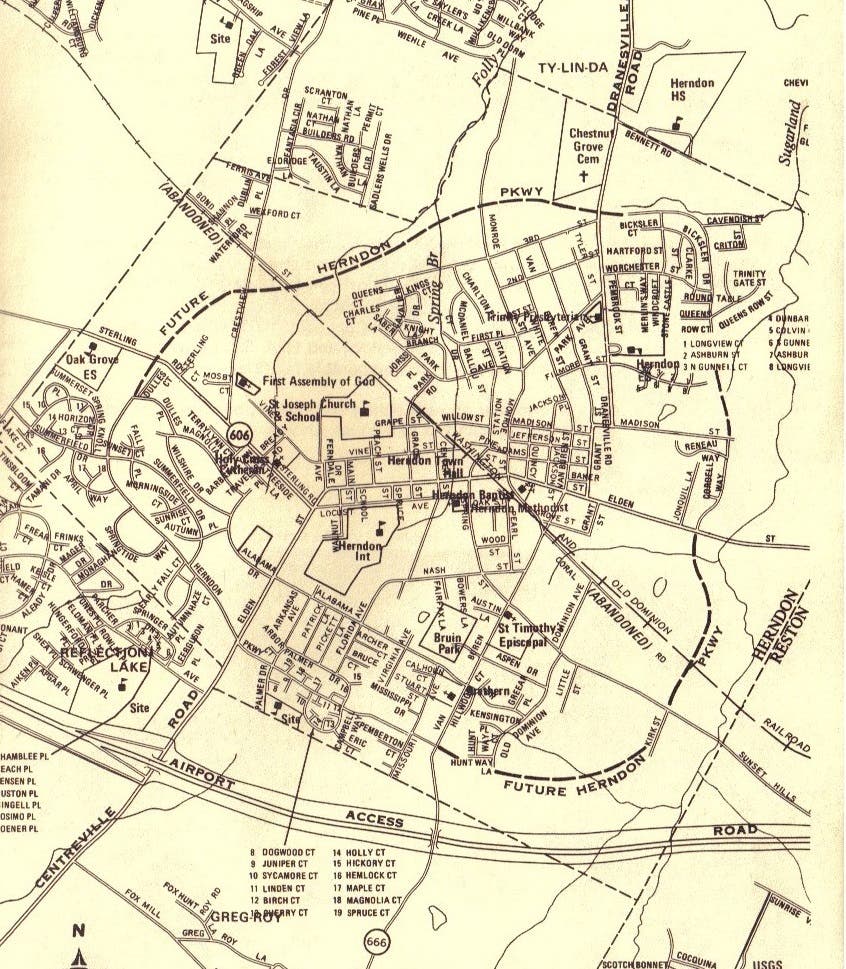
Stirewalt initially called his plan for an in-town beltway “Circle Drive,” which he later said in the 1990s, “It sounds funny now.” He added, “I was perfectly delighted to hear years later that the council decided to call it Herndon Parkway because it gave it more dignity.”
In 1958, the town of Herndon’s population was about 1,800 people with one police officer and seven roads that came into town. Reston was being planned to the town’s east and Dulles Airport was being planned to the town’s west. Stirewalt and his fellow planning commissioners knew that growth and its associated traffic were coming to the little town of Herndon and they were determined to figure out how to control it. In May 1958, Stirewalt, then the chairman of the Herndon Planning Commission, and his fellow commissioners presented their General Master Plan for the Town of Herndon, at a public hearing in the auditorium of Herndon High School (then on Locust Street) in front of over 200 residents. The plan included the Herndon Parkway concept and was overwhelming approved by the people present by a standing vote.
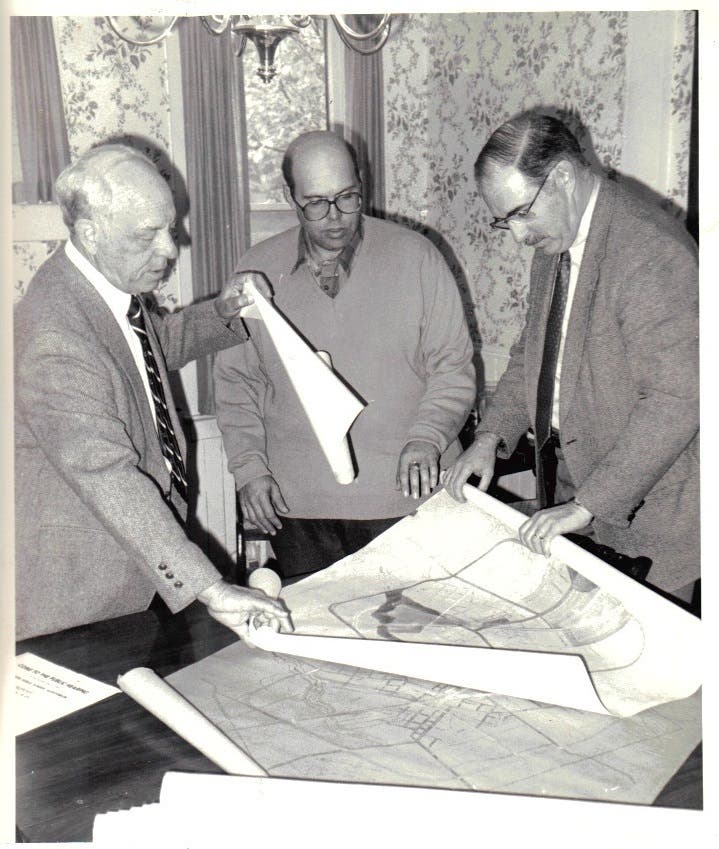
The original plan for the parkway was a four-lane road, two lanes each direction, with a median strip down the center, just as it is today. Luckily, the path for the proposed parkway went through empty land, and nothing had to be moved. However, developers still had to cooperate with the town in order that any future planned development included a section of the Herndon Parkway.
Stirewalt said the idea was to place the parkway about two-thirds the way to the town’s border. “You didn’t want to get it way out to the edge [of town], because then it would be serving the people outside the town, and you didn’t want it too close either.” The intended function of the road was to take Herndon traffic from point A to point B, without ever having to go through the middle of downtown.
Stirewalt later explained in 1987, “The Parkway is one feature of that [general master] plan, and it is almost the only one that has survived. The plan was never formally adopted by the town council … then, as developers came in, for some reason the Parkway idea survived.”
The concept for the “circular drive” was placed into the town’s master plan in 1958. Construction started in the 1960s but took over 30 years to complete. In a later interview, Stirewalt said the first section of the parkway that was built was located between south Elden Street and Sterling Road.
A town memo dated April 1985 includes a proposal for two more short sections of the Herndon Parkway to be completed. One was a short section that was on the east side of the parkway in the vicinity of Reneau Way. And the second was a section on the northeast side of the parkway, just east of Dranesville Road. A map was attached to the memo which showed that about three-quarters of the parkway had already been completed. Other than the two small proposed sections previously mentioned, one large section that had yet to be completed was the northwest section that ran from Crestview Drive, northward, through the Herndon golf course, Stanton Park and the Chestnut Grove Cemetery areas, up to where it would connect with Dranesville Road.
The final section of the 6.5-mile Herndon Parkway was completed in September of 1997, connecting Crestview Drive to Dranesville Road. The continuous traffic loop finally encircled Herndon to carry traffic around the downtown area of Herndon and provided the needed relief for the cut-through congestion on Elden and Van Buren Streets, Sterling Road and Dranesville Road. The town of Herndon’s population had grown from 1,960 people in the year 1960, to about 20,000 people in the year 1997.
Ed Stirewalt died before the parkway was completed. Mrs. Marcia Stirewalt and her three children were included in the ribbon cutting ceremony in 1997, after the parkway was completed. The ceremony included Mayor Tom Rust, County Supervisor Stu Mendelson, and many other local dignitaries. Stirewalt’s daughter, Lyn, recalled:
“They drove us in a motorcade around the whole parkway. Then at the event, folding chairs were set up for a small crowd. A VDOT representative, Mayor Rust, and a congressman all spoke. They unveiled the plaque, mom cut the ribbon, my brother delivered prepared remarks, then refreshments, and picture taking. The VDOT speaker said there was so much attention on it because it was the only such roadway in the state.”
In his remarks, Stirewalt’s son, James, noted that had his father been alive he would have likely experienced a certain amount of discomfort with so much recognition for the Herndon Parkway being credited to him. James noted the collaborative efforts of the Herndon Town Council, transportation officials and developers. He also noted some of the other Herndon planning commissioners who were serving in the late 1950s and early 1960s, naming Mack Bruin, Dudley Page, Bill Burton, Cliff Reeves, Boomer Stutsman and Kenneth Sullivan.
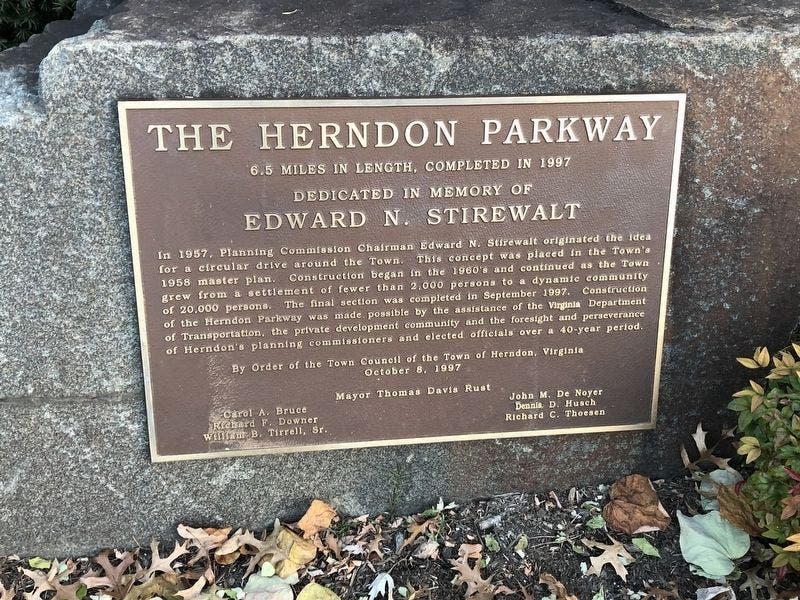
The plaque, dedicating the Herndon Parkway to Ed Stirewalt, is located near Trailside Park at the intersection of Herndon Parkway and Crestview Drive. It reads as follows:
“The Herndon Parkway. 6.5 miles in length, completed in 1997. Dedicated in memory of Edward N. Stirewalt. In 1957, Planning Commission Chairman Edward N. Stirewalt originated the idea for a circular drive around the Town. The concept was placed in the Town’s 1958 master plan. Construction began in the 1960s and continued as the Town grew from a settlement of fewer than 2,000 persons to a dynamic community of 20,000 persons. The final section was completed in September 19997. Construction of the Herndon Parkway was made possible by the assistance of the Virginia Department of Transportation, the private development community and the foresight and perseverance of Herndon’s planning commissioners and elected officials over a 40-year period. By order of the Town Council of the Town of Herndon of Herndon, Virginia, October, 8, 1997.”
Ed Stirewalt, the Father of Herndon Parkway, died in 1995. His famous compass, which he used to draw his original circular concept plan in 1957, is framed and located in the Herndon Municipal Building.
About this column: “Remembering Herndon’s History” is a regular Herndon Patch feature offering stories and anecdotes about Herndon’s past. The articles are written by members of the Herndon Historical Society. Barbara Glakas is a member. A complete list of “Remembering Herndon’s History” columns is available on the Historical Society website at www.herndonhistoricalsociety.org.
The Herndon Historical Society operates a small museum that focuses on local history. It is housed in the Herndon Depot in downtown Herndon on Lynn Street and is open every Sunday from noon until 3:00. Visit the Society’s website at www.herndonhistoricalsociety.org, and the Historical Society’s Facebook page at https://www.facebook.com/HerndonHistory for more information.
Note: The Historical Society is seeking volunteers to help keep the museum open each Sunday. If you have an interest in local history and would like to help, contact HerndonHistoricalSociety@gmail.com.
Get more local news delivered straight to your inbox. Sign up for free Patch newsletters and alerts.