Community Corner
Remembering Herndon's History: Follylick Farm
Barbara Glakas writes about one of the last working farms in Herndon.


By Barbara Glakas
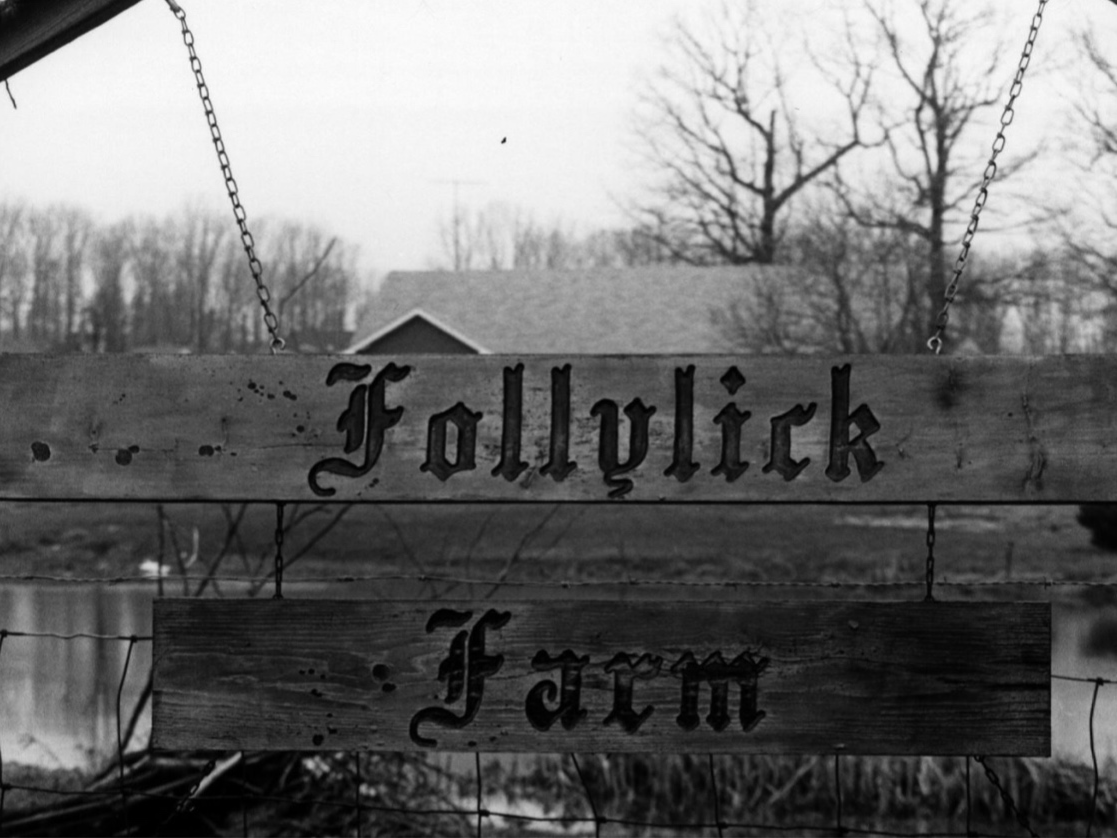
HERNDON, VA — One of the last working farms within the Herndon area was Follylick Farm, owned by the Young family. The farm consisted of 99 acres of land on the north edge of town, in what is now considered part of the Kingston Chase subdivision. The farm would be operated by Freeland G. Young, Sr. (1895-1980), and later by his youngest son, Freeland Young, Jr. (1930-2016).
In the mid-1800s, this land was part of Joseph Orrison’s farm. Orrison owned several hundred acres that generally stretched from the Washington and Old Dominion Railroad on the south, and from Crestview Drive and Dranesville Road on its west and east, respectively. The Orrison’s land area was comprised of what now includes parts of the Herndon Centennial Golf Course, and the Kingston Chase, Hiddenbrook and Barker Hill subdivisions. After Orrison died, he willed his land to his descendants. Parts of the Orrison land were sold over the course of years.
Find out what's happening in Herndonfor free with the latest updates from Patch.
Son of a farmer from Grayson County, Virginia, the elder Freeland Young married his wife, Ida, in 1917 and they went on to have five children. Young moved his family from southwest Virginia to the Follylick farm area in 1928. They initially rented the old Orrison home. The Youngs entered into a deed of trust with previous owners, Raeburn W. and Leona E. Updike, to pay the balance due on the land. By 1933, the Youngs owned the land in full and then moved into the main house on the farm.

Along with the land, the deed to the Follylick Farm included eight cows, one heifer, one mower, one Ford Tractor, a tractor plow and all the other dairy equipment that was located on the farm. The land also included various building, including a main house, a tenant house, a dairy building and two barns for cows and horses.
Find out what's happening in Herndonfor free with the latest updates from Patch.
When initially purchased, the main house had several rooms on the first floor but had an unfinished second floor and a dirt cellar. There were few modern conveniences. There was a small room for a bathroom, but plumbing and fixtures had not been installed. Water was provided by a well next to the house. Heat was provided by a fireplace. There were coal and wood stoves in the dining room for heating and cooking. Water had to be heated on the stove. The only modern features were electricity and running cold water in the kitchen.
Eventually, the Youngs made improvements to their home, to include finishing the second floor, adding bathroom plumbing, remodeling the kitchen and adding air conditioning and heating. The tenant house was also later modernized.
Access to the farm was a narrow dirt road in the town of Herndon that came off of Monroe Street. That dirt road had a bridge that crossed over Follylick Run, the stream branch that ran in a north/south direction along the east side of the Young property. The town allowed the Youngs to maintain access to that dirt road to get in and out of their farm. The dirt road, which was a dedicated right-of-way to the farm previously deeded in 1903, was eventually graveled over to make it more passable in winter weather. That access road is now known as Young Avenue.
When the Youngs first bought the farm, it was partially fenced. Those fences were repaired and replaced with new ones. Young nurtured his farm land with proper fertilization and crop rotation, making the land more productive. The dairy operations were also improved and expanded. The original barn was enlarged to 28 stalls and a silo was added. A second barn and large loafing area was eventually built, along with a large tool shed. Over the course of years, the Follylick Farm, which had modest beginnings, became a very modern and productive dairy farm.
Young’s oldest son, John (1925-2015), attended Herndon High school and helped work on the farm up until he joined the Navy during World War II. After the war, John married Amelia and they went on to have three children. They initially lived in the main house with John’s parents. John later built a separate house on the farm for his family. John helped out on the farm when he could but he was not the main operator, as he had other full-time jobs at the Herndon Southern States and later at the U.S. Naval Supply Command-Publications Branch in Washington, D.C.
Freeland Young Jr. played a large role in the success of the farm. He was born on the former Orrison farmhouse that was formerly located on Permit Court in Kingston Chase. He graduated from Herndon High School in 1948. Later, after John left for the Navy, and while Freeland was attending American University in Washington, D.C., his family convinced him to quit college and come home to Herndon to revive the family business. In return for his sacrifices, the farm would be his.
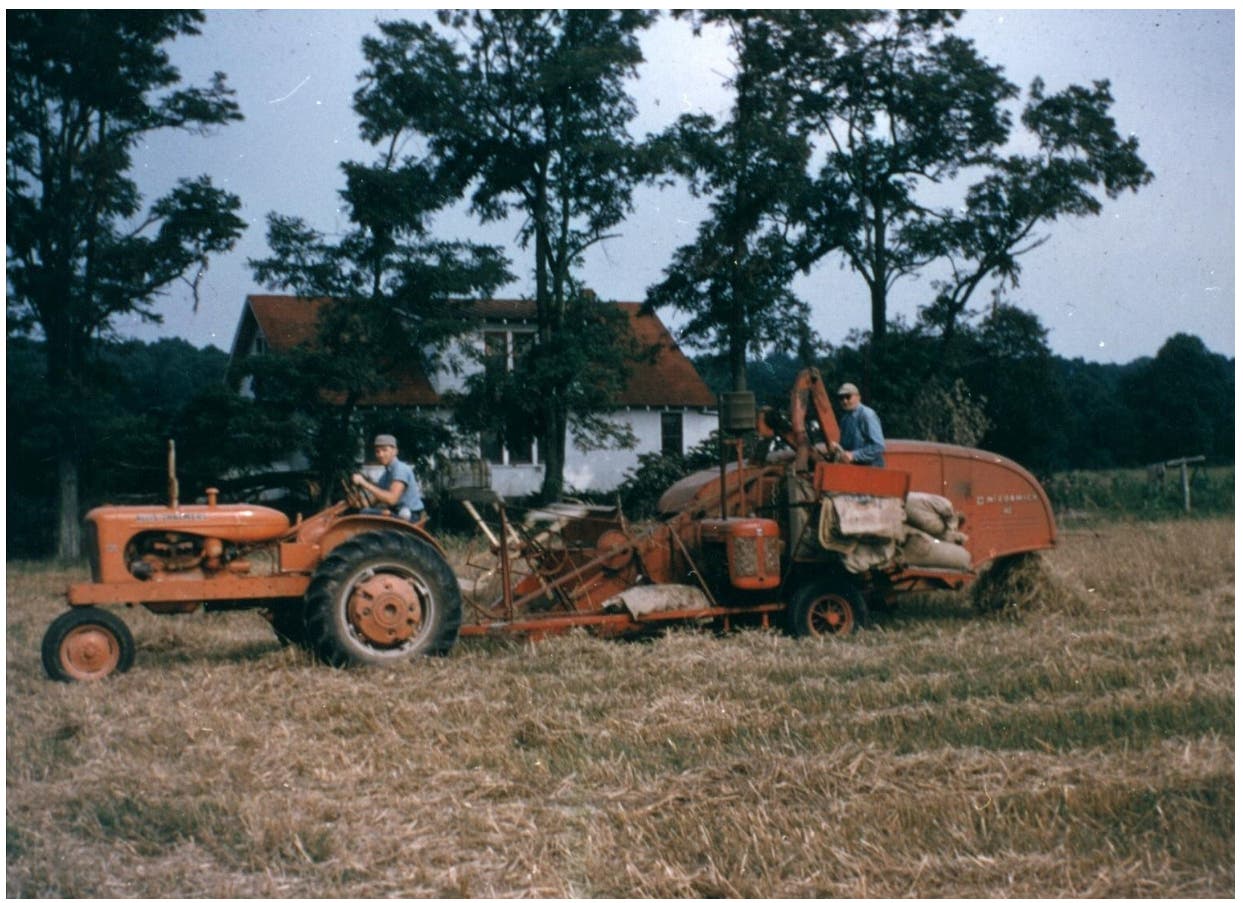
Right after Freeland Young Jr. took over operating the farm, he married Norma Slack in 1950. Norma said, “My ‘dowry’ of one horse and 45 sheep was not accepted by ‘dairy farmers,’" a loving dispute that persisted for years. The Youngs went on to have three children. They lived in the tenant house until 1962, after which they built themselves a new brick house on the farm.
By the time they took over the farm, Norma said, “The equipment was worthless. The land was overused and under fertilized, and the herd run down and exhausted. The operation sadly antique. We began to throw every cent we had into refurbishing this operation.” In addition to supporting her husband on the farm, Norma worked for the federal government for 35 years. Her salary helped support the farm.
The plow horses were eventually replaced by tractors. Excess herd stock was reduced. Soil tests were conducted and re-supplied with well-needed lime. Freeland started keeping meticulous records on equipment, cows and crop production. He also joined local farm organizations and started participating in farming seminars, demonstrations and activities. A pond was created as a water source for the stock. They started selectively purchasing registered calves whenever they could afford them. Each cow was affectionately named, such as Annabelle, Gene and Jane. Freeland devised special formulas for each cow to boost production and their collection grew into a well-producing herd. Norma and her mother-in-law made many pounds of butter, cottage cheese and cheese which they would freeze and use for months.

Norma remembered one proud moment when they purchased “Aaggie” from another local farmer, William “Dutch” Middleton in 1952. This was their first registered Holstein Friesian cow. Norma described Aaggie as being …
“… a beautiful, bossy, young heifer… who arrived on an open truck, bawling her head off. She proceeded to go into the field, challenged every aggressive cow out there and position herself as the Queen of the Herd” the first day she arrived. Aaggie became the hereafter unchallenged herd leader for 13 years. And a smart one she was. A whistle to Aaggie and she struck a 4-H pose and bawled the herd in, even when she got older and her feet were too sore to lead them in. My kids never liked Aaggie because she was bossy to them too. She blew and snorted at them and would pick them up with her head and set them in the center aisle. But they did like rides on her back, which she gave freely.”
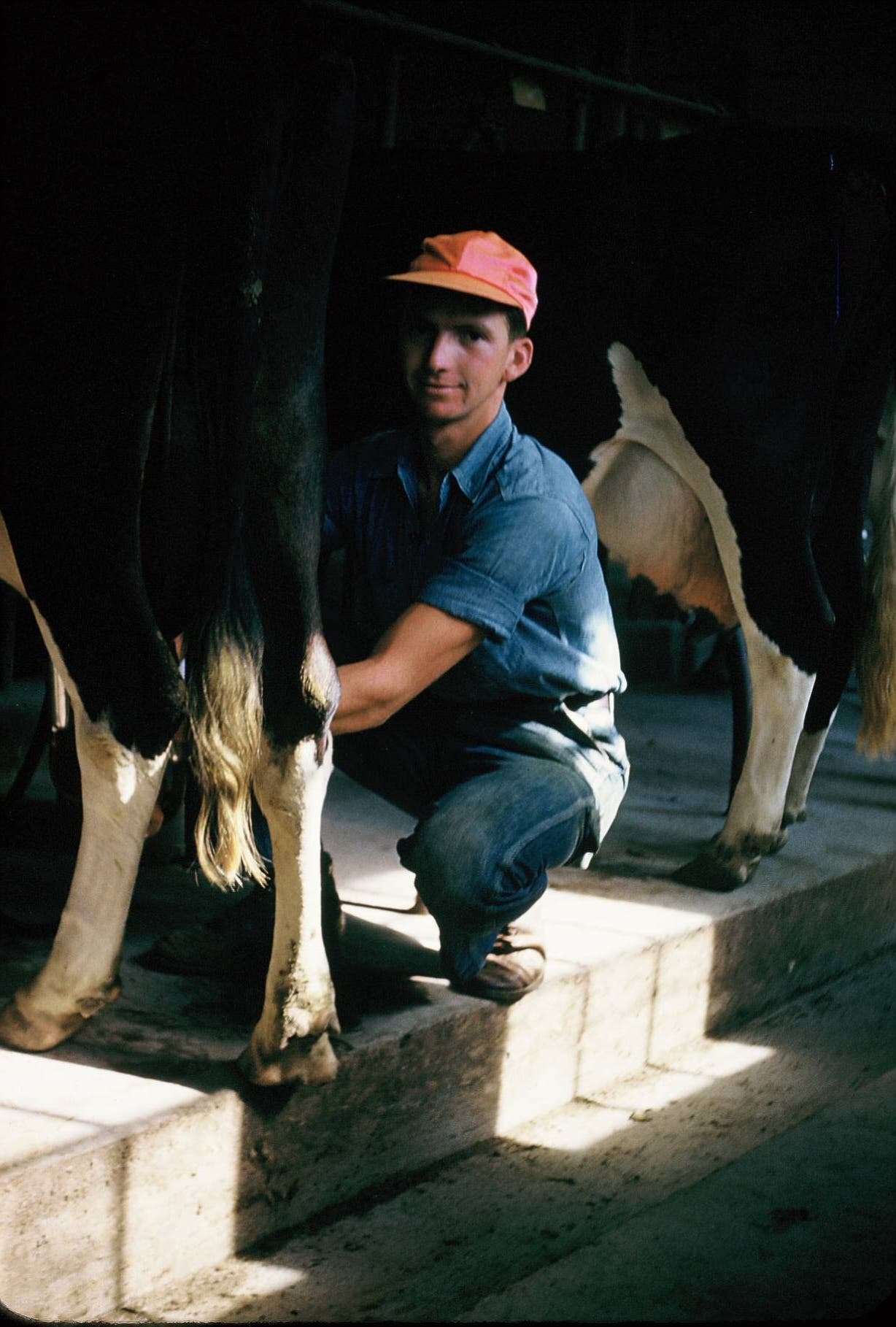
With the improving land came extra work — harvesting. Norma also helped with haying, which she said was one of her favorite things to do on the farm. She recalled “many a pleasant day and evening in the field” and how the hay smelled so sweet. After she and her husband would deliver loads of hay, Freeland would put away the equipment while Norma went home to prepare the evening meal. At 3:30 the next morning, Freeland would go to the barn to start milking, and by 5:30 a.m. Norma prepared a big breakfast. Milking resumed again at 3:30 p.m.
The grandchildren have fond memories of the farm as well. One grandchild said he remembered the milker machines being used, strapped under the cows. He would sometimes help his grandfather carry the milkers to the dairy house and watch the milk being poured through the strainer into labeled milk cans. A truck would pick up the cans, with labels to ensure that the cans were returned to the farm. The full milk cans would be delivered to the Herndon depot platform. The milk was checked to make sure it was not even one degree too hot or else it would be rejected. He also remembered a steam room in the dairy where the equipment was cleaned, recalling how hot it was.
Another recollection is when they transitioned to automatic milkers and when milk cans were no longer used, except to bring milk to the house. There was a compressor on the wall at the end of the barn, and pipes running down the stanchions that held the cows. Milk was collected by siphoning the milk in the dairy house from the cooling tank to large dairy tanker trucks via a large hose. The milk was transported directly to the dairy processing plant via truck.
Another grandchild remembered:
“There was the dairy barn with a silo and a calf barn that I remember, the large sheds and corn cribs, feed room, dairy house, chicken houses, smokehouse (Grandaddy did hams), the large gardens and, of course, the farm house. It was such a lovely place to grow up. Dad had a rhythmic machine that he ran during milking, “music” for the cows that settled them during feeding and milking. I can still hear it.”
But while the farm was successful, the price of milk and farm produce started declining, and farm help became harder to find and maintain. Continued increases in taxes also made it hard to continue farming. The investments in the farm paid off in production, but was not always profitable.
By 1963, soon after Dulles Airport was built, pressure from suburban redevelopment and rezoning brought about the sale of much of the farm land to housing developers. When the opportunity arose, all but about 12 acres of the farm land was sold. The herd was sadly sold, feeling much like losing members of their family. Freeland Sr. and Ida Young passed away in 1980 and 1979, respectively, and are buried in Herndon’s Chestnut Grove Cemetery, just a half a mile away from their beloved farm.
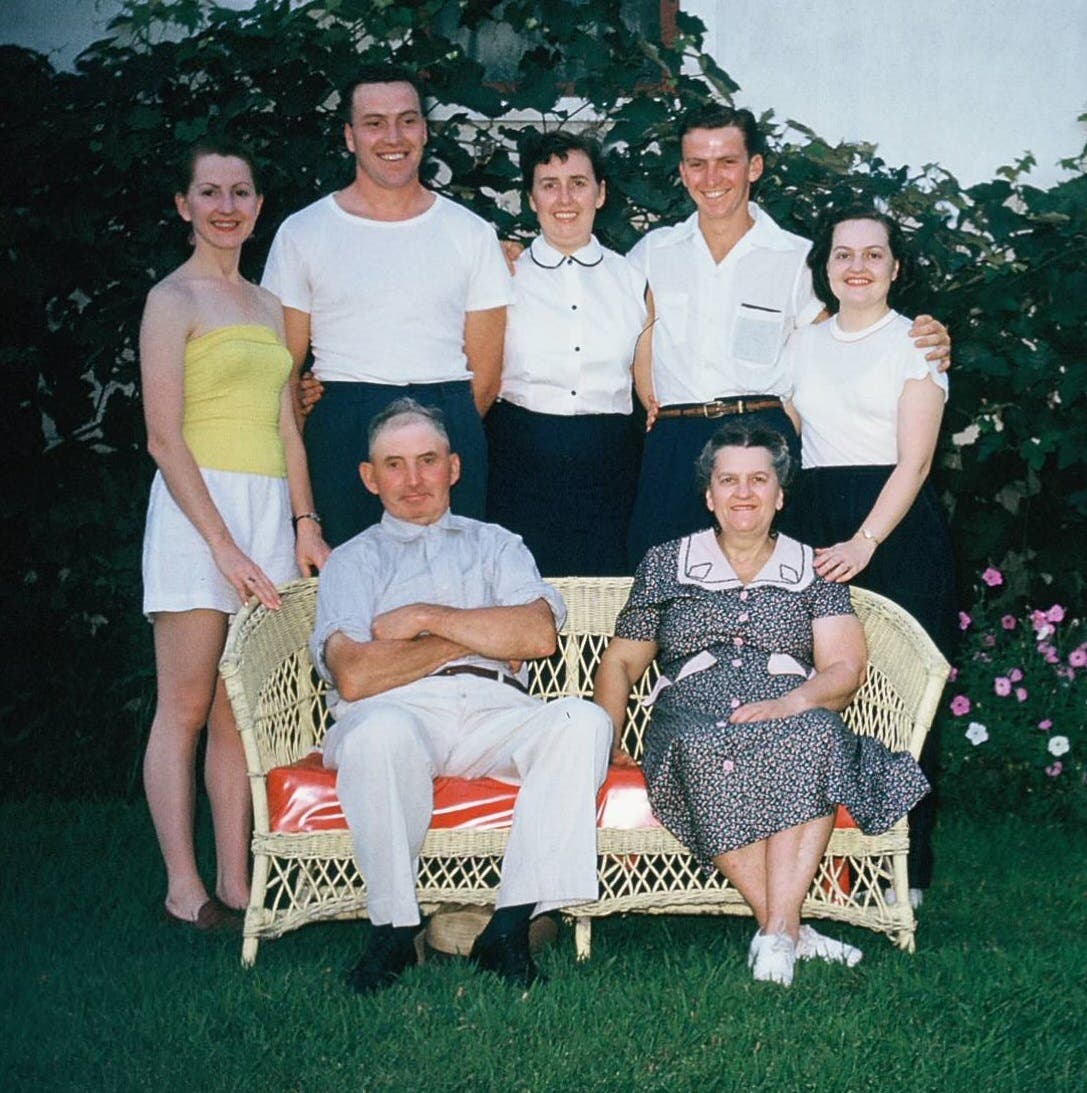
After the dairy operations had ceased, Freeland Jr. joined the Fairfax County Fire Department, retiring after 25 years of service. Freeland and Norma’s daughters became interested in horses. They acquired burros and ponies. The Youngs still had plenty of land and trails to ride on. They began stabling and renting horses. Some Herndon service clubs asked if they could arrange hayrides on their property. Soon after, the Youngs were also in the hayride/bonfire business.
The horses were kept on the small piece of land as the suburban subdivisions were built around them. The Youngs stayed on their land until 2005, forming new friendships with the many horse boarding families affectionately called “the Darn Barn family” and the new neighbors in the surrounding neighborhood. They sold their remaining 12 acres and moved to the Richmond area to join their children.
Freeland and Norma together created what they called a “little piece of heaven” at the Follylick Farm. They both passed away in 2016 and were also buried in Chestnut Grove along with the other members of the Young family. The access street off of Monroe Street was later named Young Avenue, and what remains of the redeveloped farm is the Young’s former brick home and the pond.
About this column: “Remembering Herndon’s History” is a regular Herndon Patch feature offering stories and anecdotes about Herndon’s past. The articles are written by members of the Herndon Historical Society. Barbara Glakas is a member. A complete list of “Remembering Herndon’s History” columns is available on the Historical Society website at www.herndonhistoricalsociety.org.
The Herndon Historical Society operates a small museum that focuses on local history. It is housed in the Herndon Depot in downtown Herndon on Lynn Street and is open every Sunday from noon until 3:00. Visit the Society’s website at www.herndonhistoricalsociety.org, and the Historical Society’s Facebook page at https://www.facebook.com/HerndonHistory for more information.
Note: The Historical Society is seeking volunteers to help keep the museum open each Sunday. If you have an interest in local history and would like to help, contact HerndonHistoricalSociety@gmail.com.
Get more local news delivered straight to your inbox. Sign up for free Patch newsletters and alerts.