Neighbor News
Remembering Herndon's History: Herndon in 1909
One newspaper's description of what the town of Herndon was like in 1909.

Herndon in 1909
By Barbara Glakas
A recently discovered Real Estate section of a 1909 Washington Herald newspaper featured Herndon on the front page of the section. The town was described as a thriving milk-producing community. The article also featured five photographs of Herndon: Schneider’s Hardware store (that used to be located on Lynn Street across from the Herndon Depot); a dairy farm scene; Elden Street looking west; the canning factory that used to be on Center Street; and the Post Office & Stephenson Office (which is now the Nachman building, home of Green Lizard cycling shop).
Find out what's happening in Herndonfor free with the latest updates from Patch.
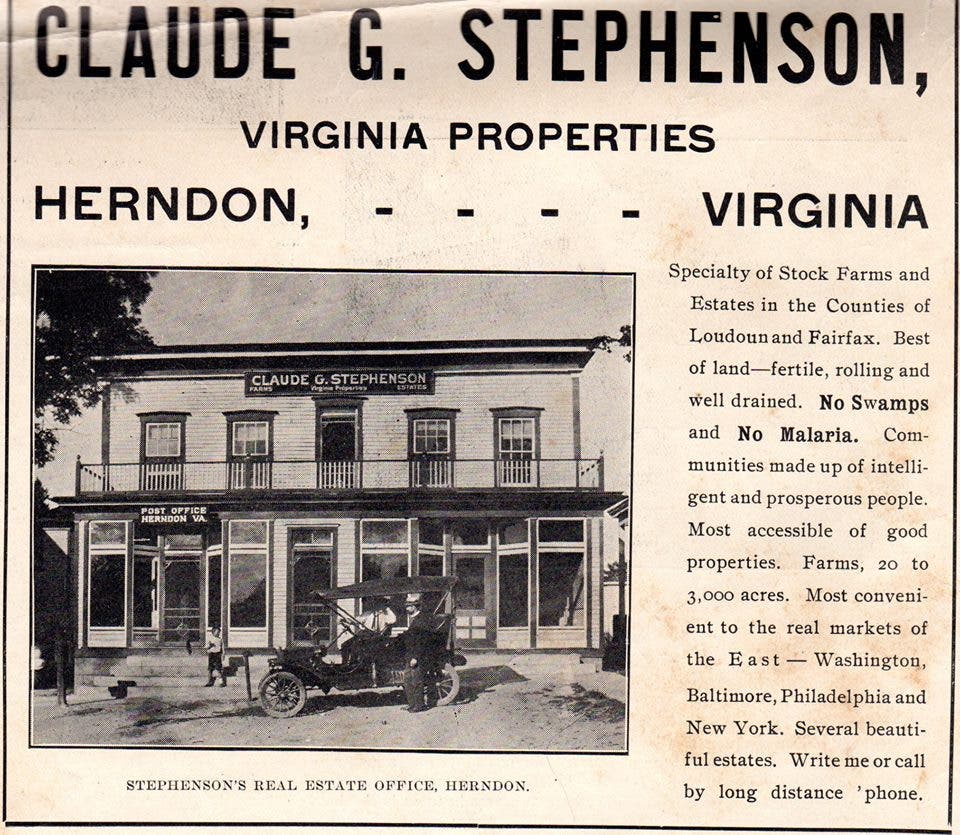
1909 ad for Claude Stephenson’s Real Estate Agency on Lynn Street, now the Nachman Building (Walter Wyatt)
Herndon was described as the “chief milk depot to supply Washington,” as “more milk is shipped out of this little burg than from any other place, either in Virginia or Maryland.” Indeed, from the late 1800s to the early 1900s, Herndon was considered the dairy capitol of Virginia.
Find out what's happening in Herndonfor free with the latest updates from Patch.
It said how Herndon “occupies a vantage point midway between the Potomac Rover and the mountains… built on a ridge on the western side of Fairfax County.” One exaggeration, however, was when they said that “no mosquito hums his siren song at nightfall, and no typhoid or malaria.”
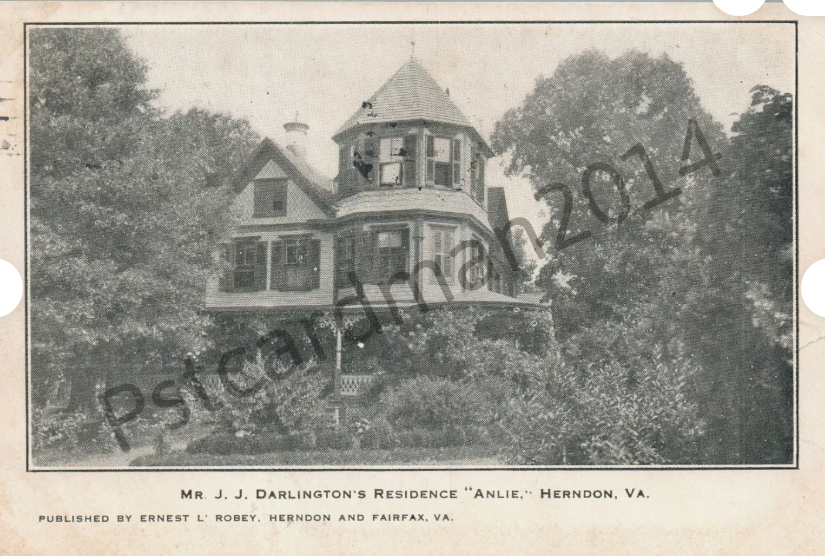
1909 postcard of J.J. Darlington estate house in Herndon (Ernest Robey)
It further described Herndon as having “some of the finest farms in the country, on which prosperous farmers are surely making their way to wealth. “Making their way” might be the key phrase in that sentence, as we have never known any Herndon farmers to be rich. The article went on to say how there was at least one cow per acre in Herndon. “In the pastures were grazing herds of fine Jerseys, Guernseys, [and] Holsteins…the barns are big and fine; beside each stands the silo, singly, in pairs, or triplets.”
They said that the dairymen presently depend on buying bran and other mill feed for their cattle. But they noted that the most progressive farmers were now exploring the use of cow-pea and other legumes as feed, which in time they anticipated Herndon would “take one more step toward self-support and independence of the outside world.”
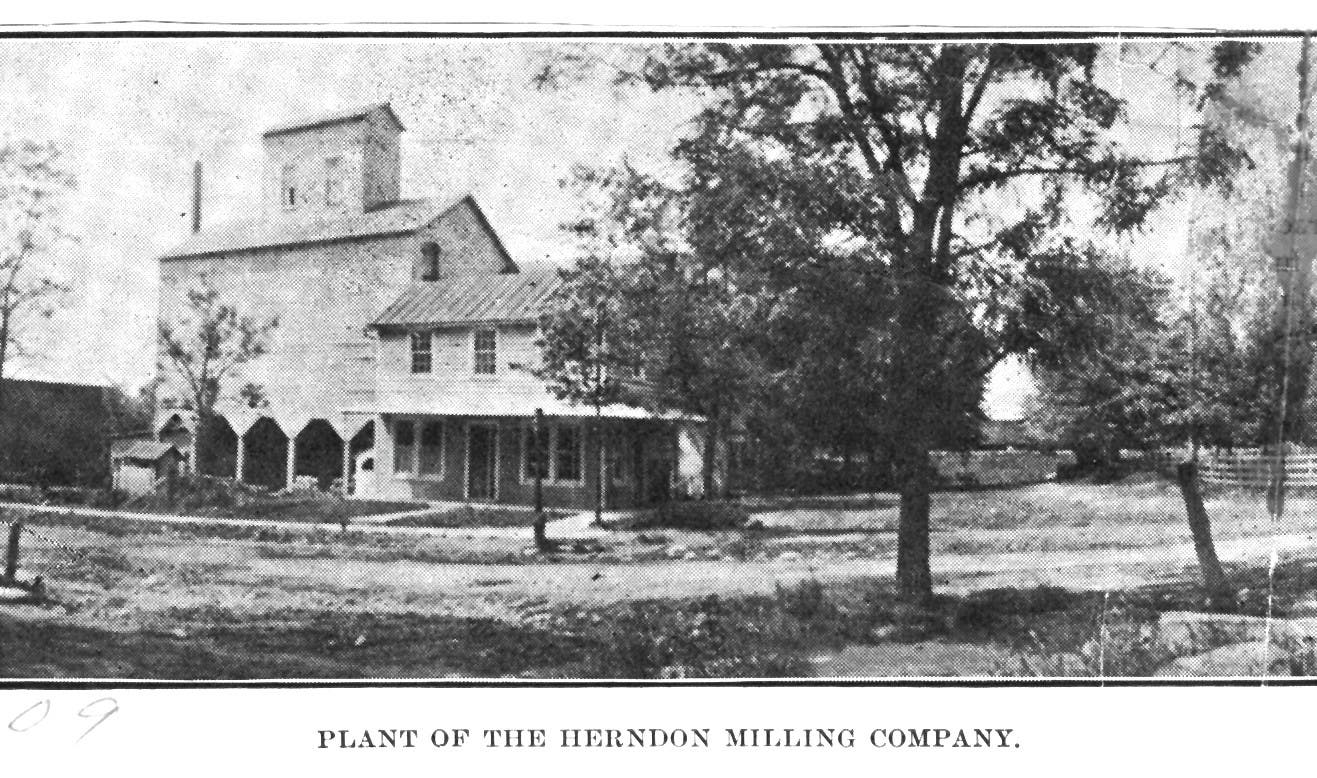
Herndon Milling Co. near Elden and Station Streets, 1909. (Mary Rosonet)
Other than dairy, the article also noted that “both eggs and fowl, to sell in the Washington markets, is considerable of an industry here. Every farm has a large flock of domestic fowls, and a number of breeders give their full attention to raising poultry.”A local association held an annual poultry show.
They described the town as having fours churches, one graded school (although we had two, one White, one Black), a young ladies seminary (which was a private boarding school run by the Castlemans), a public library, a bank, a large flour mill, and a weekly newspaper called the Observer. Herndon also had twenty stores, “in which it is possible to get anything from a toothpick to a shovel.” Those stores included four general stores, two furniture stores, one hardware store, two millinery (hat) parlors, two butcher shops, two confectionaries, one drug store, one stationary store, one harness shop, two jewelry stores, a canning factory, and two seed/fertilizer/agricultural implement houses.
The town undertaker was “not very busy.” A stone cutter “makes doorsteps and chisels terse epitaphs upon the monuments to stand in the local cemetery.” And local attorneys and a justice of the peace “help in the settlement of civil and petty criminal troubles.” It also mentioned how “Herndon boasts a large and comfortable town hall.” We are not sure where that was because Herndon’s first official town hall was built in 1939. Prior to that the town council had their meetings in various rented spaces around town. However, they mentioned that this “town hall” also hosted lectures, meetings, plays, and gatherings of various sorts. Therefore, we surmise that this “town hall” may have been the old Garrett Hall, a big building once located at the northeast corner of Elden and Center Streets, that was rented out for various functions.
The article also mentioned Herndon’s many fraternal organizations: “The Masons, Knights of Pythias, Junior Order of American Mechanics, Maccabees, and Red Men have lodges in Herndon.” Another fraternal organization that they did not mention was the Odd Fellows.
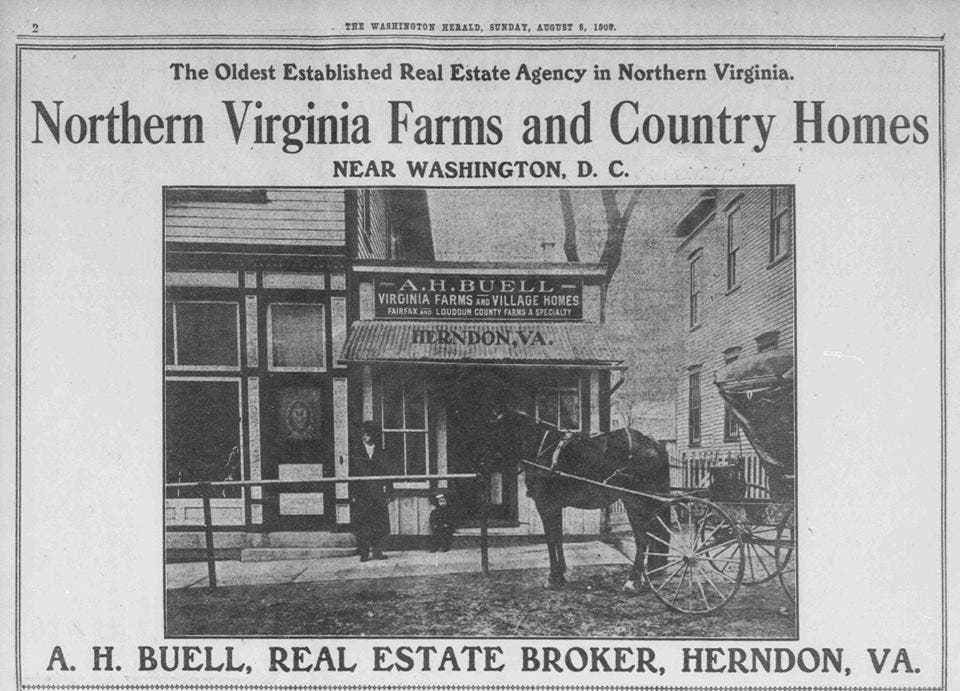
A 1909 ad for Buell’s Real Estate agency on Lynn St. (The Washington Herald)
In 1909 Elisha Dyer was the mayor of Herndon. He had served as mayor more than once. The article said, “he has held the office so long that the oldest inhabitant remembereth not when he was first elected… he is a capable and popular mayor.”Dyer was first elected in the late 1880s and served until 1891.He was elected again in 1907. Prior to his first term as mayor, he had held the position of Town Sergent.
One thing that had put Herndon on the map was the coming of the railroad. By 1909 the operating railroad company - which changed hands over the years - was the Southern Railway. The article noted that the Southern Railway had a “daily schedule of six trains… its mails come twice a day, each way,” with the mail being distributed at the Herndon post office for the town and immediate vicinity. The trains not only carried the farmers’ dairy products, but also passengers, freight, and the U.S. mail. Much like how small cities tend to grow up around Metrorail stations today, the same happened in Herndon when the 1860 railroad station was built in the center of our town. Most of the above-mentioned stores, schools, churches, and businesses were located within a short walking distances of the Herndon Depot.
In 1909 our little old town of Herndon was a rural but happening place, a hub of activity!
-----------------------------------
About this column: “Remembering Herndon’s History” is a regular Herndon Patch feature offering stories and anecdotes about Herndon’s past. The articles are written by members of the Herndon Historical Society. Barbara Glakas is a member. A complete list of “Remembering Herndon’s History” columns is available on the Historical Society website at www.herndonhistoricalsociety.org.
The Herndon Historical Society operates a small museum that focuses on local history. It is housed in the Herndon Depot in downtown Herndon on Lynn Street and is open every Sunday from noon until 3:00. Visit the Society’s website at www.herndonhistoricalsociety.org, and the Historical Society’s Facebook page at https://www.facebook.com/HerndonHistory for more information.
Note: The Historical Society is seeking volunteers to help keep the museum open each Sunday. If you have an interest in local history and would like to help, contact HerndonHistoricalSociety@gmail.com.