Community Corner
Remembering Herndon's History: The History of Herndon Jails
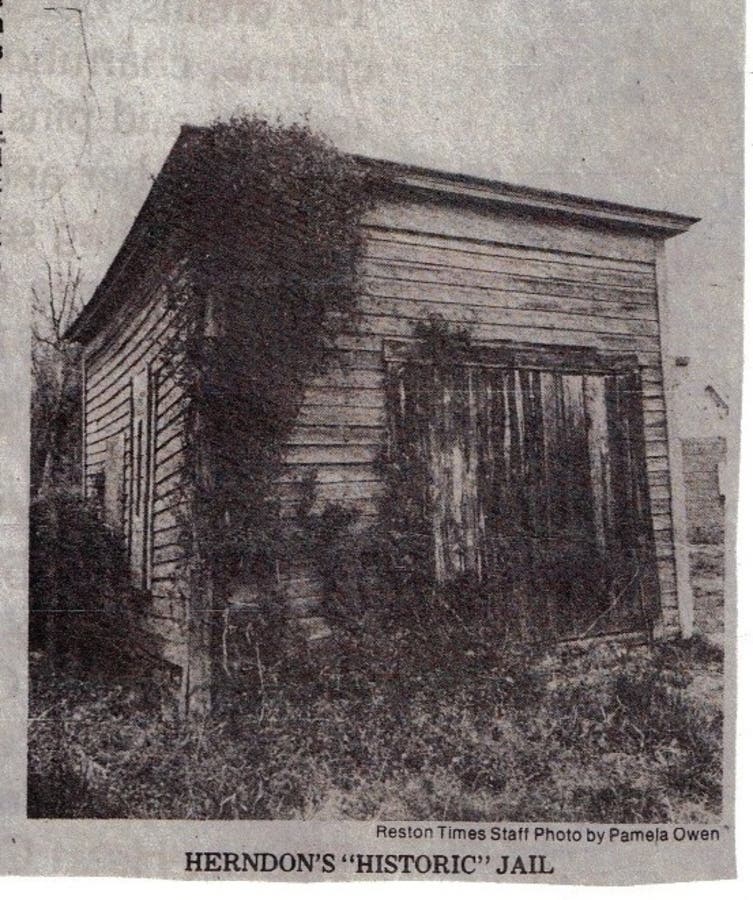
Main image: Herndon's historic jail. Reston Times.


By Barbara Glakas
The first paid employee of the Town of Herndon was the Town Sergeant, the Town’s sole police officer. His name was Charles M. Burton. He was elected the same year as the first Town Council in 1879 and was paid $200 “for the faithful performance of his duty.”
The Town Council immediately started formulating the first set of Town ordinances, codifying penalties for illegal activities, amongst other things. Some of those ordinances, for example, indicated that it shall be unlawful to destroy any public trees, to deface any public notices, to disturb any congregation engaged in religious exercises, to destroy or deface public or private property, to congregate on public or private land and engage in loud or boisterous talking or insult, to allow any cow or cattle to graze at large within the corporation, to trespass across the land of another, or to throw any missile in the street.
Find out what's happening in Herndonfor free with the latest updates from Patch.
The Town Council minutes indicated that violations of many of these ordinances would result in fines, but some other violations resulted in jail time. For instance, if anyone would be found guilty of…
“…carrying about his person any pistol, dirk, razor, bowie knife, or other dangerous or deadly weapon, he shall be fined from five to twenty dollars, and in the default of payment thereof, shall be confined in jail, not more than three months.”
Find out what's happening in Herndonfor free with the latest updates from Patch.
-1539006588-3490.jpg)
Herndon’s first Town Sergeant, Charles M. Burton. J. Berkley-Green Collection of the Herndon Historical Society.
It is not clear where town residents were jailed in 1879. But one thing that we do know is that in 1888 the Town Council obtained a lot of land for the purpose of establishing a jail site. The three-quarter acre of triangular land was a lot located at the northeast corner of Vine and Center Streets, alongside the W&OD railroad track, a lot belonging to the St. Johns. The Town Council decided to acquire the property through condemnation. Mayor Elisha Dyer wrote a letter to the land owner, Mrs. St John, which stated,
“To Mrs. Isabelle St. John,
“Please take notice that on Monday, December 17, 1888, there will be application made to County Court of Fairfax County in behalf of the Town of Herndon to appoint commissioners to ascertain a just compensation to be taken by the Town for the purpose of a prison, and a pound and to make all necessary order for the administration thereof. The said lot is described as follows … [description of land] ... containing ¾ of an acre and 16 square rods of land. This notice is given and the said application is to be made by order of the Council of Herndon.”
The court appointed five commissioners who determined that $61 would be just compensation for this land. Attorneys representing Mrs. St. John appeared and convinced the honorable body to raise the compensation to $100.
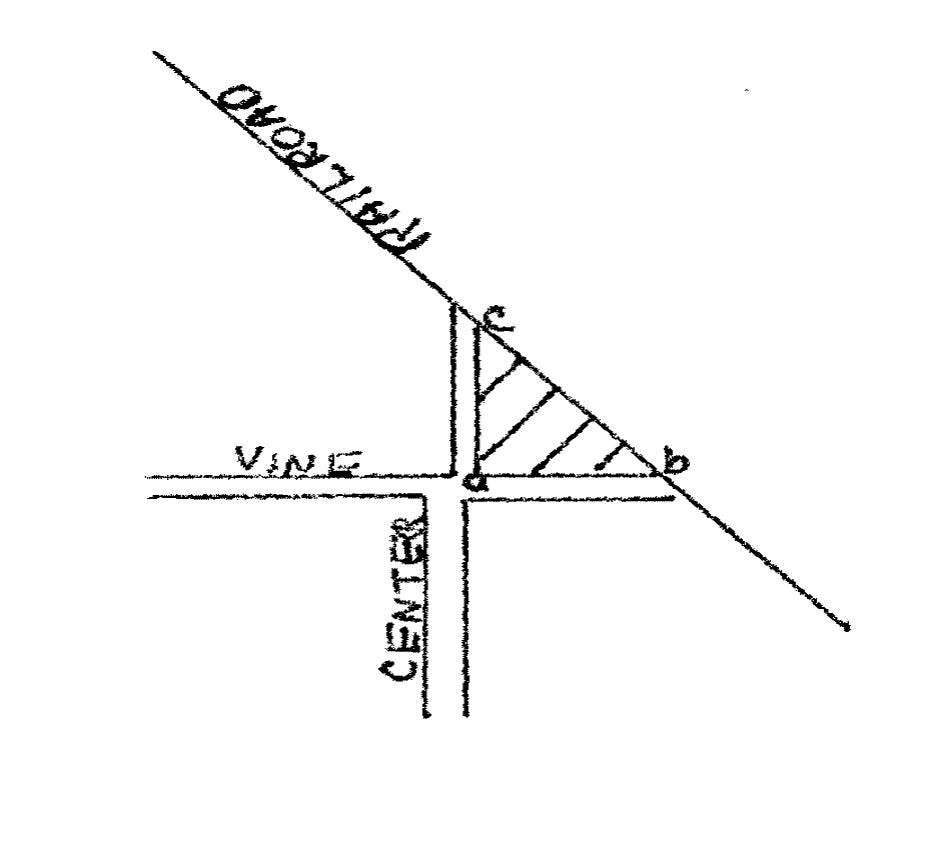
Map excerpt showing the site of Herndon’s first jail. Donald Levine.
At some unknown point a jail was built. An early picture of a Town jail shows a wooden building that looked more like a shack or a shed rather than a jail. The building measured about 10’ X 12’ and had clapboard siding with an angled flat roof. The door opened inward and the window had bars.
A 1979 Reston Times article quoted Holden Harrison, a former Town Councilman, who said he believed the jail was built sometime between 1910 and 1915, although it is unknown if the building he was referring to was actually the original jail. Harrison believed that jail was likely used to hold prisoners no longer than overnight.
Elisha Dyer was not only an early Herndon Mayor, but also served as the Town Sergeant. His daughter, Lottie Dyer Schneider recalled:
“When father was active in town affairs he had many problems with men of both races drinking and with petty thefts. I recall at one time he had the jail full and had to house a few in the cellar. Mother was loud in denouncing this, and I think it only occurred once.”
According to Harrison, this wooden structure was moved across the street to the northwest corner of Center and Vine Streets sometime between 1924 and 1926.
Newspaper articles published in the 1937 indicated how many members of the Herndon Volunteer Fire Department considered the jail to be a fire hazard. They went on record as being opposed to the any further use of the jail. They explained that prisoners in other similar jails around the state had lost their lives because the jails were unsafe. A Herndon fire department committee wrote a resolution stating the that Herndon jail was a fire menace to the life of any prisoner and the only safeguard would be to have an attendant posted at the jail continuously during occupancy so that the prisoner could be release in if any emergency arises.
By 1939 the new brick Town Hall was built next to the Herndon Depot. That building was equipped with three jail cells in its basement. The jail cells in the Town Hall basement still exist today but are now used for storage.
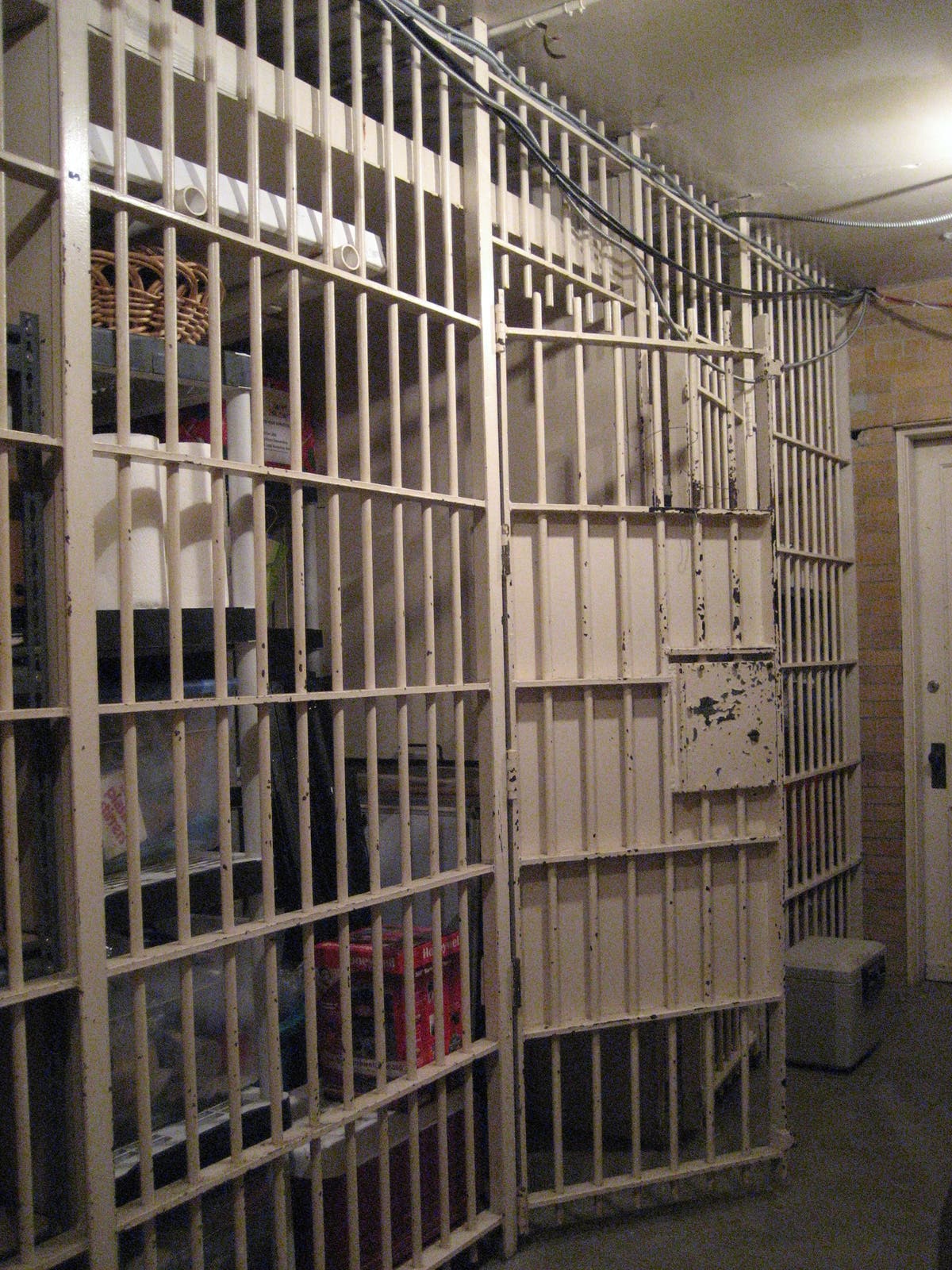
Jail cells in the basement of Herndon’s Town Hall are now used for storage. Barbara Glakas.
Once the new Town Hall jail cells started being used in the 1930s, Town officials found other uses for the older wooden jail. It served as a garage and later as storage for the police department. In the 1970s police officers recalled how they used the old wooden building to store lost bicycles, often finding wasps and black snakes inside when they entered.
Sometime around the late 1970s the jail location moved into what was called the Hoover Building at 898 Crestview Drive. This building was also once used for municipal court and for Town Council meetings. The jail was located in the basement. There were two bunks and one jail cell. It was used as a temporary holding cell until prisoners were transported to the Adult Detention Center in Fairfax. The old Hoover Building is now used as a Montessori School and the jail cells have been removed.
At about the same time, there was a Town discussion about what to do with the old wooden jail building that still sat over by Center and Vine Streets. Members of the Town Council were favorable to the idea of restoring the Town’s historic railroad Depot, but they lacked enthusiasm to restore the old jail, what one person called, “a wood box to lock drunks up in.”
One person representing the Herndon Historical Society spoke to the Town Council and said, “The Town jail is important because it represents a time gone by. If you elect to remove the jail, you would lose a part of Herndon’s history… at least see that it is properly preserved.” It was proposed that the structure could be moved near the community center and repaired and used by artist and various groups for display and exhibit purposes. The Historical Society requested matching funds to renovate and relocate the Town’s old jail.
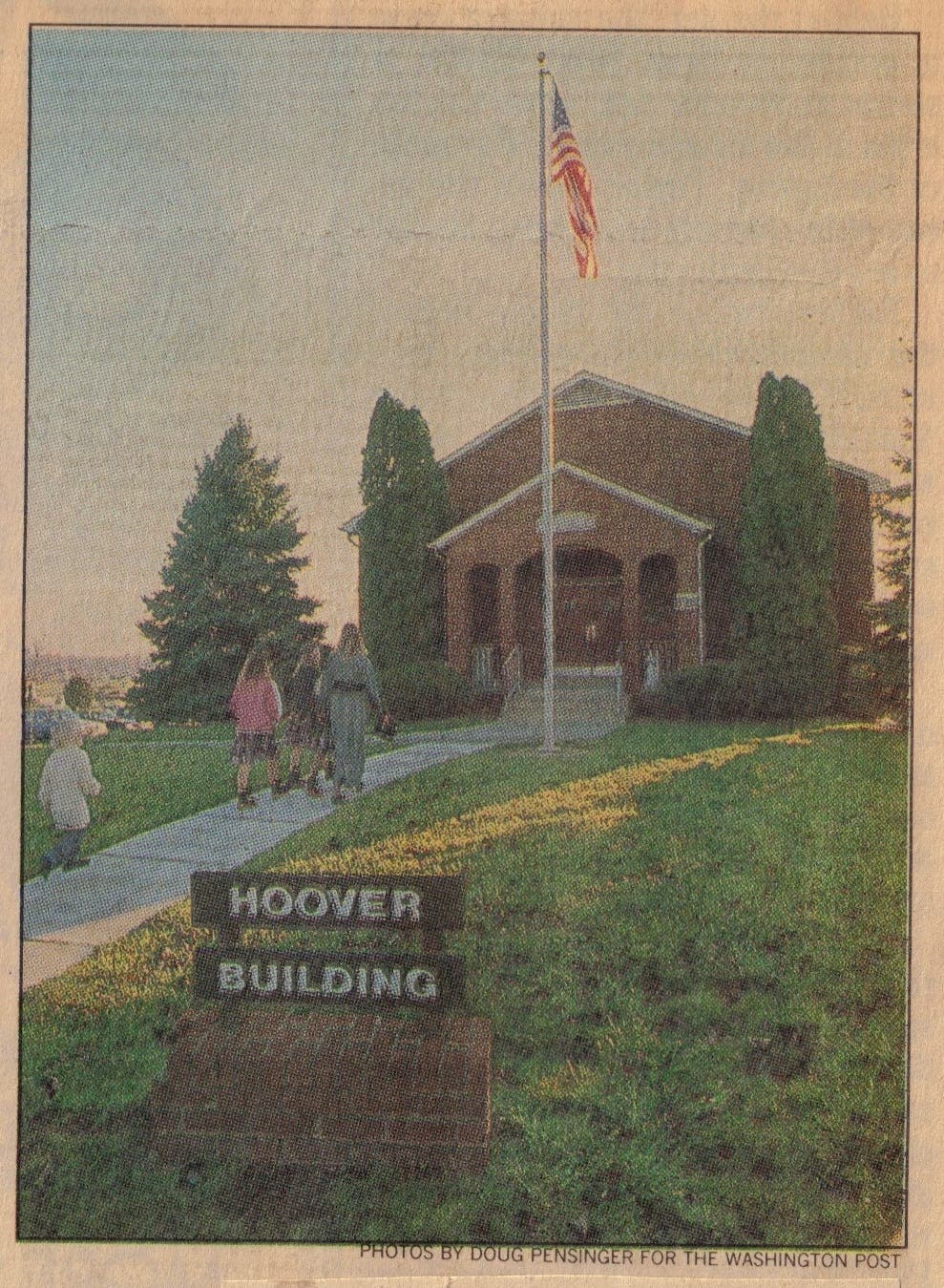
The Hoover Building on Crestview Drive used to house a jail in its basement. 1987, Washington Post.
Council members, however, felt that the preservation of the Depot was more important than preserving the jail. One council member said he saw no historical value to the jail, while another said that there was a practical side to where to best use the taxpayer’s money. The old jail was not saved.
By the mid-1980s the Herndon Police Department moved into what was the former Oak Grove School building at the southeast corner of Sterling and Rock Hill Roads. That building had two jail cells. Those jail cells were initially used to process prisoners until they could be transported to Fairfax. But at some point after the completion of an accreditation process in the late 1980s, the jail cells stopped being used altogether due to the need to meet various jail accreditation standards, such as the need for medical support. The cells were then utilized to store property that was waiting to be disposed.
The Herndon Police Department eventually grew out of the old school building at 1481 Sterling Road and moved into their new facility at 397 Herndon Parkway in 2004. There are no jails in the new police station, only a couple of lockable interview rooms where prisoners are interviewed and processed before being taken to the Fairfax Adult Detention Center. This is not unique to Herndon, as many police departments in our region have moved away from housing prisoners in their police stations due to the need for special certifications and training in jail operations. Currently, jails in Fairfax County are run by the County Sherriff’s Department.
------------------------------------------------------------------------------
About this column: “Remembering Herndon’s History” is a regular Herndon Patch feature offering stories and anecdotes about Herndon’s past. The articles are written by members of the Herndon Historical Society. Barbara Glakas is a member. A complete list of “Remembering Herndon’s History” columns is available on the Historical Society website at www.herndonhistoricalsociety.org.
The Herndon Historical Society operates a small museum that focuses on local history. It is housed in the Herndon Depot in downtown Herndon on Lynn Street and is open every Sunday from noon until 3:00. Visit the Society’s website at www.herndonhistoricalsociety.org, and the Historical Society’s Facebook page at https://www.facebook.com/HerndonHistory for more information.
Note: The Historical Society is seeking volunteers to help keep the museum open each Sunday. If you have an interest in local history and would like to help, contact HerndonHistoricalSociety@gmail.com.
Get more local news delivered straight to your inbox. Sign up for free Patch newsletters and alerts.