Neighbor News
Remembering Herndon's History: The Not-So-Lost Colony of Roanoke
A look back to a key event in America's history
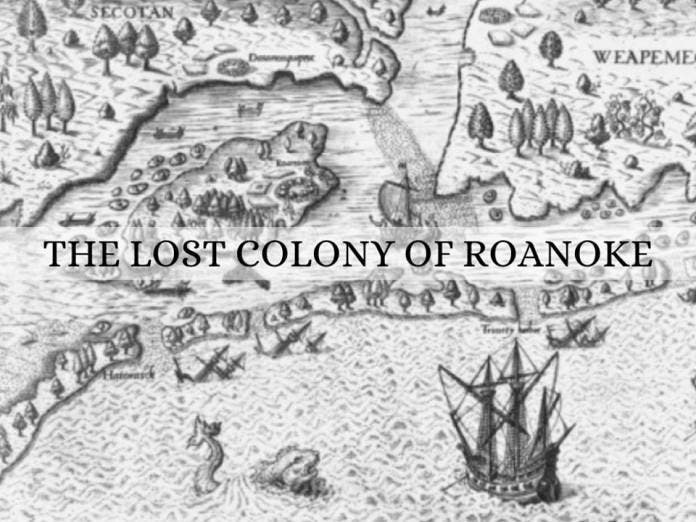
The Not-So-Lost Colony of Roanoke
By Barbara Glakas
Happy New Year! This year marks the 250th anniversary of the United States of America. Happy anniversary!
Find out what's happening in Herndonfor free with the latest updates from Patch.
This month I decided to stray away from writing about Herndon history (since the town did not exist 250 years ago), and instead write an Americana story about one aspect of our national history. This story will be about new information that has recently come to light about the Lost Colony of Roanoke, which occurred during the early European exploration period of the United States in the 1580s.
Here is a short chronology of some key American events that took place in the early colonial period of our nation’s history that many of us learned in school:
Find out what's happening in Herndonfor free with the latest updates from Patch.
- In 1492, Christopher Columbus is often credited with “discovering America.” However, he never landed on what is now the Continental United States. He landed on an island in the Bahamas and thought he was in the East Indies. And he really did not actually “discover” America, because the indigenous people had lived in the Americas for thousands of years.
- In 1587 an English settlement was established on Roanoke Island in what is now North Carolina, but the fate of the colonists was considered unknown, thus this colony is often referred to as “The Lost Colony of Roanoke.”
- In 1607 an English colony was established in Jamestown, Virginia. This is widely considered to be the first permanent English settlement in the Continental United States. (However, the Spanish settled St. Augustine, Florida, in 1565).
- In 1620 a group of English pilgrims sailed on The Mayflower to what is now the United States and established a colony in Plymouth, Massachusetts.
- The Revolutionary War started in 1775 with the Battles of Lexington and Concord. It lasted until 1783 (the year the Treaty of Paris was signed).
- In 1776 the Second Continental Congress signed the Declaration of Independence while the American Revolution had already begun (which is the anniversary we are celebrating this year).
- In 1787 the US Constitution was signed.
This article is about the Lost Colony of Roanoke Island. For hundreds of years, it was theorized that the people of this 1587 colony had either been massacred by native Americans, or had died of diseases, or had assimilated with nearby Native American tribes, either as friends or slaves. But now, after new archaeological discoveries, it appears that this colony may have not been “lost” after all, but had simply moved to another location, living with a nearby native tribe called the Croatoans.
The basic story of the Lost Colony of Roanoke that many of us learned in school is as follows:
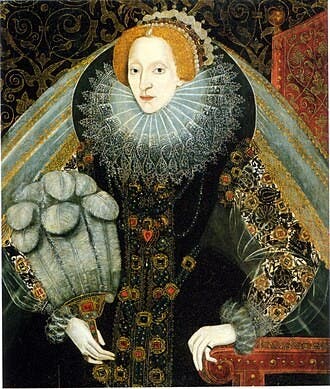
Queen Elizabeth I (Wikipedia).
England’s Queen Elizabeth authorized the establishment of the Roanoke colony by granting a patent to Sir Walter Raleigh. John White was appointed Governor and the leader of the expedition which landed in 1587 at Roanoke Island. (The island sits between the eastern shore of the mainland of North Carolina and the Outer Banks). The expedition included about 115 men, women, and children, including White’s own pregnant daughter, Eleanor Dare, who gave birth to her daughter, Virginia Dare, shortly after arriving to the New World. Virginia Dare was the first English child born in an American English colony. White had to return to England to obtain more supplies for the struggling colony. However, once back in England, White was unable to obtain another ship and could not return to Roanoke until three years later in 1590. Once he returned, he found that all the colonists were gone from the settlement. He found a message inscribed on a tree that said “CROATOAN,” but the message was widely considered to be a mystery. The colonists were never found, and consequently, they were always referred to as, “The Lost Colony of Roanoke.”
That story is only partially true. Here is the a more complete, accurate, and updated story:
Before Queen Elizabeth had commissioned the 1587 expedition, she had authorized three other previous expeditions to the New World.
(Note: The term “New World” was used to generally refer to the western Hemisphere, what is now commonly referred to as “The Americas,” including the Caribbean islands. By the late 1500s, “Virginia” referred to the east coast of North America, an area that then stretched roughly between what is now North Carolina to New York).
These mid-1580s expeditions were attempts to explore, map, and eventually colonize the territories of the New World, and to establish a base of operations from which English ships could launch privateers to harass Spanish trading ships, as at the time, England and Spain were at political odds.
Walter Raleigh previously sent two ships to America in 1584, landing in what is now North Carolina, spending about six weeks on the Outer Banks. The expedition was comprised of soldiers, not civilian colonists. This first 1584 scouting expedition was led by Philip Amadas and Arthur Barlowe. Initially, the English explorers established positive relationships with the native peoples. Two of the natives, Manteo and Wanchese, were invited to come back to England with them, and were essentially used to impress and cause a sensation, so that the two could help the Queen, her court, and investors learn about the New World and the financial benefits of potential future ventures there.
Manteo was from an island about 50 miles south of Roanoke, the present-day Hatteras Island (then called Croatoan Island). Wanchese was an advisor to Wingina, chief of the Secotan, a Carolina Algonquian tribe. In addition to occupying Roanoke Island, the Carolina Algonquian tribes also occupied the surrounding mainland of North Carolina. Manteo learned some English language and befriended his English hosts, whereas Wanchese remained more suspicious and distrustful of his hosts and their motives.
Manteo and Wanchese returned to the New World on a second English voyage in April 1585. Once there, Manteo served as a guide and interpreter for two new English leaders, Richard Grenville and Ralph Lane. Wanchese immediately rejoined his people on Roanoke Island, leaving Manteo as the colonist’s sole Indian ally. Wingina, chief of the Roanoke Island Indians, had initially received the White men with hospitality and had cooperated with them in the initial phases of their arrival. But after Grenville returned to England, Lane did not know how to properly work with the natives. Lane’s military background led him to rely more on force than diplomacy. On several occasions the colonists kidnapped Indians to extort supplies or extract information. In 1586, Lane attacked and killed Wingina, and burned a village and its fields to the ground. Outraged by these events, tribes planned a coordinated retaliatory attack against the colonists. However, Lane and his Englishmen were rescued less than a week later by Sir Francis Drake, and were evacuated back to England. Manteo went back to England for a second time.
Soon after, in 1586, Grenville returned to Roanoke with supplies. He was surprised to find no men there. He did not want to lose the land they had held, so he left 15 men there and then went off to conduct raids in the Spanish-held Azores (islands in the region of Portugal). Unfortunately, the 15 men left behind paid the price for Lane’s previous mistakes. They were attacked by native warriors; some Englishmen were killed and others fled.
In 1587, a fourth attempt was made to establish an English colony in the New World. It was recommended that they go to the Chesapeake Bay, since Roanoke Island seemed inhospitable. The Chesapeake Bay also seemed to be a more suitable area to setup a thriving port town. Although the previous voyages were primarily for military operations and trading, this expedition was meant to be a permanent settlement and was made up of families, approximately 117 middle-class men, women, and children. John White, who was accompanied by his pregnant daughter and her husband on the voyage, was named Governor of Virginia (which then included North Carolina) by Sir Walter Raleigh. John White was also an artist, and used drawings to document native life in the New World. Manteo was with them when they returned to the New World. By this time Manteo’s English was much improved and he had established friendly relationships with many of the colonists. At one point, Manteo was baptized as a Christian.
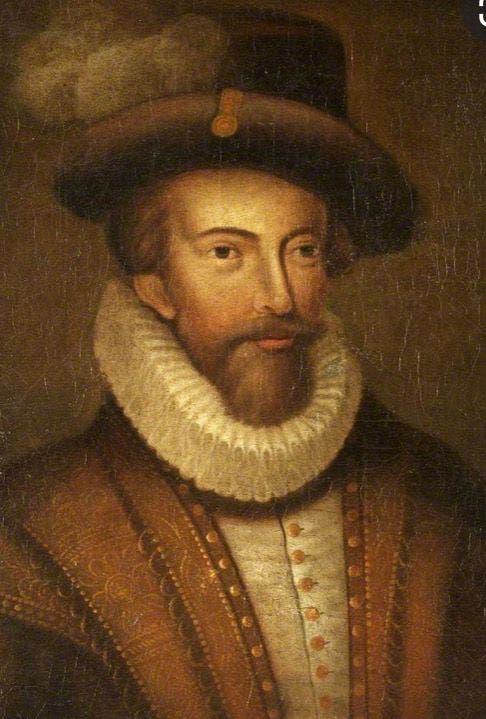
John White (Find-a-Grave.com)
The ships first stopped at Roanoke Island in July of 1587 with the intention of picking up Grenville’s 15 men, only to find they were not there. To make things worse, while there, one of the colonists was killed by Indians while he was crabbing alone. He, and some of the previous 15 men, were apparently killed by members of the mainland Secotan tribe. White turned to Manteo and the Croatoans for assistance, asking them for their help to negotiate peace with the Secotans. The Croatoans established peaceful relationships with the colonists and agreed to help them. Peace with the Secotans was not successful, however, the Secotans had moved further inland so the colonists did not need to encounter them for a while. John White’s daughter had her baby, named Virginia Dare, in August of 1587, the first English child born in an American English colony.
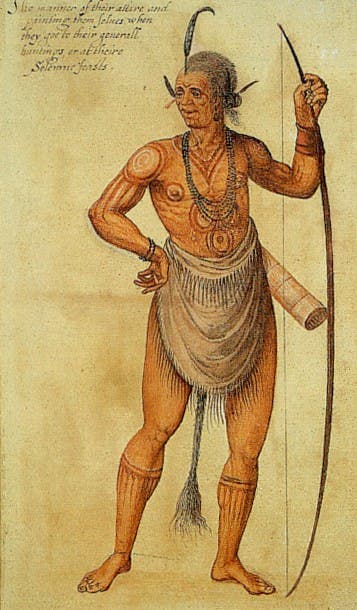
John White's watercolor of a native warrior. (WorldHistory.org).
The colonists never made it to the Chesapeake Bay area because the ship’s captain, Simon Fernando, decided to abandon the colonists there on Roanoke Island. John White was forced to return to England with Fernando, yet he promised to return soon with more supplies. Before he left, White instructed the colonists on Roanoke Island that, should they need to relocate, they should carve the name of their new location into a tree or in some other obvious location, so that when he returned, he would know where they had gone. He also told them to carve a star underneath the name of the new location, should they have to relocate under duress.
Unfortunately, resupplies from England were an ongoing problem. In anticipation of Spain attacking England, Queen Elizabeth put a ban on English ships leaving English waters, to ensure the safety of her nation. Due to the Queen’s ban, John White was unable to obtain a ship to return to Roanoke Island with more supplies until 1590.
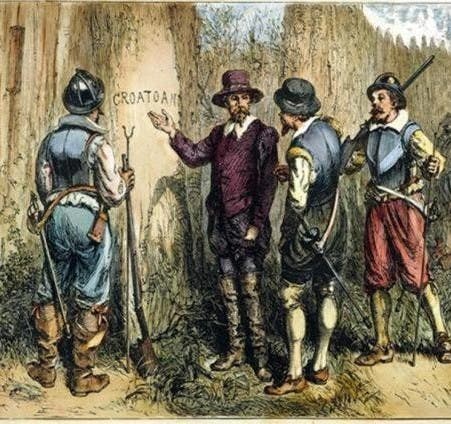
Depiction of John White finding a carved message on a palisade. (American Heritage.com).
Once Governor White and his crew finally returned to Roanoke Island three years later in 1590, they found a tree that had a carved marking on its trunk that said “CRO.” When White got to the site of the colonists’ settlement, he found it to be abandoned. And on one of the palisades (or wooden timber stakes) that had been built around the settlement, was another message that had been carved into it. It said, “CROATOAN.” There was no star (or cross) carved below the word “Croatoan.” Inside the settlement walls, White found that most of the buildings within the settlement had been dismantled or moved. In other words, it was not evident that the settlement had been attacked, destroyed, or burned. None of the settlers’ boats, equipment or supplies could be found. There was no sign that anyone had been living there recently.
White surmised that the settlers must have gone to Croatoan Island to join Manteo and the Croatoan tribe. Croatoan Island is now known as Hatteras Island, located on the outer banks, about 50 miles south of Roanoke Island. To White, the Roanoke settlement looked abandoned, not attacked. And he believed that three years with no resupplies may have caused such a great hardship that the settlers must have needed to join their Croatoan friends to survive. One can almost imagine that John White may have felt a sense of relief when he saw the “Croatoan” mark in the tree, since Manteo and his Croatoan people were the only true native allies of the English settlers. It seemed sensible that if the colonists were under attack, or experiencing famine, they would have chosen to evacuate to an area with friendly natives.
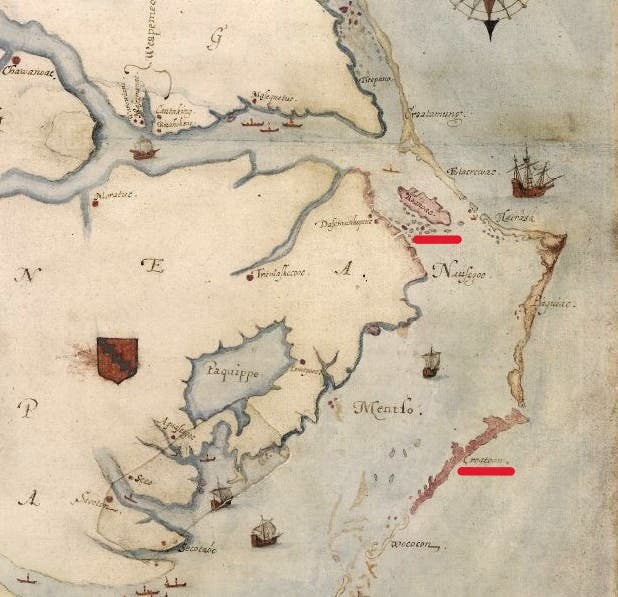
1584 map by John White with Roanoke Island and Croatoan Island marked in red. (Wikimedia)
White planned to go to Croatoan Island to look for the colonists. But as they started sailing south, they ran into a bad storm, throwing them well off course. They also lost all but one of their anchors. The crewmen almost mutinied and White was forced to head back to Europe. Unfortunately, John White died in 1593 and was never able to make it back to Croatoan Island to find the settlers and his family members.
In 1607, about 100 miles north of Roanoke Island, the first permanent English settlement would be founded in Jamestown. The people of Jamestown were aware of the possibility of finding the Roanoke colonists, and they paid attention to Indian reports of Englishmen living among nearby tribes. Powhatan leaders informed Jamestown leader, Captain John Smith, about nearby settlements, where people wore European style clothes and lived in walled houses. Smith was not able to find these settlements.
William Stracci also made a voyage to the Americas in 1610, but he was also not able to find the colonists. He theorized that the English settlers may have integrated with a friendly native tribe. But others did not agree with Stracci and believed the settlers may have been attacked and killed by native tribes, assuming this was done at the hands of the Powatan, even though they had no evidence of that.
Samuel Purchase travelled to America in 1625. Tensions still existed between the native peoples and the settlers. Purchase supported the general assumption that the Powatan had killed the original Roanoke Island colonists in the 1580s, since the Powatan had attacked Jamestown in 1622. Modern historians now view those assumptions as anti-native propaganda.
In 1701, explorer John Lawson came to America to investigate the fate of the Roanoke Island colonists. Speaking to the Hatteras people, he noticed a high level of English influence there. They had English coins and guns. Remains of an English-built fort could be seen on their island as well. Those natives also told Lawson that some of their ancestors had been White European people who were part of the Walter Raleigh expeditions. This led Lane to believe that the Roanoke settlers had joined the peaceful Croatoan tribe on their island (modern day Hatteras) when their supplies ran low and they were not able to return to England.
In his book, A New Voyage to Carolina, Lawson described how he had found evidence of the colony on Hatteras Island, finding Indians with grey eyes, wearing English-style clothes, and who knew how to read out of a book. Lawson wrote in part:
“Hatteras Tribe: These tell us, that several of their Ancestors were white People, and could talk in a book as we do; the Truth which is confirmed by gray Eyes, being found frequently amongst these Indians, and no others. They themselves extremely for their Affinity to the English, and we are ready to do them all friendly Offices.
“I cannot forbear here, a pleasant Story that passes for uncontested. Truth amongst the Inhabitants of this Place; which is that the Ship which brought the first Colonists, does often appear amongst them, under Sail, a gallant Posture, which they call Sir Walter Raleigh’s Ship; And the truth of this has been affirmed to me, by Men of the best Credit in the Country.
“Hatteras Indians: these are them who wear English dress.
“It is probable, that this Settlement miscarried for want of timely Supplies from England; or thro’ the Treachery of Natives, for we may reasonably suppose that the English were forced to cohabitate with them for Relief and Conversations; and in process of Time, they confirmed themselves to the Manners of their Indian Relations. And thus we see, how apt Human Nature is to denigrate.”
The “denigrate” comment reflects the common anti-native view of the time, the view that the Indians were “savages.” But there can be no doubt that Lawson thought that some of the Indians he found at Hatteras Island were in fact descendants of the Roanoke colonists.
A similar sentiment was also reflected in the writings of a missionary named Reverend John Irmstone (or Urmston) from Bath, England, who had visited Hatteras Island in 1710. In a letter he wrote to his superior about the natives who came to get baptized, saying:
"These persons, half Indian and half English, are an offense to my own and I gravely doubt the Kingdom of Heaven was designed to accommodate such.”
Again, the prejudicial language is evident. But, like Lawson, he confirmed that at least some of the natives he encountered on Hatteras were mixed race, “half Indian and half English.”
Now fast-forward to today, over 430 years after the Roanoke Colony was supposedly “lost.” Up until recently, little evidence was available to prove the theory that the Roanoke colonists had joined the Croatoan. Popular modern theories remained that the settlers were either attacked by hostile native tribes, or died of disease, or they moved to a different location, or they may have attempted to return to England and were lost at sea, or they integrated (forced or not) with a nearby tribe.
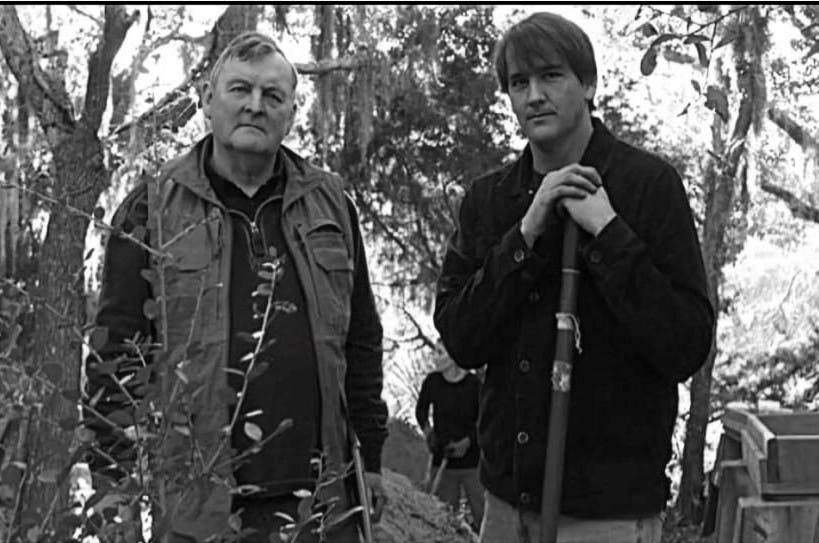
Dr. Mark Horton and Scott Dawson. (Croatoan Archeological Society Facebook page).
The Croatoan Archeological Society (CAS) was founded by a native Hatteras Islander, Scott Dawson – a teacher, firefighter, EMT, and amateur archeologist who has Croatoan roots. Dawson said, “My family has lived on Hatteras for generations, and family lore says that we ourselves are partly descended from members of the Croatoan tribe from the 1700s.” The Croatoan Archeological Project (CAP) is under the leadership of Dr. Mark Horton, Professor of Archeology from the University of Bristol, England. Since 2009, the CAS and the CAP have been working together to learn as much as possible about the history of the former inhabitants of Croatoan/Hatteras Island, using scientific archeology. They started with test pits in 2009 and by 2012 they were doing full-scale excavations.
Their excavations on Hatteras Island started by finding artifacts that ranged from 1650 to 1750. Not only were they finding native artifacts but, over time, as they dug down through the layers, they started finding a sequence of colonial artifacts. They eventually found 1580s artifacts that reflected both native and European origins, from the period of the above mentioned early English expeditions. The trick, however, was to try to distinguish any 1587 Lost Colony artifacts, from any 1584 or 1585 artifacts that may have been present at Croatoan Island through trade.
Some of the European artifacts found on Hatteras included a hilt of 1500s rapier (sword), an English gun barrel, Nuremburg tokens, fire bars, glass beads, a glass arrowhead, copper earrings, gun flint, stoneware, a writing slate and lead pencil, a pocket watch key, pipe bowls, lead shot, a shoe buckle, a hook and eye closure, a double heart leather fitting, smelted copper, and many more items.
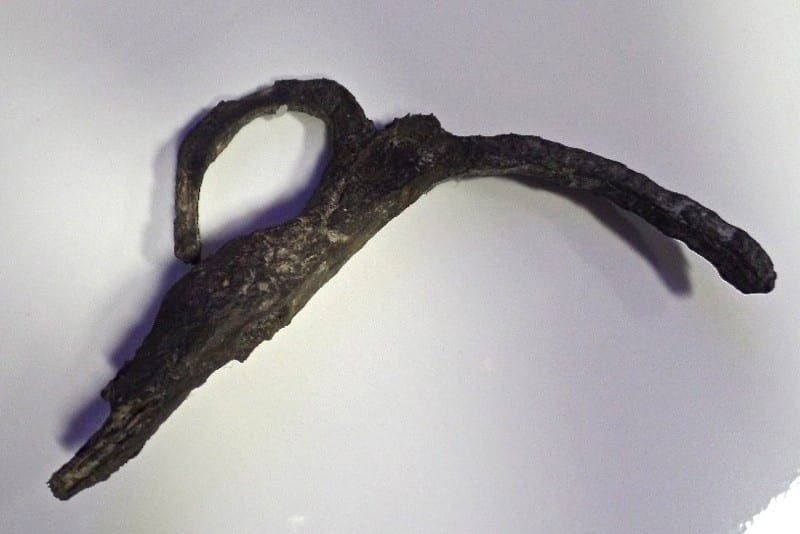
Found piece of a hilt from a 1500s rapier. (Croatoan Archeological Society).
The Croatoan did not have glass, so the glass items would have been from England. No swords or guns of the age like the ones found were ever found at any locations between Jamestown and Hatteras. Nor would the Englishmen have traded away their weapons to the natives. The writing slate would not have been a traded item because the Croatoan did not write. A piece of the slate showed a man shooting gun. The double heart leather fitting was a common 1500s European fashion accessory.
The CAS and CAP also found and mapped numerous postholes left by the wood frames of Croatoan houses. These postholes were typically round. But among them were also larger, square postholes, a feature not related to Native American structures. It is theorized that these holes were the remnants of 1500s European structures/houses, evidence a more permanent European presence on the site.
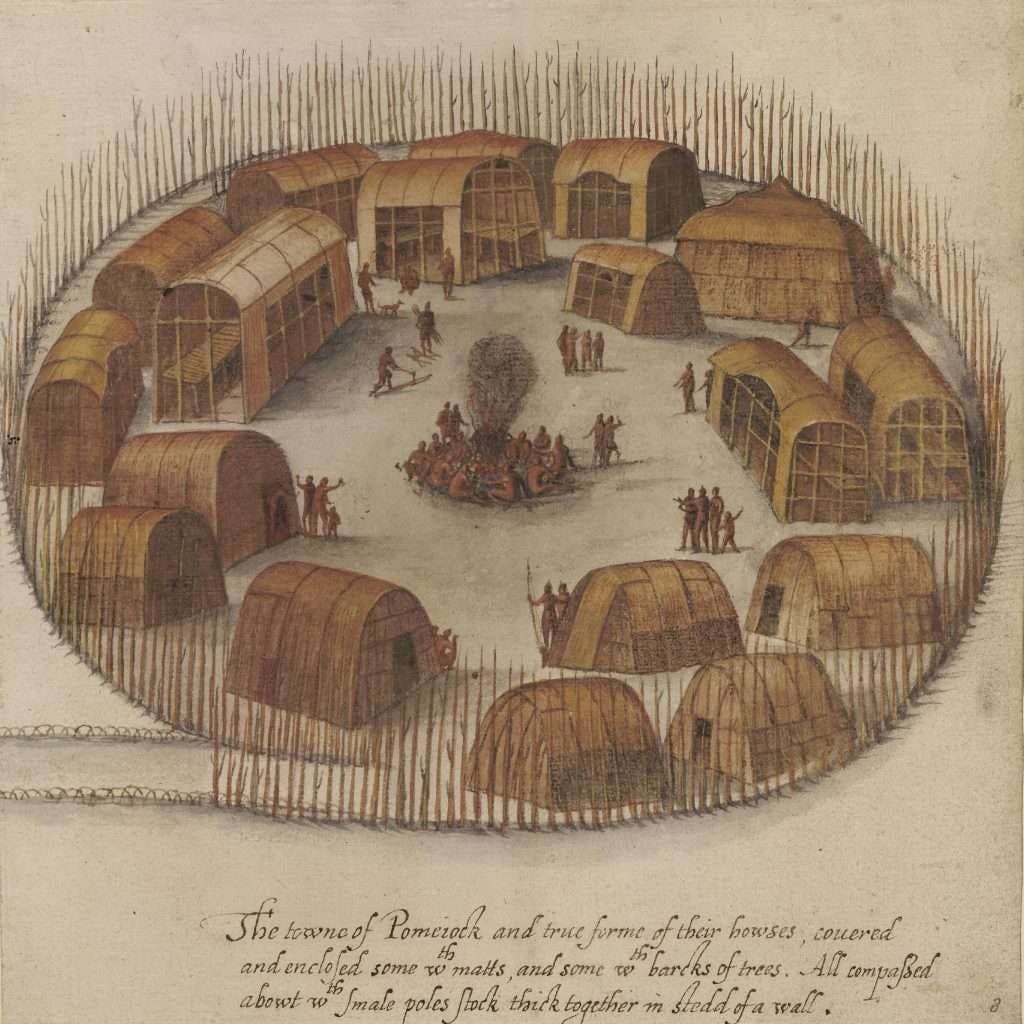
John White's watercolor of a native town on the Outer Banks. (EncyclopediaVirginia.org).
More than one Nuremberg token had been found in North Carolina. (A Nuremberg token is a round coin-like medal that was used to count inventory). Two were found on Roanoke Island and two of the exact same type were found on Hatteras Island. No other tokens like these have been found in Jamestown or anywhere else in America. Therefore, the chance that these tokens did not come from the same source is extremely unlikely.
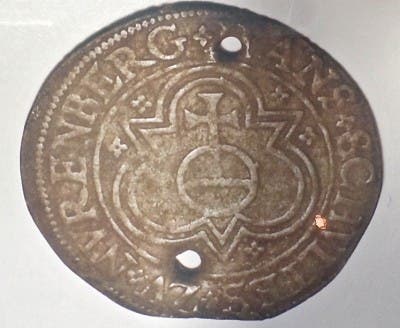
Found Nuremburg token found on Hatteras Island (CoastalReview.org).
One of the tokens was also found in the correct strata layer on Hatteras, near some copper smelting. Smelting is the extraction of metal from its ore by a process involving heating and melting. It is a necessary process to transform raw ore into useable metals. Also there, in the same layer as the token, was a smelted copper bun, stoneware, an iron ingot, brass scabbard tips from daggers, crucibles (a heat-resistant container), a silver-plated ring, and a lot of hammerscale (a flaky or spheroidal byproduct of the iron forging process). A copper bun is a type of copper ingot produced as a result of the smelting process formed at the base of a furnace, beneath a layer of slag (the waste byproduct of smelting).
What is the significance of all these findings on Hatteras Island? The silver ring, based on the size, once belonging to a woman. Women were not on the pre-1587 expeditions. Also, the Croatoans did not do smelting or forging. They did not have those skills. The evidence of smelting activity, such as the presence of hammerscale and slag, indicate that there was a permanent smelting/forging operation happening on Hatteras Island, which would have only been done by Europeans. Horton reflected, “This is metal that has to be raised to a relatively high temperature … which, of course, [requires] technology that Native Americans at this period did not have.” These findings challenge the theory that all the artifacts found on the island were the result of trade with the native tribe. Moreover, we know that Europeans did not inhabit Hatteras Island during their brief expeditions in 1584 and 1585.
What was the fate of the Croatoan people on Hatteras Island? According to Dawson, the Croatoan fought alongside of the English in the Tuscarora War (1711-15), which likely reduced their numbers. In 1731, North Carolina Governor George Burrington indicated that the tribe was still on the island but was comprised of fewer than twenty families. A 1733 map, called the Mosely map, shows a Hatteras Indian village still on the island. Visiting missionaries in 1761 found Hatteras, Roanoke, and other tribe members living together on Hatteras. A 1759 land grant that North Carolina Governor Arthur Dobbs issued to the Hatteras tribe listed European last names as the heads of households for the tribe. Based on all this, along with the archeological and oral evidence, it seems pretty evident what happened. John White instructed the colonists to leave a message as to where they were going if they had to move, and that is exactly what they did on the palisade: “CROATOAN.” And, thus far, the archeology supports that.
Citing all the evidence they have found, Professor Horton says,
“We think a number of them [the colonists] actually survived among the Croatoan Indians. We think they assimilated into the Native American Community and their descendants, their sons, their granddaughters, and grandsons, carried on living in Hatteras Island until the early 18th century. The story of the Lost Colony and denial that essentially the first English assimilated into native American society has been denied in America for generations. And what I find intriguing is even today we will probably find the descendants of those lost colonists in the surviving Native American communities in the Carolinas.”
That the colonists at one point assimilated with the Croataons is supported by the evidence. And one of the theories is that they eventually moved off the island into the mainland of North Carolina.
The use of DNA to solve the Lost Colony mystery is a fraught exercise. A 2018 paper entitled “The Lost Colony of Roanoke: Did They Survive? – National Geographic, Archaeology, Historical Records and DNA,” described a Lost Colony Y DNA Project in which DNA testing is to be used as a genetic resource to prove that the colonists survived. This would require the project members to identify the correct families in England, and find a direct male descendant carrying the colonist’s surname to test, a highly difficult task. Researchers have compiled lists of surnames from old Hatteras Island property deeds. The project’s intent is to try to identify male colonist lines in England, and then attract men with the colonist’s surnames that were found in eastern coastal North Carolina in the earliest records, or from the Native groups claiming or suspecting to be descended from the colonists. But the main challenge of this work is obtaining a genetic point of comparison, either from the remains of a Lost Colonist or one of their descendants.
Another project is called the Lumbee DNA Project. As far back as the late 1880s, North Carolina legislators believed that the Lumbee People, mostly of Robeson County (about 200 miles west of Hatteras), were thought to be likely descendants of the colonists based upon their own oral history. The Lumbee language incorporated Elizabethan words that were over 300 years old, their last names included names from some of the colonist’s names, and some of the Lumbee were described as having facial characteristics of the English.
James Ennis Street, a prominent Lumbee leader, who made efforts to gain federal recognition for the tribe, wrote in a 2022 paper:
“The Lumbee Tribe has taken on different names throughout its history. In 1885, State Senator Hamilton McMillan sponsored state legislation to recognize the group as ‘Croatan.’ Though the bill passed, as Senator McMillan himself acknowledged in his later book, “The Lost Colony Found,” the Indians rejected this name. According to Senator McMillan, upon reading the 1885 Act recognizing the Tribe as Croatan, ‘an intelligent Indian remarked that he had always heard that they were called Hatteras Indians.’ In 1911, after the name ‘Croatan’ took on derogatory connotations, these Indians called themselves the ‘Indians of Robeson County.’”
More recently, an Appalachian State University study wrote,
“A document dated 1725 does identify four Siouan-speaking groups living near a river called the 'Drowning River' in North Carolina. Today the 'Drowning River' is known as the 'Lumber River,' and tribal records for the Lumbee, which begin in the 1700s, show that the four Siouan-speaking groups are, in fact, the earliest documented ancestors of the Lumbee People.” During the 1970s, the Lumbee people were typed for the Human leukocyte antigen and they had a low frequency of HLA-B40 while more Native American groups have a high frequency, which proves that admixture with Europeans has occurred in the tribe. The Lumbee people also have similar linguistic patterns as Europeans.”
Regardless of any connection to Europeans, without a sample of the colonists DNA, or an English family member to compare the data to, any link to the Lost Colony cannot be scientifically proven. The work goes on.
Despite the lack of indisputable DNA evidence, the archeological evidence, written evidence, and oral history seem to be strong. Professor Horton said, “Have we solved the mystery? Well, you know, it’s pretty good evidence, but there’s always more work to be done.”
As a Virginian, I would love to say that I am sure that the first permanent English colony established in the Continental Unted States was in Jamestown, Virginia. However, I now wonder if it could also be possible that the first English colony was the one first established on Roanoke Island, which later moved to Hatteras Island, in North Carolina. It appears, the Lost Colony of Roanoke was not so lost after all, but simply moved to Hatteras Island, with the help of Manteo and members of his friendly Croatoan tribe.
------------------------------------
About this column: “Remembering Herndon’s History” is a regular Herndon Patch feature offering stories and anecdotes about Herndon’s past. The articles are written by members of the Herndon Historical Society. Barbara Glakas is a member. A complete list of “Remembering Herndon’s History” columns is available on the Historical Society website at www.herndonhistoricalsociety.org.
The Herndon Historical Society operates a small museum that focuses on local history. It is housed in the Herndon Depot in downtown Herndon on Lynn Street and is open every Sunday from noon until 3:00. Visit the Society’s website at www.herndonhistoricalsociety.org, and the Historical Society’s Facebook page at https://www.facebook.com/HerndonHistory for more information.
Note: The Historical Society is seeking volunteers to help keep the museum open each Sunday. If you have an interest in local history and would like to help, contact HerndonHistoricalSociety@gmail.com.