Community Corner
Remembering Herndon's History: A Story of a Town Tinsmith
A picture of a family in 1892 leads to the story of Paul Buchwald. By Barbara Glakas


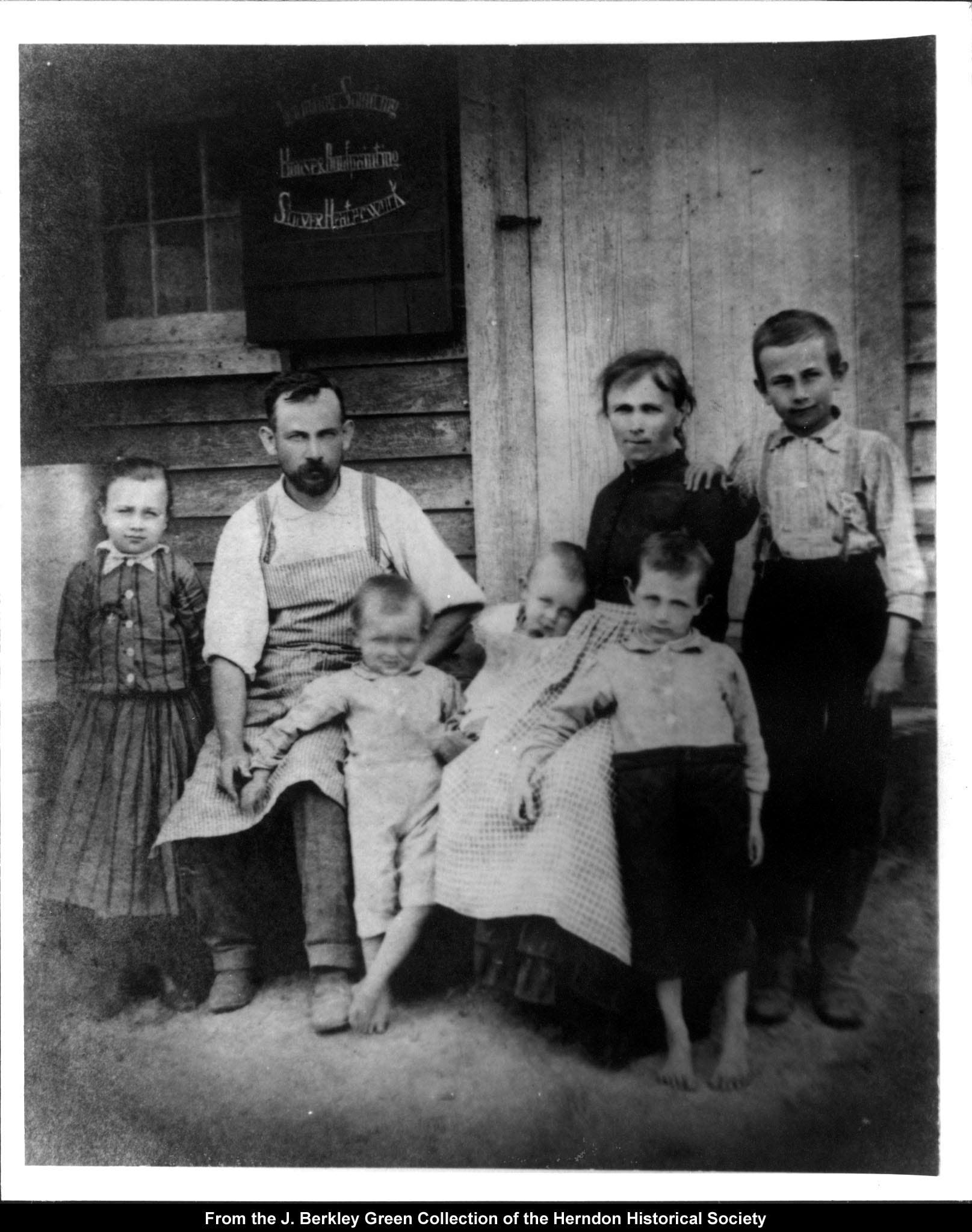
Paul Buchwald and his family in Herndon, circa 1892. Photo from the J. Berkley Green Collection.
By Barbara Glakas
Occasionally I happen upon an old Herndon photograph that captures my imagination and compels me to write a story about it. So it was with the 1892 picture of a town tinsmith, Paul R. Buchwald, and his family.
Find out what's happening in Herndonfor free with the latest updates from Patch.
The picture shows a seated Mr. Buchwald, who looks to be in his thirties, with disheveled hair, donning a workman’s apron. Seated next to him is a woman, presumably his wife, holding a baby. Closely surrounding the parents are five children. There is one girl and four boys, whose ages range from about one to twelve years old. The children’s clothes are simple. Two of the children are barefooted. The photo is obviously posed, all eyes trained on the camera, with a hint of a smile on a couple of the children’s faces.
The family is positioned in front of a building with wood siding, most likely Buchwald’s place of business. Behind them is a door, and next to the door a window with a dark colored hinged shutter. On the inside of the shutter, opened, facing the camera, are some words displayed in three lines. The first line is difficult to read. But the second and third lines appear to say: “House & Roof Painting. Stove & Heaterwork.”
Find out what's happening in Herndonfor free with the latest updates from Patch.
Paul Richard Buchwald was born in Germany in either 1855 or 1856. Buchwald’s first wife was born in Saxony in 1856. Census documents show that he immigrated to the United States in 1888. A caption that came with the family photograph said that Buchwald came from Meissen, Germany, which lies within the state of Saxony. It is unknown why he came to America, but we are aware of some things that were happening in Germany during that time period. The Austro-Prussian War occurred in 1866, which resulted in the Prussians over running Saxony. The Franco-Prussian War occurred in 1870-71. The year 1888 was known as “the year of three emperors” because two of the German emperors – Wilhelm I and Frederick III -- died in rapid succession, leaving Kaiser Wilhelm II in control. Between the 1870s and the 1880s, Germany was experiencing high unemployment, low wages and declining industries. This all resulted in many Germans seeking to go abroad to find a better life, many going to the United States. Some of the immigrants were peasants wanting to own land, while others were rural workers, artisans and shop keepers.
The Buchwald family photograph is dated circa 1892. The caption that came with the photograph said that Paul and Louise Buchwald had children named Louise, Paul Jr., John, Bruno, and Maritz. Unfortunately, no 1890 census documents exist to confirm that caption, due to a fire in Washington D.C. that wiped out all the 1890 census documents.
However, a 1900 census document showed that Buchwald (45) and his wife Emma M. (34) – now a wife of a different name and eleven years his junior -- had five children named Louise (16), Paul Jr. (13), Hans (11), Bruno (10), and Josie Heny (11), who was listed as being adopted. John is likely Hans, a common translation. The census also said that Buchwald and his wife Emma had only been married for five years – since 1895 - with her having no children of her own. Clearly, Buchwald must have had a previous wife, presumably, Louise.
Evidence of Buchwald’s first wife came in his son Bruno’s 1890 baptismal records. Those records from St. John’s Lutheran Church in Springfield, Pennsylvania, named Bruno’s parents as Paul Richard Buchwald and Louise Walther. This confirms that the woman in the 1892 photo was the mother named Louise. Bruno, the youngest, had been born in Pennsylvania but all the other Buchwald children had been born in Germany.
In another marital change, a 1910 census indicated that Buchwald later had yet another wife named Emilie J. Buchwald, two years his junior. They had been married for eight years. Living with them that year were Paul Jr. and Bruno.
Going back to Buchwald’s life in Herndon, by all accounts Buchwald came to the United States in 1888. Just a few years prior, in 1880, Herndon had no tinsmiths living in town. The first advertisement to show up in local newspapers for Buchwald’s tinsmith business in Herndon started appearing in 1892. Buchwald became naturalized in Fairfax County in 1894.
There are many advertisements in various 1892 issues of The Fairfax Herald newspaper in which Buchwald advertised his Herndon business. The first ad appears in February of 1892 in what seems to be a business announcement. Buchwald indicates that he is “prepared to do all kinds of tin and sheet iron work and to guarantee the same.” There were many subsequent ads that year in which he said he also did plumbing and pump work, as well as house and roof painting, and repair work for roofs and tinware.
A tinsmith was a skilled metal worker who fashioned objects out of tin, a malleable metallic material that does not rust. Some commonly produced tin items included plates, cups, candle holders, canteens, lanterns, coffee pots, pails and bowls. Some tools of the trade included shears and snips for cutting sheets of tin, a soldering iron, an anvil, metal punches, and a few hammers.
Tinware was used extensively in Germany the early 1800s. Some of the German immigrants carried those skills into the United States. But as tinware became increasingly mass-produced in factories – as opposed to being made by individual craftsman -- some tinners found additional work repairing gutters and spouts, as well as laying tin roofs.
There were not too many German families in Herndon during this time period. The Leonhardts were one long-time prominent German family in town. Another German, Robert Schneider, and his father, were also present in Herndon in 1900. Not surprisingly, the Schneiders and the Buchwalds ended up being connected in this story.
Schneider was born in Germany in 1852 and immigrated to the United States in 1868. He travelled all over the country. At one point he was living in Honesdale, Pennsylvania, repairing bicycles, with his father living with him. Work was lacking in Pennsylvania so Schneider was thinking about going west to the Washington Territory. But fearing that his father would not do well in that climate, he did not go. Soon after, he read a letter in a German newspaper. In his memoir, Schneider said:
“[I] read the German newspaper, which brought letters from subscribers, advertising different parts of the country. There was one from Mr. Bu[c]hwald, who often wrote of the opportunities in Herndon, Virginia. Father advised me to write to him, which I did. This man asked me to come down and look the country over.
“I went down to see him. He made everything look so rosy, that I fell into the trap. So we moved to Herndon. He was a good talker and a first class tinsmith, having learned his trade in Germany. He advised me to start a tinsmith shop in connection with a hardware store, which I decided to start by this time. This all looked good to me, and thinking him an old resident, who would be an advantage to the business, I made a partnership with him for a year. In this year I found his character was such that he hindered the business instead of being a benefit to it, and after a year I did not renew the partnership, but bought him out with the understanding that he leave the town.
“I hired a tinner and carried the shop in connection with the store and did fairly well.”
By the year 1900 there were four other tinsmiths living Herndon. Schneider went on to be a successful and well-respected businessman, with his hardware store on Lynn Street.
Buchwald, on the other hand, must have moved on, as Schneider suggested. In 1898 there was a newspaper ad which showed that Buchwald had a business in Vienna, doing similar things he did in Herndon: cooking stoves, heating stoves and tinware. He now also dealt in groceries and hardware.
In 1899 Buchwald put a “special notice” in the paper saying he was closing his Vienna business because he had “gotten a position.” In this ad he advertised the sale of all his stock, dwelling and property, and asked anyone who was indebted to him to settle their accounts.
Between the years 1900 and 1930 Buchwald lived in Baltimore, Maryland. It seems clear that the new position he had gotten, which caused him to leave Vienna, was in Baltimore. In 1900 his occupation was “tinner.” In 1910 he was a “tinner and plumber.” In 1920 he was a “plumber and fireman.” By 1930, at the age of 75, he was a widow and was the President of a plumbing company. By then he was living with his son Paul Jr. (who shared his father’s plumbing business), along with his daughter-in-law, Emma, and granddaughter, Eva.
The photograph that started this story shows a man who brought his dreams and skills to America, looking for work, making a living, raising his family, and spending a snapshot of time in Herndon as the town tinsmith.
About this column: “Remembering Herndon’s History” is a regular Herndon Patch feature offering stories and anecdotes about Herndon’s past. The articles are written by members of the Herndon Historical Society. Barbara Glakas is a member. A complete list of “Remembering Herndon’s History” columns is available on the Historical Society website at www.herndonhistoricalsociety.org.
The Herndon Historical Society operates a small museum that focuses on local history. It is housed in the Herndon Depot in downtown Herndon on Lynn Street and is open every Sunday from noon until 3:00. Visit the Society’s website at www.herndonhistoricalsociety.org, and the Historical Society’s Facebook page at https://www.facebook.com/HerndonHistory for more information.
Note: The Historical Society is seeking volunteers to help keep the museum open each Sunday. If you have an interest in local history and would like to help, contact HerndonHistoricalSociety@gmail.com.
Get more local news delivered straight to your inbox. Sign up for free Patch newsletters and alerts.