Main image: The U.S.S. Herndon (DD-638) in 1943. From the Herndon Historical Society.
Story by Barbara Glakas
As many readers already know, the Town of Herndon is named after Commander William Lewis Herndon (1813-1857). An accomplished Navy officer, he was an outstanding explorer and seaman who served with distinction in the Mexican-American War as the commander of the brig U.S.S. Iris. He also led an important expedition which explored a vast uncharted area -- the Valley of the Amazon. But what really sealed his reputation as a naval hero were his actions on the S.S. Central America, a steamship that – while transporting passengers, California gold and mail between Panama and New York - sunk off the Atlantic coast in the midst of a horrendous hurricane in 1857.
Find out what's happening in Herndonfor free with the latest updates from Patch.
It took two days for the ship to sink once the leak was discovered. There were many accounts from survivors in which they described the brave captain’s actions. He remained calm throughout the course of events and worked tirelessly to keep up the spirits of the passengers and crew. He set standards for behavior and order of work, organizing bailing crews, and employing his high level of seafaring knowledge and skills to maintain control of the ship and slow its sinking so that it would stay afloat long enough to get the women and children into the few life boats they had available. He stayed with his ship until the end, perishing in the Atlantic Ocean, along with hundreds of others who were not able to be saved.
After Herndon’s death Navy Lieutenant Matthew Fontaine Maury wrote to the Secretary of the Navy saying that Commander Herndon “showed himself a good example of virtue and patriotism; and never was example more nobly set or beautifully followed.”
Find out what's happening in Herndonfor free with the latest updates from Patch.
In 1857, local villagers decided to name their post office in their new train depot as the Herndon Post Office in honor of the Commander. Twenty two years later, that village would become officially incorporated and named the Town of Herndon.
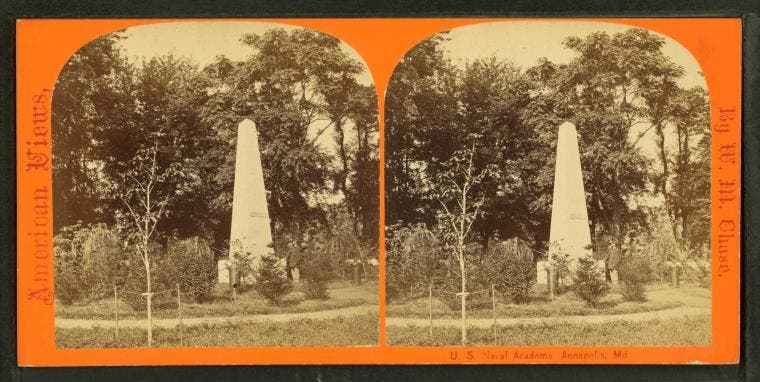
Caption: The Herndon Monument on the grounds of Naval Academy at Annapolis, 1868. Photo by William Chase.
In 1860, the United States Naval Academy unveiled a 21 foot tall grey granite monument on their grounds in Annapolis in the Commander Herndon’s honor. This is the site of the annual Naval Academy “plebes-no-more" tradition where plebes work together to climb the greased monument and place a combination cap on top. The plaque at the base of the monument says:
Commander William Lewis Herndon
1818-1857
Naval Officer - Explorer - Merchant Captain
In command of the Central America, home-bound with California gold
seekers, Captain Herndon lost his life in a gallant effort to save
ship and lives during a cyclone off Hatteras, September 12, 1857.
The Navy also honored Commander Herndon by naming two ships after him. The first ship named the U.S.S. Herndon was a Clemson-class destroyer (DD-198) which was launched in 1919 by the Newport News Shipbuilding and Dry Dock Company. The ship was sponsored by Miss Lucy Taylor Herndon, niece of Commander Herndon. Sponsorship is, by tradition, a ceremonial role in which a female civilian - who is typically selected for her relationship to the ship’s namesake - is invited to the ship’s commissioning ceremony to bestow good luck and protection over the ship and all who sail aboard it.
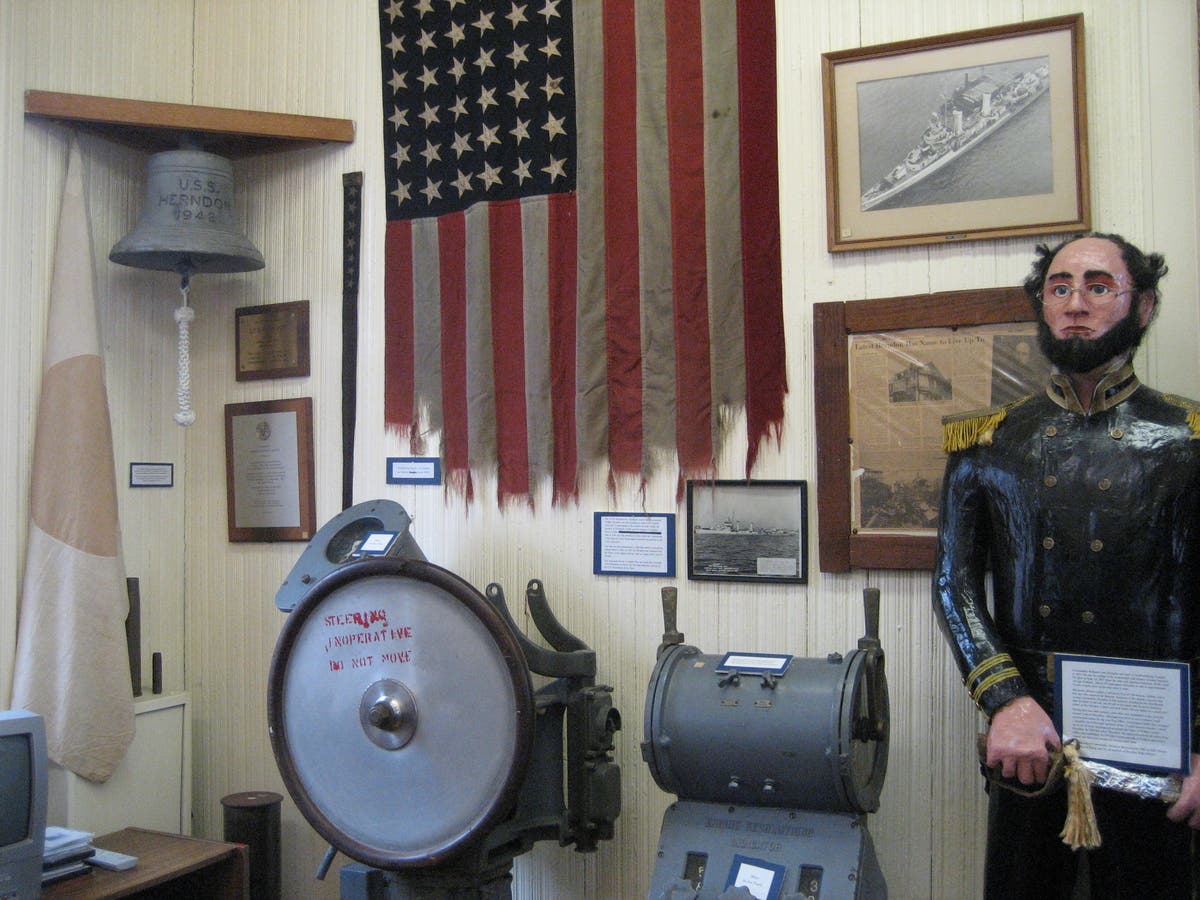
Caption: A display in Herndon's Depot Museum honors Commander Herndon and artifacts from the U.S.S. Herndon (DD-638). Photo by Barbara Glakas.
This ship served in reserve training exercises off the Atlantic coast. In the 1930s it was transferred to the Coast Guard. She was later recommissioned back onto the Navy and operated tactical maneuvers in the Panama Canal Zone. In 1940 she was transferred to the United Kingdom and re-named the HMS Churchill. A few years later she was transferred to the Soviet Union and re-named Deyatelny. She was sunk in action in 1944 in the Barents Sea.
The second United States Navy ship named the U.S.S. Herndon was a Gleaves-class destroyer (DD-638). This ship was launched in 1942 by the Norfolk Navy Yard and was sponsored by Lucy Herndon Crockett, a great-grandniece of Commander Herndon. This second ship had a more storied history, especially for its participation in the World War II’s Normandy invasion.
During the Normandy invasion the Americans were assigned to the Omaha and Utah beaches. The Bay of Seine is the body of water that abuts those beaches. The plan of assault for D-Day called for the destroyers to come in close to the beach via the Bay of Seine for fire support, flanking and protecting the small landing craft that carried the troops. The U.S.S. Herndon was not only part of this joint task force of screening carriers, but it was selected to lead the destroyer division. The ship was dubbed “The Lucky Herndon,” as its sister ships gave her a 1 in 10 chance of surviving this Allied invasion. Before the invasion, sailors aboard the Herndon were told by their commander to write letters home and to “make it a good one,” as it was likely to be their last letter home.
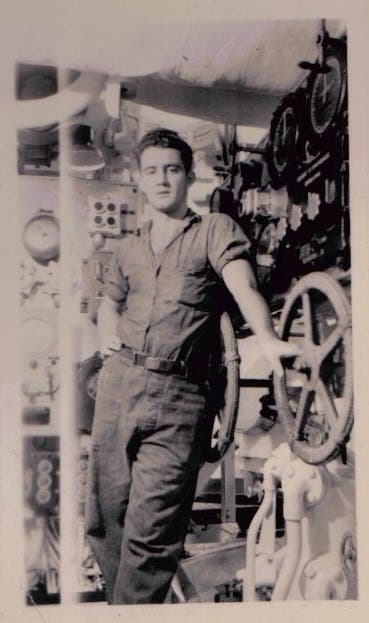
Caption: A sailor on the U.S.S. Herndon in WWII. From the Herndon Historical Society.
Some excerpts from the ship’s anchor log show a brief outline of her early actions on the morning of D-Day:
- In the early hours of D-Day Herndon [actually 2300 hours on June 5, not June 6] approached Channel #1 at 8 knots, darkened and “Condition II.”
- At 0156 hours, they entered the Bay of Seine and anchored.
- At 0331 hours they led the mission to lead warships forward, and then were assigned stations in the Utah Beach fire support areas.
- The Herndon steamed on various courses and at various speeds within the [mine] swept channel.
- Enemy shore batteries began to shell the Allied war ships. At 0547 hours Herndon started firing her main battery to neutralize the enemy targets.
In letters home, sailors aboard the U.S.S. Herndon described what they saw during the invasion. Quotes from various sailors include:
- “Our Air Force was bombing the beach. There must have been 3,000 planes overheard. Boy, they were really letting them have it! But there were planes being hit too, plenty. And swell American boys were dying.”
- “We’ve been tracking our first target, Target #34. Everyone topside can see France. We’ve been expecting the enemy shore batteries to open up on us at any moment.”
- “The beach is so close you can see the houses…. there are ships all over the horizon… they are landing troops on the beach in droves.”
- “When we opened fire, it seemed like a combination of an earthquake and all of the volcanoes in the world erupting at the same time!”
- “We could see our men storming the beach, trying to gain a foothold. Under our naval fire, the troops were enlarging the beachhead. As the Germans reeled back, our shells were landing farther and farther inland.”
The U.S.S. Herndon was at Normandy for about 30 days. Throughout that time she did convoy escort, escorted troop ships in preparation for the invasion in France, engaged in anti-submarine duty, and she provided fire support off the beach of Normandy, screening Allied landings, submarine patrols and aircraft carriers.
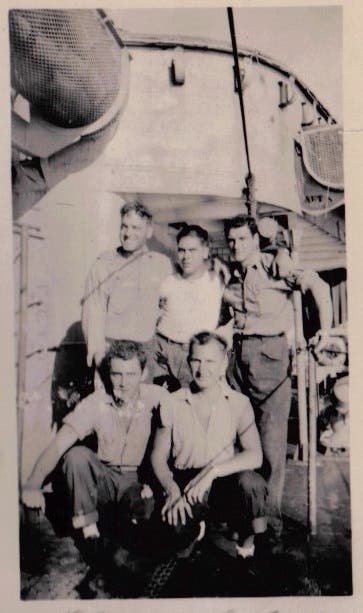
Caption: A group of sailors on the U.S.S. Herndon in WWII. From the Herndon Historical Society.
The Herndon later headed to the Pacific Ocean, reaching Pearl Harbor through the Panama Canal. She escorted convoys between some of the islands in the Pacific.
After Japan surrendered, the U.S.S. Herndon went to China. Japanese Vice Admiral Kanako and his staff came aboard the Herndon to sign surrender documents for all Japanese combatants in that area. Afterwards the Herndon patrolled the China and Korean coasts. She then was assigned to “Operation Magic Carpet” to transfer troops home from the Pacific.
The U.S.S. Herndon was decommissioned in Charleston in 1946 and then entered the Atlantic Reserve fleet. In 1971 she was struck from the naval registry and was sunk as a target off the Florida coast in 1973.
Before its sinking, parts of the ship were saved and put on loan to the Herndon Historical Society by the U.S. Navy in the late 1970s. The Historical Society placed the artifacts on display when their Depot Museum opened on Lynn Street in the early 1980s. Those ship parts – which are still on display today - include the pilot’s wheel, the rudder indicator and the ship’s bell. Additional donated artifacts include flags, photographs, shell casings, muster rolls, and an anchor log.
In an exciting turn of events, the Herndon High School Band was selected to represent the United States at the 75th anniversary of the D-Day events in Normandy, France, in 2019. Each band member will carry a photograph of one of the veterans who served aboard the Herndon as they march in France.
Commander William Lewis Herndon’s legacy of bravery and gallantry has been highly honored in the United States Navy and continues to resonate with great pride in the Town of Herndon.

Caption: Commander Herndon is depicted in the seal of the Town of the Herndon. Photo by Barbara Glakas.
---------------------------------------------------------------
About this column: “Remembering Herndon’s History” is a regular Herndon Patch feature offering stories and anecdotes about Herndon’s past. The articles are written by members of the Herndon Historical Society. Barbara Glakas is a member. A complete list of “Remembering Herndon’s History” columns is available on the Historical Society website at www.herndonhistoricalsociety.org.
The Herndon Historical Society operates a small museum that focuses on local history. It is housed in the Herndon Depot in downtown Herndon on Lynn Street and is open every Sunday from noon until 3:00. Visit the Society’s website at www.herndonhistoricalsociety.org, and the Historical Society’s Facebook page at https://www.facebook.com/HerndonHistory for more information.
Note: The Historical Society is seeking volunteers to help keep the museum open each Sunday. If you have an interest in local history and would like to help, contact HerndonHistoricalSociety@gmail.com.
Get more local news delivered straight to your inbox. Sign up for free Patch newsletters and alerts.