Community Corner
Remembering Herndon's History: The W&OD Railway Strike of 1916
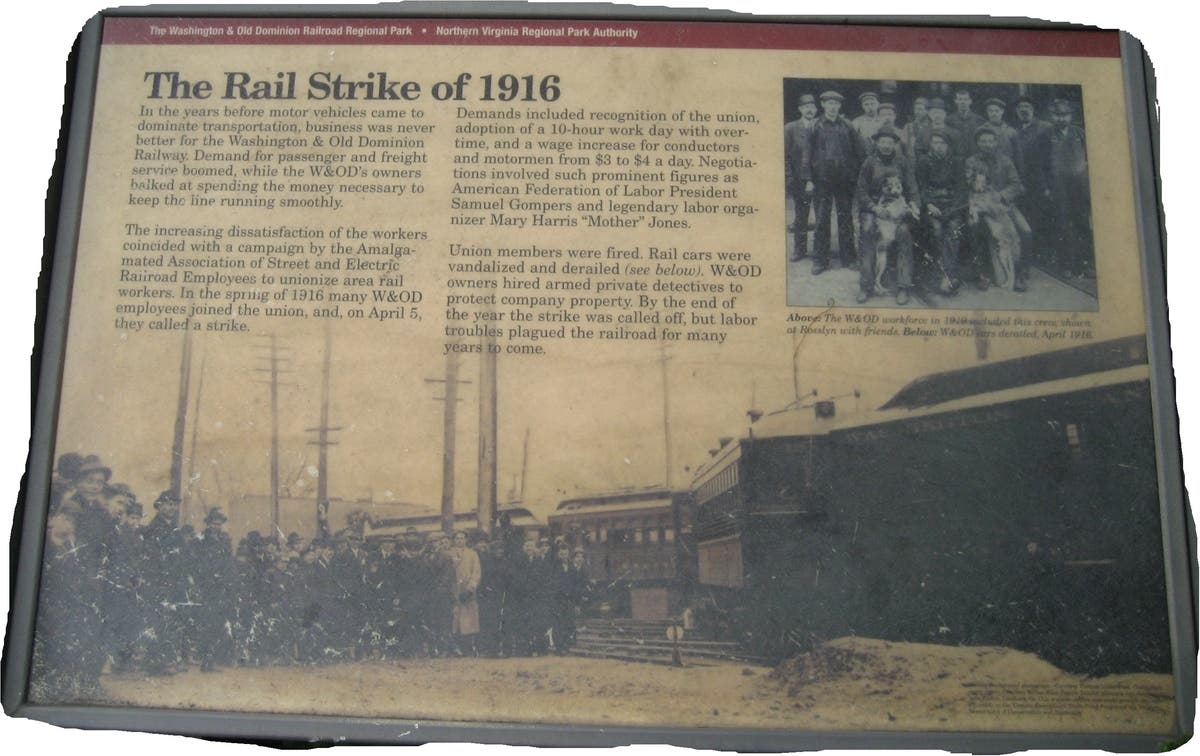
Main image: Northern VA Reg. Park Authority historical marker shows derailed train cars during the 1916 strike


By Barbara Glakas
For a time in the early 1900s the paved path we now know as the Washington and Old Dominion Railroad Regional Park (or hike and bike trail), was known as the Washington & Old Dominion Railway. Wealthy entrepreneurs John McLean and Stephen Elkins formed the new incorporation as a successor to their already acquired Great Falls and Old Dominion Railroad with plans to lease the Bluemont branch of the Southern Railway. The larger section of rail that travelled from Washington, D.C., through Herndon and on to points further west was called the Bluemont Branch, while the separate Great Falls branch was a shorter line that ran just north of the Bluemont branch, connecting Washington to Great Falls. The two lines, however, did not connect. McLean and Elkins started making plans to lease the Bluemont branch, electrify it and connect it to their successful Great Falls Branch.
Although Henry Ford had already been building Model-T cars for three years, and the future implications of automobiles seemed obvious, Elkins and McLean may have anticipated greater development and increased opportunities for rail transportation in the western regions, given that the Herndon and Loudoun areas were hubs of dairy business. Additionally, an electric line would be less expensive than steam and – since their railway would be an independent company that did not use unionized workers – Elkins and McLean could pay lower wages and not be bound by employee work restrictions. They moved ahead with their plans.
Find out what's happening in Herndonfor free with the latest updates from Patch.
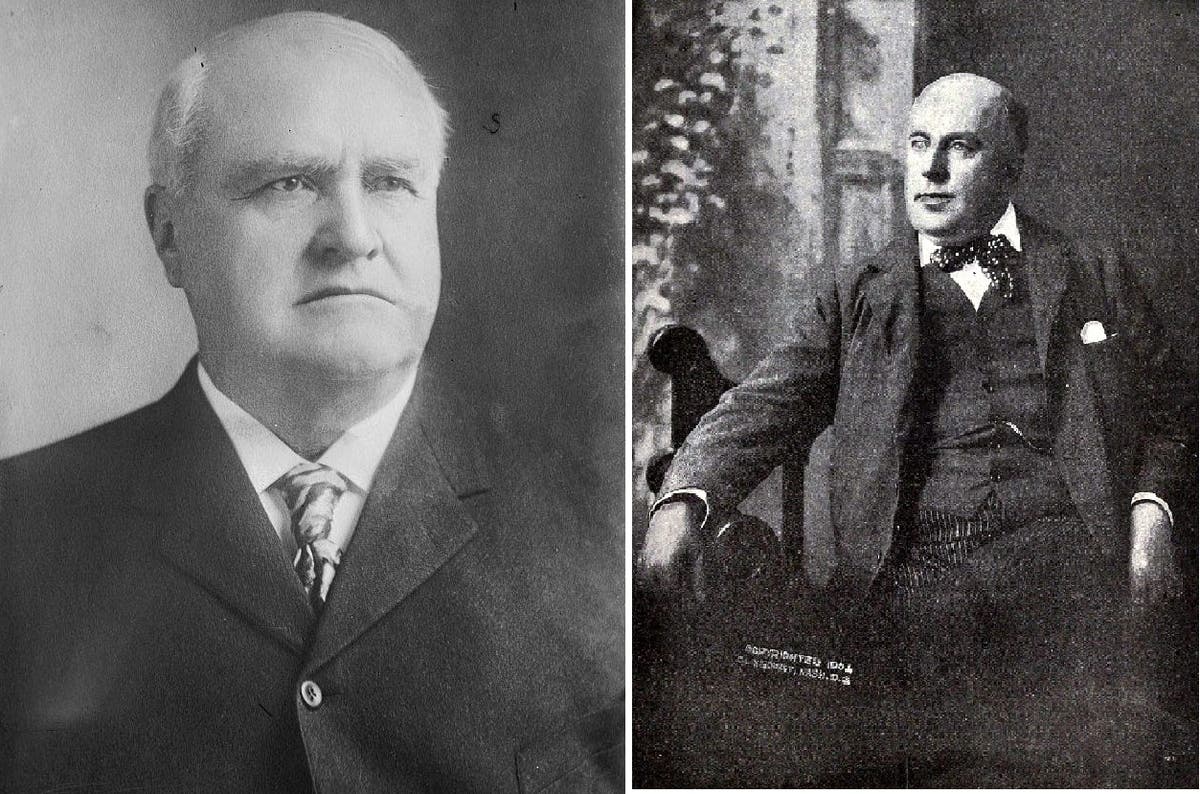
(Stephen B. Elkins and John R. McLean, c. early 1900s. Bain News Service and National Magazine.)
However, in 1911, Mr. Elkins died. His son, Davis Elkins, assumed responsibility for his father’s part of the project. The two families held all the securities and were responsible for all the debt of the railroad. The contract called for a 50-year lease, which had an annual rent starting at $45,000 and gradually increasing to $60,000. The rent proved to be formidable. Electric lines were hung and brick substations were built adjacent to the depot stations at Bluemont Junction, Herndon, Leesburg and Round Hill. The electrified W&OD Railway became an Interurban electric trolley system that carried passengers, mail, milk and freight.
Find out what's happening in Herndonfor free with the latest updates from Patch.
The contract called for a July 1, 1912 takeover date from the Southern Railway. Although the electrification work was done, the electric cars had not arrived by that date. This caused confusion and a disjointed start, necessitating the rental of locomotives and passenger cars, and the need to run on old timetables. Things eventually got organized and service proceeded.
In its first year of operation the company lost about $100,000 and the following year was even worse. By 1913 service was cut back. A trip from Washington to Bluemont now took over two hours with schedules sometimes changing at the spur of the moment. Traditional daily milk runs continued between the freight and passenger runs. Trying to operate a rail line with too much traffic volume and not enough investment money caused great problems. Infrastructure was needed such as signalization, improved tracks and more cars. The trainmen were also equally unprepared, with some trainmen being carefree youths who sometimes operated the cars at high speeds, causing the cars to be overtaxed, with frequent collisions. This caused the scrapping of even more equipment. Equipment problems, in turn, caused more erratic schedules and more financial troubles.

(Rand McNally map of the W&OD Railway, shows Bluemont and Great Falls branches, c. 1920. ‘Rails to the Blue Ridge,’ by H. Harwood.)
According to Herbert H. Harwood Jr., in his book Rails to the Blue Ridge, in 1912, the Farmers Club of Loudoun County complained that, “some of the cars have taken as long as eight hours to make the trip from Washington to Leesburg in the past week.”
It was reported that another commuter in 1915, “claimed to have counted 300 people crammed into the… terminal at 5:00 one afternoon…and noted that the cars were leaving so crowded that the motormen could barely operate them.”
In 1916, a dissatisfied commuter who wrote to the Interstate Commerce Commission said that he had, “waited 40 minutes for an inbound train, only to watch it whiz by him with people not only hanging onto the steps but standing on the coupling of the car.”
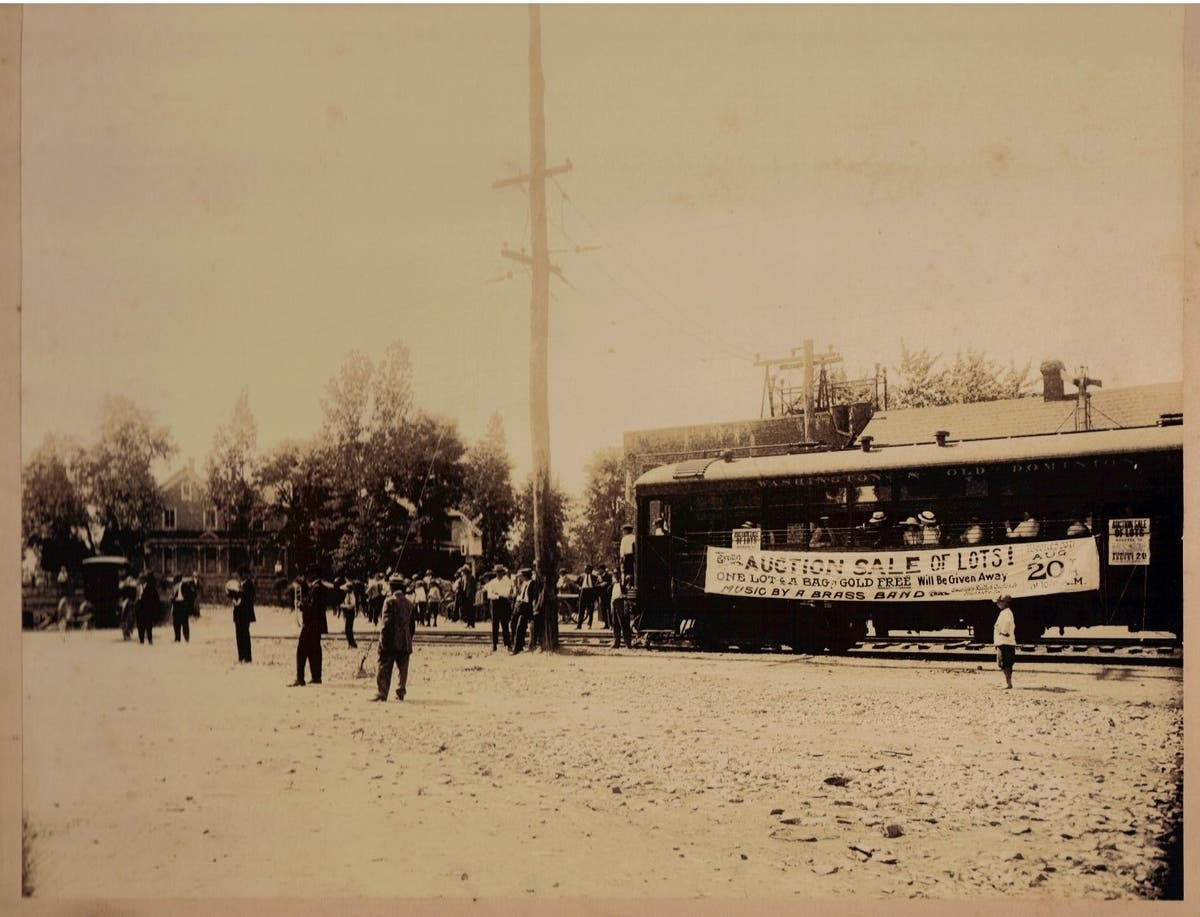
(A W&OD Railway passenger car parked by the Herndon depot, c. 1912-1920. The Buell Family Photo Collection.)
Also in 1916, evening passengers were startled by gun-toting trainmen who exercised their love of sport, taking pot shots out of train windows at rabbits that hopped out of bushes into the view of train headlights.
It became obvious that the W&OD was a complicated new rail operation for which the owners may not have been fully prepared. The owners were reluctant to spend the money necessary to keep the line running smoothly. Despite the thriving market, there was not enough time for preparation or training, and this was complicated by inadequate funding. Previous experienced workers were replaced by low-wage and overworked employees.
Significant efforts were made to increase the flow of summer traffic to the Blue Ridge Mountains, with publications advertising the scenic views and all the hotels and boarding houses along the way. However, making the situation worse, Mr. McLean died in 1916 and his share of ownership was placed into his estate, leaving it in the hands of disinterested heirs and estate lawyers who were unwilling to support the financially troubled railway. Therefore, investment money for railway improvements was not forthcoming.
Maintenance money was cut back severely. The electric system often broke down. Night trains sometimes ran without headlights. Many of the electric cars were either out of service or in poor condition. Maintenance shop employees were cut back.
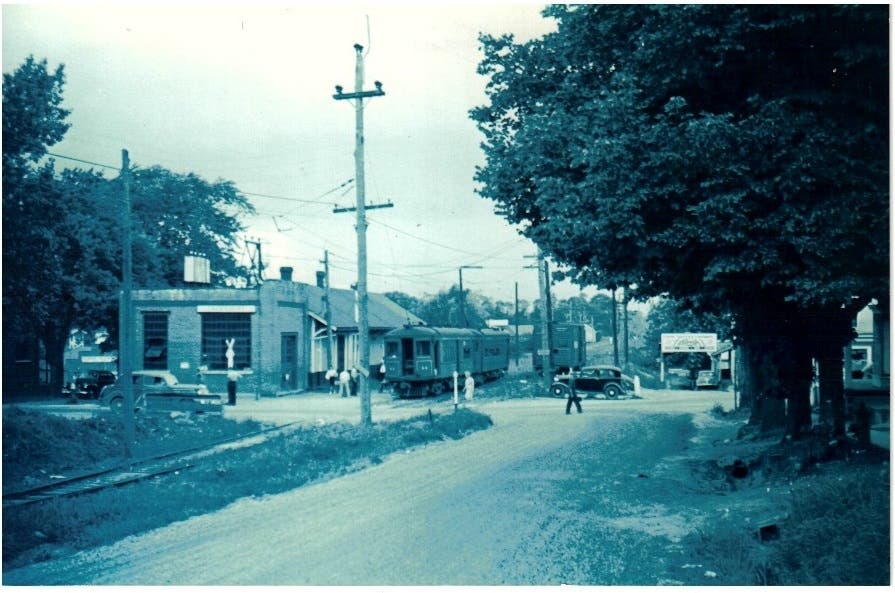
(An electric passenger car arrives in Herndon, 1940. The brick electric substation can be seen next to the Depot. The Herndon Historical Society.)
To no one’s surprise, worker dissatisfaction and labor relations also worsened. The W&OD Railway was an independent line it had not originally unionized. However, in 1916 approximately 150 employees finally joined the Amalgamated Association of Street and Electric Railway Employees. At issue were disputes over working conditions, wages and hours. Amongst other things, the workers demanded a 10-hour work day, wage increases for conductors, motormen, dispatchers, trolley men, as well as shop and barn men. They also requested regular overtime pay for “regular men,” seniority rights in choosing runs, and two days off each month and 10 days annual leave with pay for dispatchers.
The Amalgamated Association was formed in 1892 operating mostly in the eastern United States. Samuel Gompers, President of the American Federation of Labor, invited local street railway associations to form an international union, in order to have the ability to settle disputes and secure good pay and working conditions. The international union would have significant authority over local unions.
Despite efforts of the Amalgamated Association to arbitrate disputes, a 1916 strike ensued amongst the W&OD Railway workers. Trains continued to run during the daytime amid intense negotiations and accusations, while riots and damage to equipment occurred. Union members wound up fired. Workers retaliated by vandalizing and derailing cars. The W&OD owners hired 30 armed private detectives to protect company property.
The American Federation of Labor withdrew its support while newspapers reported it had “washed its hands of the whole business.” The union denounced the actions of the striking employees for breaking the compact for arbitration. President Gompers called on the employees to call off the strike, but the employees did not immediately comply.
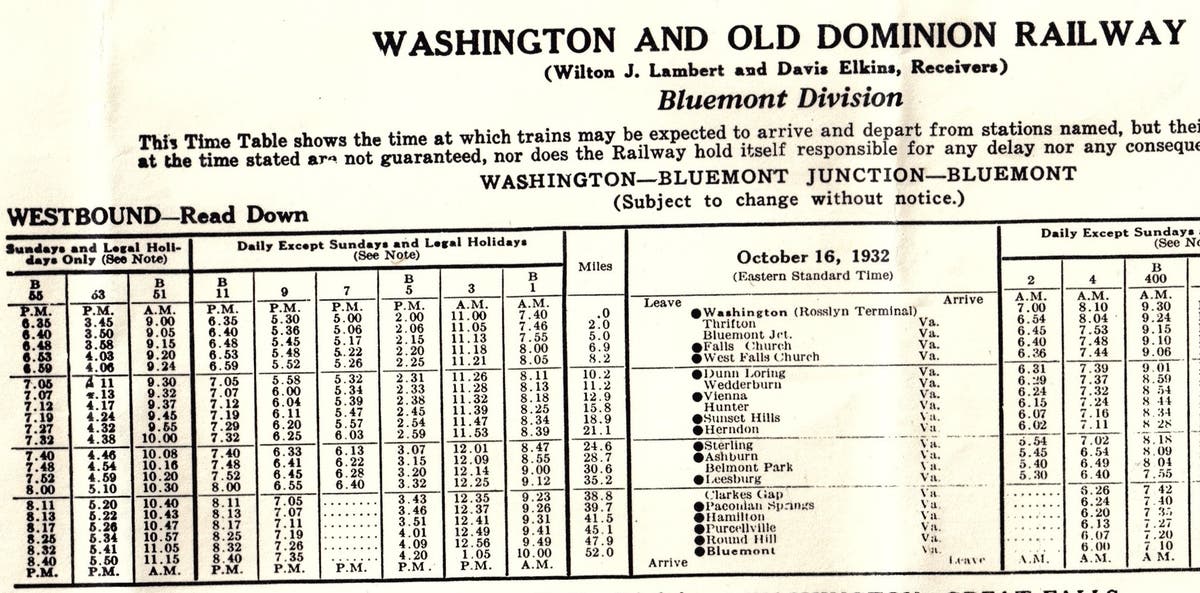
(An excerpt from a W&OD Railway time table, 1932. The Herndon Historical Society)
By the end of 1916 the strike was called off. But labor troubles continued for many years. There was a series of lawsuits, investigations and hearings before the Virginia Corporation Commission which lasted for years. After the initial investigation in 1918, the Commission concluded that,
“Because of insufficient labor and material, insufficient equipment and inadequate motive power, the Washington & Old Dominion Railway does not, and under existing conditions cannot, give the public a reasonably safe, adequate and dependable service.”
The railway company was reprimanded and ordered to improve its tracks, electrical system and add cars. However, the owners paid little attention, despite continued complaints and orders. The W&OD Railway continued to carry many passengers each year at inexpensive rates, with no deaths or serious injuries occurring to any of its passengers. Although deficits continued, passenger service continued to be enthusiastic. In 1919 the railroad posted its highest income yet.
By the early 1930s during the Great Depression, the railway went into bankruptcy and was placed in receivership.
-----------------------------------------------------------------
About this column: “Remembering Herndon’s History” is a regular Herndon Patch feature offering stories and anecdotes about Herndon’s past. The articles are written by members of the Herndon Historical Society. Barbara Glakas is a member. A complete list of “Remembering Herndon’s History” columns is available on the Historical Society website at www.herndonhistoricalsociety.org.
The Herndon Historical Society operates a small museum that focuses on local history. It is housed in the Herndon Depot in downtown Herndon on Lynn Street and is open every Sunday from noon until 3:00. Visit the Society’s website at www.herndonhistoricalsociety.org, and the Historical Society’s Facebook page at https://www.facebook.com/HerndonHistory for more information.
Note: The Historical Society is seeking volunteers to help keep the museum open each Sunday. If you have an interest in local history and would like to help, contact HerndonHistoricalSociety@gmail.com.
Get more local news delivered straight to your inbox. Sign up for free Patch newsletters and alerts.