Community Corner
Remembering Herndon's History: When Was The Herndon Depot Built?
Barbara Glakas of the Herndon Historical Society traces the origin of one of the town's most iconic buildings.


By Barbara Glakas
Sometimes history needs to be re-written. By that we do not mean that we should just “re-write” history for the sake of making it say something we want Instead, we sometimes find it necessary to re-write — or update — history when we become aware of new information. And that is the case with the construction date of the Herndon Depot (also sometimes referred to as the Herndon train depot, train station or station house).
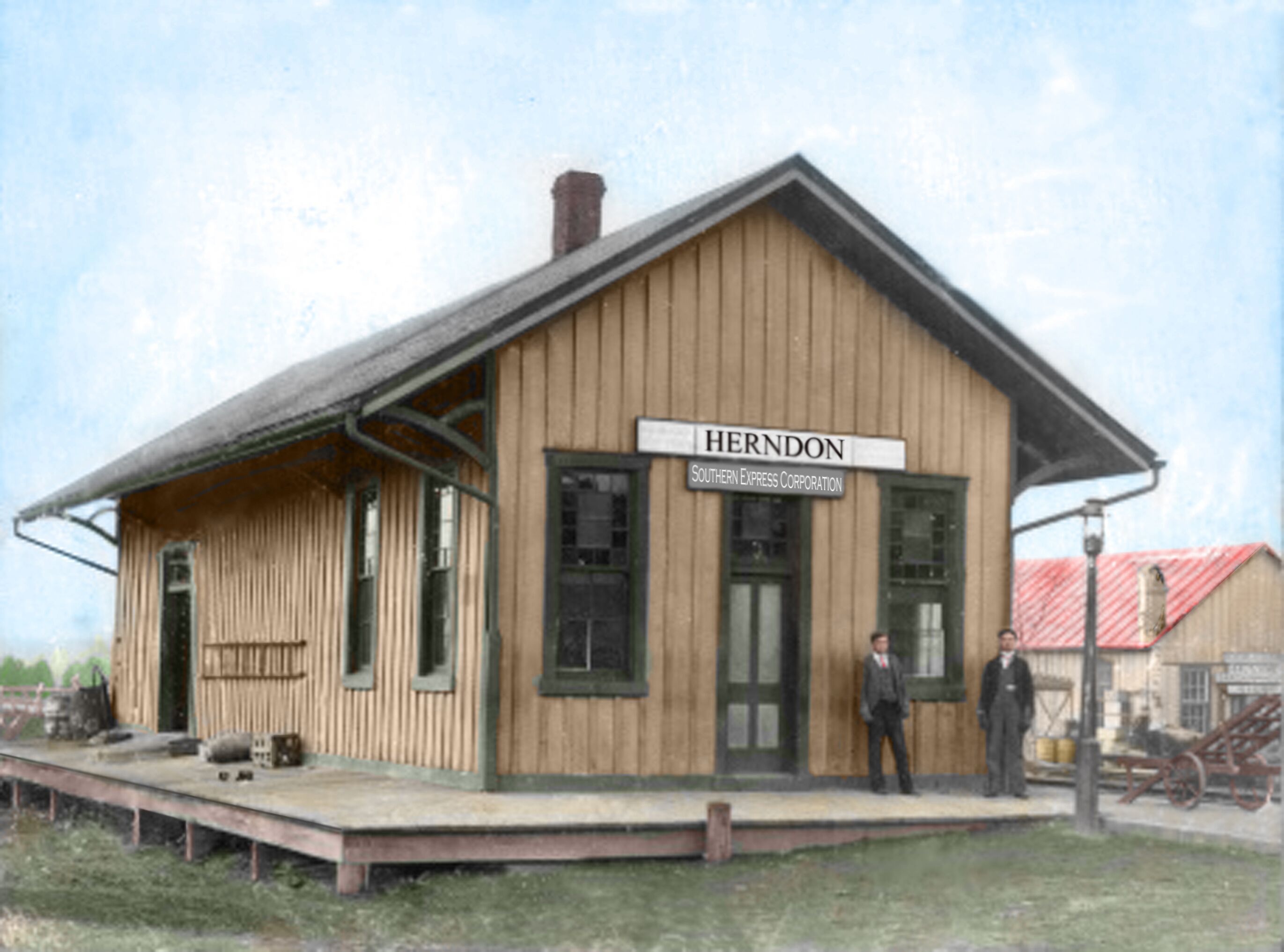
For many years, we believed that the Herndon Depot was constructed in circa 1857. However, based on new information that we have recently discovered, we now know that it was built either in late 1859 or in 1860.
Find out what's happening in Herndonfor free with the latest updates from Patch.
Why did we formerly believe it was built in 1857? One reason may be that a National Registry of Historic Places (NRHP) nomination application for the Herndon Depot written in 1979 said it was built in 1857. The application was submitted by a historic preservation planner in the Fairfax County Comprehensive Planning office. We are not sure how that date was derived, and we accept that she may not have been the person who wrote the text of the application. And although she had footnotes for some parts of the text in the application, the part of the text that said “1857” had no citations.
Maybe she used some other sources. Or maybe she — or the application writer — was making educated guesses. Regardless, she was close, and the year 1857 was the year that ended up being embossed on a plaque that hangs on the side of the depot and written in Herndon Historical Society literature.
Find out what's happening in Herndonfor free with the latest updates from Patch.
We also had a firsthand account from Catherine “Kitty” Kitchen Hanna (1830-1907), who was living in the Reston area (then called Thornton or Thorntonville) when she was first a newlywed. Soon after moving to Herndon, living at different times in homes on Monroe and Elden streets, she said:
“While we were living there [in Thorntonville], the railroad was commencing to come through the woods, leastways, it begun to come through in ’55, but didn’t entirely come through till the spring of ’56, an’ it was a long time gettin’ thro’ the cut at Thorntonville.”
Although she did not mention a construction date of the Herndon Depot, it may have been logical for some to assume that an 1857 depot construction date could have been conceivable if the railroad cut was being built through the Reston area in 1856.
Despite the 1979 NRHP application, which stated 1857 as the depot construction date, we also found a Historic Buildings Survey that was conducted on the Herndon Depot in 1977. Again, it was recorded by someone else who was a comprehensive planner for Fairfax County. This survey dated the depot to have been constructed in “circa 1861.”
There was also another NRHP nomination application dated 1991 when the entire Town of Herndon historic district was being nominated for the NRHP. In its narrative, the text of that application said: “By 1859 the line had extended twenty-seven miles to the settlement that would later be known as Herndon and a small board-and-batten frame depot was constructed.” It did not explicitly say that depot was built in 1859 but it could be read that way. That statement did have a citation; it cited Herbert H. Harwood’s book, “Rails to the Blue Ridge, The Washington and Old Dominion Railroad, 1847-1968.”
The Herndon Historical Society has a copy of Harwood’s book and after reading it we discovered that the book says nothing about our depot being constructed in 1859. What it did say was that by August of 1859 the railroad company was running limited passenger and freight service as far as the Vienna station.
Clearly, there was some confusion, or lack of clarity or documentation, as to the exact construction date of the Herndon Depot.
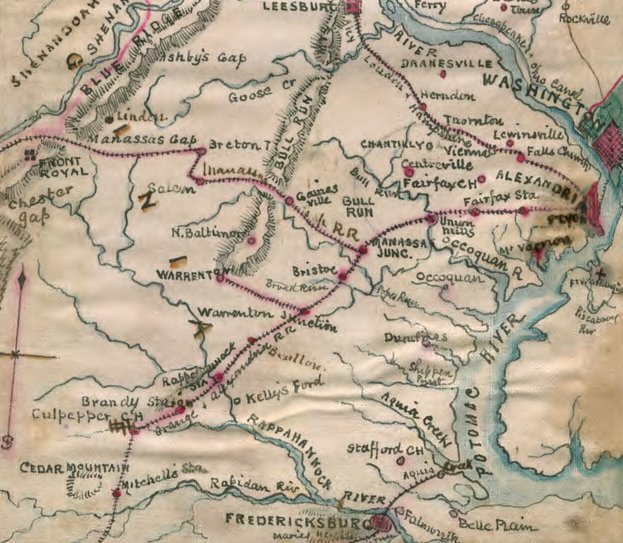
The railroad company that we are referring to is the Alexandria, Loudoun and Hampshire (AL&H) Railroad Company. The name of the railroad that ran through the town of Herndon changed names several times over the years. The name in the 1850s and 1860s was the AL&H, and the final name – from the 1930s until it closed in 1968 - was the Washington and Old Dominion Railroad (W&OD).
Hardwood’s book said by Jan. 16, 1860, regular daily roundtrips were started to Farmwell (now known as Ashburn). A timetable that the AL&H published — which was included in Harwood’s book — said that the train schedule would take effect “on or after January 16, 1860.” The timetable listed the following stops: Alexandria, Old Factory, Arlington Mills, Carlinville, Falls Church, Vienna, Hunter’s Mill, Thornton, Herndon, Guilford (now Sterling) and Farmwell. But did the schedule actually start on January 16? Or did it start later?
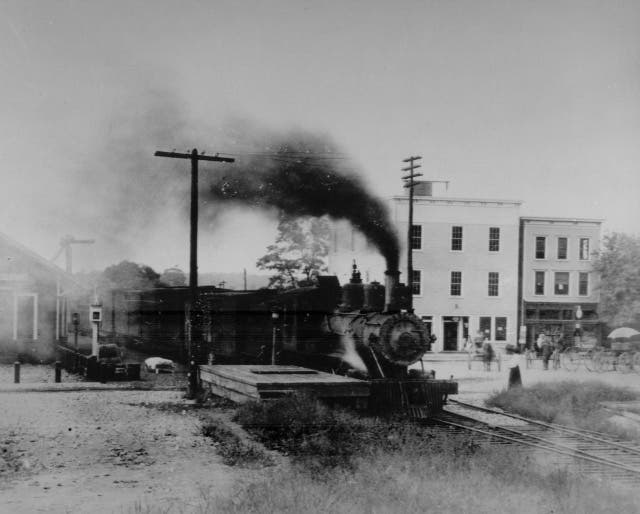
Hardwood also had an appendix page in the back of his book that was titled “Chronology.” It said this about the AL&H: “Opened to Vienna, August 1859. Opened to Leesburg, May 17, 1860.” If his information is correct then that means the railroad was running through Herndon and out to Leesburg in May of 1860, not in January of 1860.
Old railroad company documents that would have shown details of the construction of the railroad and its depots are hard to come by and some Washington and Old Dominion Railroad (W&OD) historians say, to their knowledge, such documents are non-existent. But we recently found a few old Annual Reports of the Board of Directors of the AL&H Railroad Company that range from 1853 to 1860. These included engineer reports. These documents were obtained at the Library of Virginia in Richmond, Virginia, by Herndon Historical Society member, Chuck Mauro.
In a close reading of some of those found reports from Nov. 20 and Oct. 1 of 1860, we essentially confirmed that passenger and freight had been carried on the rails since January 1860 and mail service started out to Leesburg in May 1860. The first half of the year the rail was being operated by the railroad contractor, Mr. Miller, likely only going out as far as Farmwell. On May 21, 1860, the administration of the railroad was handed over to the General Superintendent, Mr. Blythe, and then the trains started going out to Leesburg.
We also discovered a Virginia General Assembly Board of Public Works document from 1859. Within that document is an AL&H engineer’s report dated November 1, 1859.
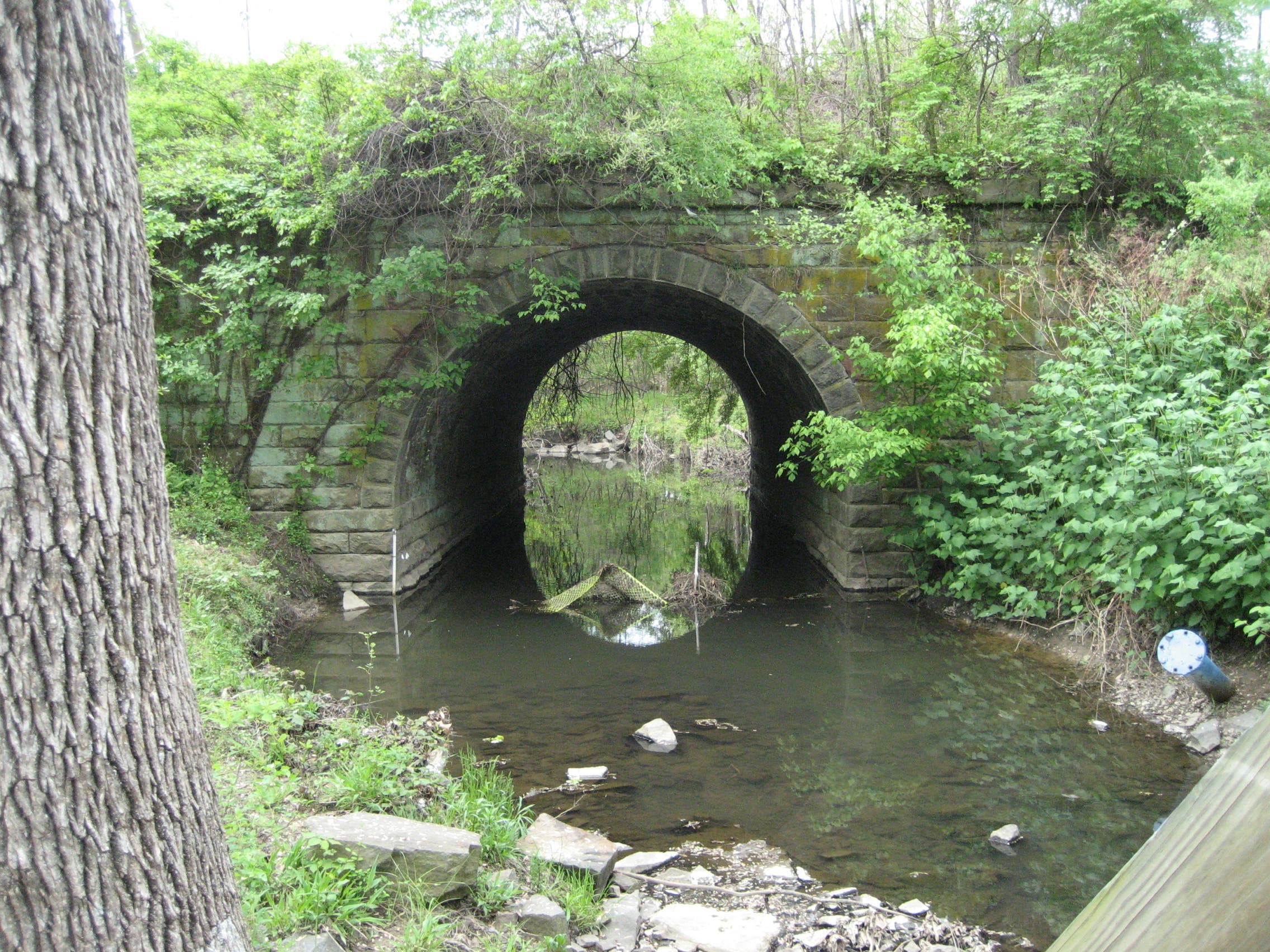
The engineer in charge of the first division (or east half) of the railroad was named Mr. Randolph. The first division of the railroad stretched from Alexandria to west of Herndon. The division was divided up into “sections.” The Herndon Depot is identified as Section 23. In his
report dated November 1, 1859, he said:
“The rails are now laid over the whole of the division, with the exception of the sidings at Lewis Johnston’s, at the beginning of section 17, and at Herndon, Section 23.”
This confirms that that railroad track had been laid in Herndon by November 1859, but was still missing its siding, a second short piece of track that ran parallel to the main track where locomotives could pull off to the side in order to allow other trains to pass.
Further in the report, Randolph said that the Falls Church depot was complete and the Vienna depot was “nearly finished.” There was no mention of the Herndon Depot (at Section 23) being completed yet.
A man named Bowie was the engineer for the second division (western half) of the railroad. He reported on Nov. 5, 1859, the progress in his division, saying that sections 25, 26, 34, 38, 39, and 40 were done, and how sections 30, 31 and 33 needed to be re-done. He also reported:
“Nothing as yet has been done to the depots on this division farther than to select the sites, viz, Van Buren, Section 26; a station near the Old Church Road, on the land of the late Dr. George Lee, section 30; and the depot at Leesburg, section 36.”
Again, Bowie’s division was west of Herndon, so this information did not report on Herndon’s section 23, however, it gave an overall picture of how the various depot buildings along the railroad were still a work in progress.
Going back to Mr. Randolph, the first division engineer … on Nov. 7, 1859, he submitted an addendum to his report that included a page entitled, “Building, Shops and Fixtures.” His list of buildings indicated that there were three completed passenger houses/freight depots, one of them made of brick/stone and two made of wood. They were not named on the chart. But the main station house in Alexandria was known to be made of brick. And the other two station houses that he previously reported as being completed or “nearly finished” were those in Vienna and Falls Church. We know that the depot in Vienna was made of wood because it still exists
today in the Town of Vienna.
Does that mean that our depot was built after November of 1859 but prior to Jan. 16, 1860, when train regular trips had supposedly started? We surmise that it is possible that if the Herndon Depot had still not been completed by January of 1860 when the trains were running, the station master could have possibly used some other nearby temporary shelter or building in Herndon to take tickets until the depot was built, but we just don’t know that for sure.
Recently we obtained another report dated Oct. 31, 1860. This was a report that the president of the AL&H Railroad Company presented to the stockholders. In this report, he stated that since the last annual meeting [in November 1859]:
“Depot buildings have been erected at Herndon, Guilford, Farmwell and Leesburg stations.”
An engineer’s report dated Oct 30, 1860, was also included in this document. In his report, the engineer stated:
“My attention has been principally occupied in designing the buildings, turntables, bridges, etc. for the road as far as Leesburg – all of which are completed.”
He went on to list all the buildings that had been completed at the bottom of the page and one of the completed buildings listed was, “At Herndon, a passenger and freight house, 20 by 55 feet.”

In an addendum report dated November 20, 1860, it was also noted in a “Buildings” chart that one brick/stone freight depot had been constructed as well as five wooden ones; and there was one brick/stone passenger house and six wooden ones.
The president also made some comments in his October 1860 report that may explain when the trains started running:
“The board, deeming it desirable to commence the running of the trains upon the completion of the track to Farmwell (31 miles), in connection with the line of coaches then carrying mails to Winchester, made an arrangement for the purpose with S.G. Miller, the contractor for building the road, to continue until the track should be laid to Leesburg – allowing him one-half of the gross earnings in full of all expenses. This arrangement terminated on the 19 th of May last, and on the 21 st the road was put in charge of the general superintendent, Mr. Blythe, since when the trains have been run with perfect regularity and without accident. … The report of the terminal superintendent, herewith submitted shows that from January 16th to May [?] th , the receipts from transportation of passengers, freight and mails, was $3,422.95; and from May 21st to 30th
September, $9,805.97.”
We interpret this to mean that the trains did indeed start running at least by January of 1860 – and possibly on a limited schedule for a few months prior to that — under the supervision of the contractor, allowing mail to be transported, at least to Farmwell. Then, by May of 1860, the railroad was put under the supervision of the AL&H general superintendent, and the trains started running on a regular schedule out to Leesburg.
To recap, this is what we do know: The Herndon Depot had not yet been built in November 1859. But it had been built by October 1860. Limited runs of the train may have started in late 1859, but a regular schedule out to Farmwell appeared to start in January of 1860, with trains running out to Leesburg starting in May 1860.
Could the Herndon Depot have been built in two months’ time between November 1859 and January 1860? At least one railroad historian says yes, it is possible. But we don’t know how probable. We believe that it was more likely that the depot may have been built by May of 1860. But we may never know for sure if our depot was built in late 1859 or in early 1860. One thing we do know for sure is that it was not built in 1857. As for now, we will stick with a construction date of “c. 1860.”
About this column: “Remembering Herndon’s History” is a regular Herndon Patch feature offering stories and anecdotes about Herndon’s past. The articles are written by members of the Herndon Historical Society. Barbara Glakas is a member. A complete list of “Remembering
Herndon’s History” columns is available on the Historical Society website at www.herndonhistoricalsociety.org.
The Herndon Historical Society operates a small museum that focuses on local history. It is housed in the Herndon Depot in downtown Herndon on Lynn Street and is open every Sunday. from 12-3 p.m. Visit the Society’s website at www.herndonhistoricalsociety.org, and the Historical Society’s Facebook page at https://www.facebook.com/HerndonHistory for more information.
Note: The Historical Society is seeking volunteers to help keep the museum open each Sunday. If you have an interest in local history and would like to help, contact HerndonHistoricalSociety@gmail.com
Get more local news delivered straight to your inbox. Sign up for free Patch newsletters and alerts.