Community Corner
Remembering Herndon's History: 'Whistling' Story Reprinted From 1886
Barbara Glakas of the Herndon Historical Society shares a story by an unknown author published in 1886 in "The Weekly Comet."


By Barbara Glakas
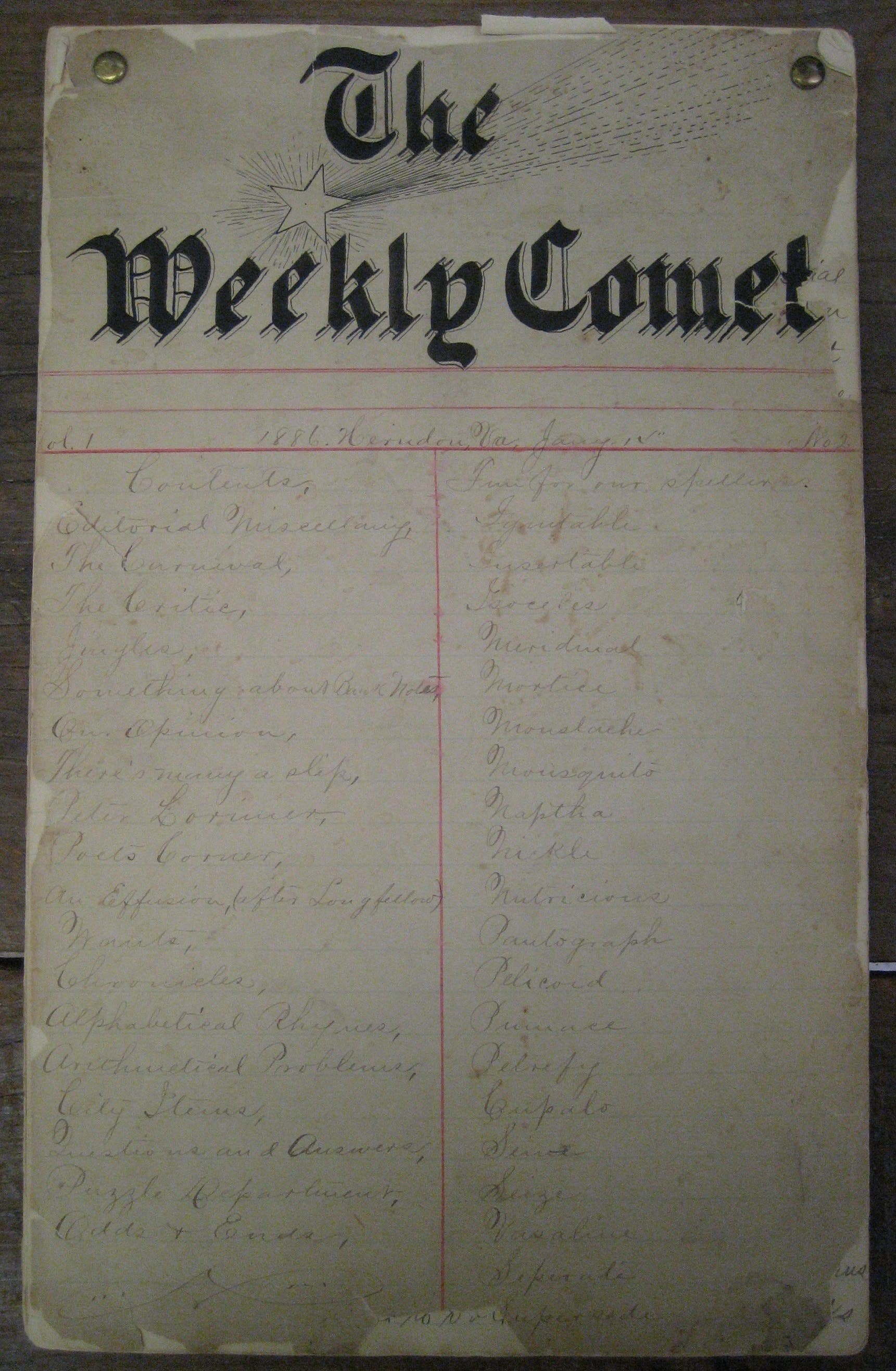
What we are sharing today is a story written in an 1886 edition of an old Herndon newspaper called “The Weekly Comet.” The Herndon Historical Society has a few original copies of these fragile hand written newspapers in its Herndon Depot Museum. The newspapers include editorials, national news, stories, poems, puzzles and word games.
One story in this 1886 issue captured our imagination. It was a tale of a conversation held between a boy and a group of men who happened upon each other inside a Herndon store. Not only did we enjoy the light humor in the story, but we imagined ourselves standing in an old Herndon store in the 1880s, putting ourselves in this time period when Herndon was predominantly a small, country, dairy farming community, and when only about 600 people lived in town.
Find out what's happening in Herndonfor free with the latest updates from Patch.
What store were they in? That is not known for sure. The story mentions buying molasses in the store. We know that the Herndon depot once housed a small store that sold molasses. We also know that the Nachman building on Lynn Street — that now houses the Green Lizard Cycling shop — was once the home of a grocery store called Hindle’s Store, run by William I. Robey. Next door on Lynn Street, Benjamin Mankin also used to run another general store.
The graveyard mentioned in the story was likely Chestnut Grove Cemetery, which was the only public cemetery in town, established in the 1870s.
Find out what's happening in Herndonfor free with the latest updates from Patch.
Published below is the full story from the 1886 newspaper, entitled “Whistling,” signed by the author who used a pseudonym, “Mummy.”
Whistling
We got to talking about whistling, down at the store the other day. I think little Dick Benton started it. He is always whistling, and while he was waiting for his molasses, he trilled away till he disturbed old Mr. Crankifer, who sat with his feet on top of the stove, reading “The Weekly Comet.”
“Shut up, can’t ye, boy?” he growled. “How’s any buddy goin’ to read or anything else in such a rackit?”
Little Dick subsided, but Charley Parker - who had come in for matches, and who was courting Dick’s sister – spoke up. “Let the boy whistle, Mr. Crankifer. You can’t expect to find quiet and seclusion in a place like this.”
“But they hasn’t no sense to it,” snarls Crankifer.
“Just what Grandma said last week,” says little Dick, gaining courage, “but she changed her mind about it fore night.”
“How was that?” asked Charley.
“Why I was whistling ‘round, an she said she bleeved I’d whistle the top of her head off, and there wasn’t any sense to it. I’d just got to stop it.”
“Sensible old lady,” interrupted Crankifer.
“Well, I always do the milkin,” continued Dick, “but that night she sent me on an errand, an’ said she’d milk old Cherry herself. When I got back, I found her in a heck o’trouble. Old Cherry had a sore teat, and wouldn’t give down her milk, and she ain’t used to Grandma, so she got kinder nervous. Grandma was frettin’ away and couldn’t do a thing. I just took she bucket an sat down an began whistlin’ ‘Yankee Doodle,’ milkin in time. Old Cherry held up a little, but I kep’ on whistlin’, and presently she got good tempered again, and I got my bucket full of o’ milk. Grandma, she says, ‘Hm, it’s funny that the very thing that riles me, should be so soothing to that cow.’ But she ain’t said a word against my whistling since then.”
Two or three had come in while Dick was speaking, and stepped in to listen.
“That don’t prove nothin’,” said Crankifer. “Something else would have calmed the cow. I say yet, there ain’t no good in whistling.”
“Well, I say there is,” this with much decision from Ab Wilcox, one of the last comers. “You know I uster cuss a spell ago; came just as nachall as breathin,’” says she. “When you want to cuss, just whistle. I can’t bear to have the children grow up to usin’ such words,” says she, and she talked so kinder, pleadin’ like I just promist to try it. “Well, there was whistlin’ round that house the next few days, you kin bet. You’d a thought a steam engine had broke loose, but I kep’ it up, and it cured me. I ain’t sed a cuss word I don’t know when, though I’m pretty liable to do some tall whistlin’ now and then.”
“Me too,” chimed in Sam Gates. “I used to go to see a girl who lived just the other side of the grave yard, and the only possible way I could manage to come back past that grave yard at two or three o’clock at night, was to shut the eye on that side tight, and whistle for all I was worth. That took me past all right.”
“Well, did you marry the girl?” demanded old Crankifer.
“What the mischief does that got to do with the whistling question?” demanded Sam in his turn.
“That’s just what we want to know; was it the case of ‘Whistle and I’ll come to you lad?’” said a new voice gaily, as our lawyer joined in the group. “Whistling?” he continued. “Why whistling is one of the fine arts. What does Shakespeare say – “
‘The man that hath no music in himself,
Nor is no moved with concord of sweet sounds,
Is fit for treasons, stratagems and spoils.’
Here old Crankifer broke in. “But he specifically says sweet sounds.”
“My dear sir,” answered our lawyer. “Some of the sweetest sounds I have ever heard have been whistling sounds. I have heard a whistling chorus, that made the most delightful music imaginable. I have heard a lady whistle an air so sweetly that it seemed as if she must literally have a nightingale in her throat and enchant a crowded concert hall with her flute like melody.”
“Whistlin’ girls are crownin’ hens,” again interrupted the irrepressible Crankifer.
“But this girl whistled to a pretty good end,” said our lawyer quickly, “for she whistled to the tune of more money in one evening than most of us see in a year.”
“Whistlers are apt to be pretty good-tempered fellows,” said Sam with a rather meaning glance at the old Crankifers surly face.”
“And pretty healthy, it’s good for the lungs you know,” said Charley, who is studying medicine, “you see the deep inhalations.”
But at this point old Crankifer rose in disgust, and stalked out the door. Little Dick Benton grasped his molasses jug and trotted after, saying something about ‘grandmother’ and ‘gingerbread.’ Our lawyer was called out by somebody, and the meeting dissolved.
Mummy
About this column: “Remembering Herndon’s History” is a regular Herndon Patch feature offering stories and anecdotes about Herndon’s past. The articles are written by members of the Herndon Historical Society. Barbara Glakas is a member. A complete list of “Remembering Herndon’s History” columns is available on the Historical Society website at www.herndonhistoricalsociety.org.
The Herndon Historical Society operates a small museum that focuses on local history. It is housed in the Herndon Depot in downtown Herndon on Lynn Street and is open every Sunday from noon until 3:00. Visit the Society’s website at www.herndonhistoricalsociety.org, and the Historical Society’s Facebook page at https://www.facebook.com/HerndonHistory for more information.
Note: The Historical Society is seeking volunteers to help keep the museum open each Sunday. If you have an interest in local history and would like to help, contact HerndonHistoricalSociety@gmail.com.
Get more local news delivered straight to your inbox. Sign up for free Patch newsletters and alerts.