Community Corner
Steeplechase: Sport Horses Do Their Best in Six Races at Morven Park
Beautiful October weather lures crowds to Morven Park to bet on the winning champ
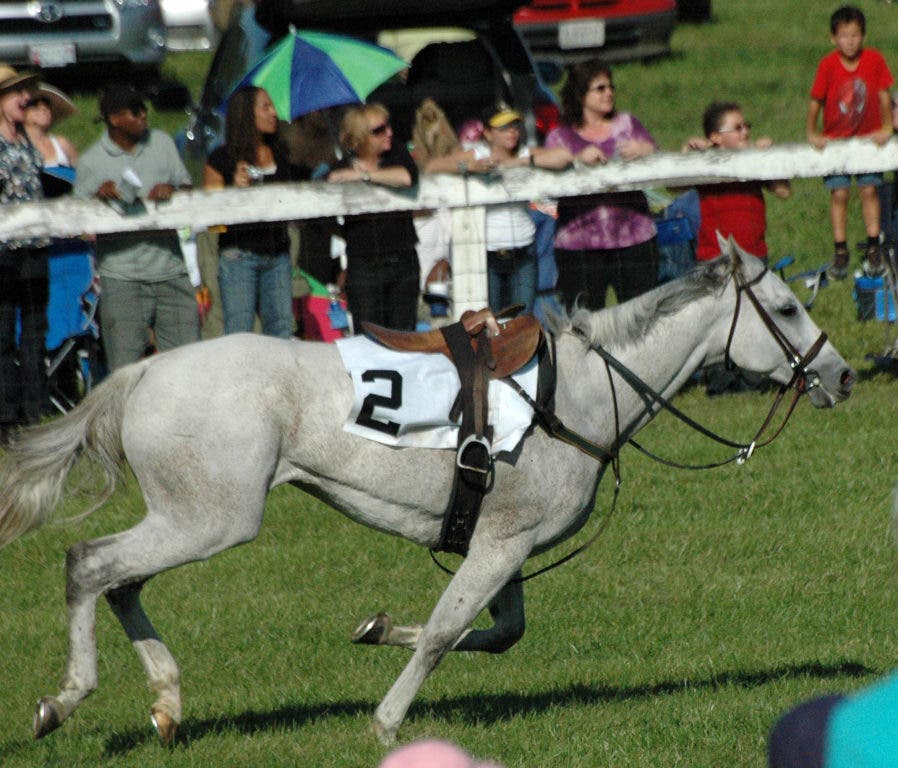


The steeplechase originated in Ireland in the 18th century on courses measured by the distance between two church steeples. The name "steeplechase", a timed event to determine the fastest horse, has stuck, even though now, the course is a grassy oval with a movable start point to adjust the distance.
Among six races in the 32nd annual Morven Park Steeplechase on Oct. 8 was a mile and a quarter training flat race with a $500 purse for three year olds. The headline event, the Samuel H. Rogers Memorial race, was for horses four years and older at a distance of three miles and a quarter with 19 timber fences. The $10,000 purse was won by Rainbows for Luck, owned by Gregory S. Bentley, trained by Edward L. Graham and ridden by Jody Petty.
"We knew it was in him," said Paul Rowland, one of the horse's former trainers. "He was a lot of fun to train."
Find out what's happening in Leesburgfor free with the latest updates from Patch.
Rowland said the horse spent the entire summer working on dressage. Then trainer Eddie Graham took over. "He gives all the horses a special touch," Rowland said.
In two of the races for younger horses, riders and mounts became separated, bringing outriders Gaylord Hoisington and Todd Atkins onto the course to corral them with the help of John Adams, a member of the Lucketts Ruritans who has managed admissions from Tutt Lane for years, he said.
Find out what's happening in Leesburgfor free with the latest updates from Patch.
The first steeplechase, in 1752, resulted from a wager between Cornelius O'Callaghan and Edmund Blake, who raced four miles cross-country between two churches in Cork, Ireland. Like most horse races, the steeplechase is timed, and the fastest horse wins. The races are run on turf, and most of them have jumps. Sometimes, people bet money on the winner.
In keeping with tradition, two odds-makers at Morven Park took small bets on each of the six races, offering odds on each of the entrants. Serious betters took into account how many races a certain horse had previously entered. Others placed bets on the name of a horse, his color, the way he moved in the paddock, or his name.
Loudoun Therapeutic Riding conducted a raffle as part of the event, selling $10 chances on a drawing for a $1000 cash price. The raffle raised about $10,000 to support horseback-riding for physical therapy.