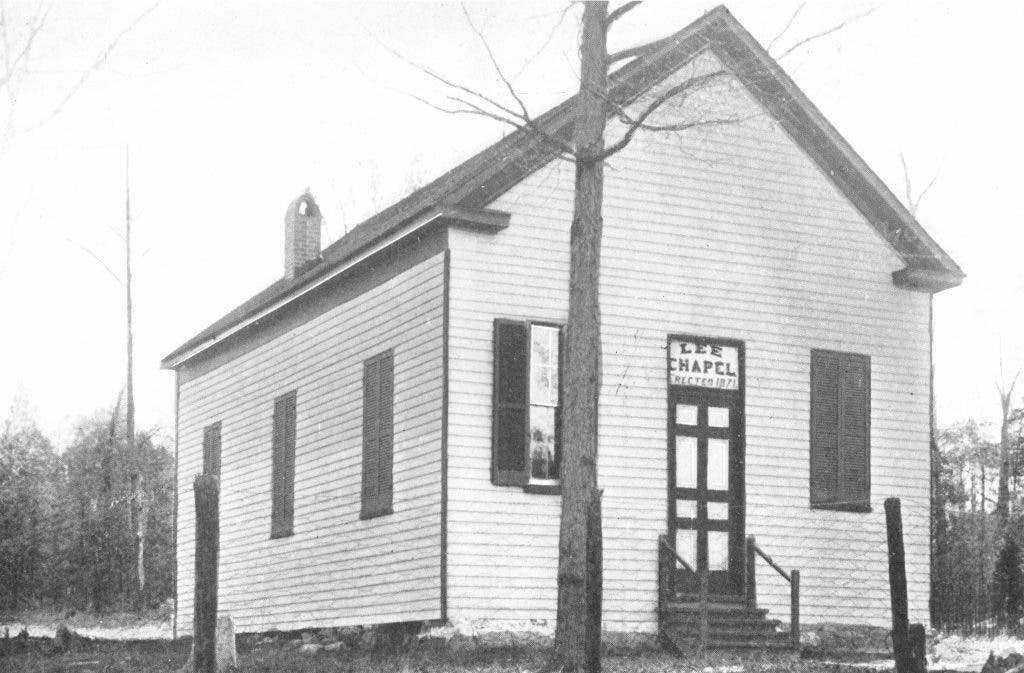


Traveling the Fairfax County Parkway along the route that was formerly Pohick Road, you will come to an intersection with Lee Chapel Road. On the northeast corner of that intersection once stood a small church referred to as Lee Chapel. The 24 x 40 foot white frame church was built in 1871 to replace Mt. Carmel Methodist Church, which had stood about a mile to the south and was burned during the Civil War. Property for the church was donated by John Mahon, a prominent landowner of the day. It is surrounded by an approximately two-acre cemetery where the oldest grave is reported to date from 1887.
Named in honor of General Robert E. Lee, the little Methodist Episcopal Church served as a center of community activities for families and worshippers from Burke and surrounding neighborhoods including Lorton. Sunday worship was an all-day affair with lunch brought by parishioners and served on the grounds surrounding the church. The Epworth League, a young adult association for individuals aged 18-35 and formed to promote intelligent and vital piety among the young people of the Church, met on a weekly basis. My mother, Naomi Beach Mahon told me that these meetings and the soirees that were sponsored by the church were the center of the area’s social life.
Some of the most prominent and respected members of the Fairfax County community attended Lee Chapel Church, and the cemetery is dotted with gravestones listing names such as Reid, Carson, and Halley. William Halley, for whom Halley Elementary School in Lorton is named, attended faithfully. The church prospered until the 1920s when attendance began to fall off. Repairs were needed with no funds available, and transportation on impassable roads caused the church to close. Items used in worship services were placed among members for safekeeping; however a key was left on a ledge above the vestibule door for the convenience of cemetery visitors. Two wooden collection plates were left containing two coins to symbolize the “widow’s mite.”
Find out what's happening in Lortonfor free with the latest updates from Patch.
Some families began attending other churches in the area, Silverbrook Methodist Church in Lorton, among them.
An increase in population in the area and a desire by former members led to the church’s reopening in 1939. It once again became a hub of activity for the community and with the improvement in roads and use of the automobile, transportation was no longer a problem. The church made it through the 1940s hosting regular services, weddings and funerals, but a future no one could have expected awaited the congregation; a plan to build an airport in the Burke area sealed the fate of Lee Chapel Church. A successful fight by county residents managed to change the government’s plan to build at Burke, but by that time many parcels of property belonging to long-time church members, and indeed the very property surrounding the church, had been purchased for the airport and the families had moved away.
Find out what's happening in Lortonfor free with the latest updates from Patch.
Lee Chapel Church closed again in 1951. The church organ was removed to the home of William Halley for safekeeping, and items used for worship were distributed to other churches or retained by long-time members. The wooden pews were transported for use at Silverbrook Methodist Church. The church stood empty for several years, but vandalism prompted a decision that it be used for a controlled burning. All that remains are the cement church steps and metal hand railing and parts of the cement foundation.
The cemetery is still used for burials and contains 40-plus headstones and an unknown number of unmarked graves. The cemetery is maintained by Sydenstricker United Methodist Church, and they hold their annual Easter Sunrise Service on the site. A marker with a brief history of the church stands near the fence in the vicinity of the cement steps which face the Fairfax County Parkway.