Arts & Entertainment
Northern Virginia Film Festival Offers Eclectic Mix
With more than 115 films screened at the Angelika Film Center, the NOVA Film Fest offered a platform for budding and professional filmmakers
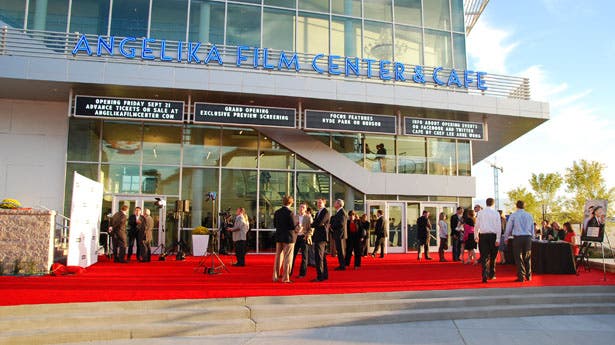
You try to see as much as you can at a film festival. You do so knowing you’re never going to see everything, but you try your hardest because something usually surprises you. It’s easier to plan a schedule when there are multiple screenings of films. Unfortunately, the inaugural Northern Virginia Film Festival, held last week at the Angelika Film Center in Fairfax, Va., had only two auditoriums to show more than 115 films. Because of its ambition and week-long parameters, and even though I attended four straight nights, I still missed what would eventually win the festival’s best feature film, “Blue Collar Boys,” a gritty tale of working class construction members who take revenge on a greedy developer.
The filmed I skipped it for still had its pleasures, though, redeeming any sense of regret once the credits ran. “Leaves of the Tree,” the latest from Ante Novakovich, offers a sun-dappled vision of a supernatural and growing religious conflict. The film is adapted from “Kindness for the Damned: A Novella of Intrigue, Love and Redemption in Sicily” written by David Healey, who also wrote the film’s script. It begins in 1808 Segesta, Italy, where we’re immediately introduced to a bleeding British soldier whose wound is rapidly healed by some olive tree leaves, carefully placed by a sheepherder and his son. Cut to the present and the tree’s healing powers remain a topic of discussion and a farfetched medical opportunity.
Eric Roberts, playing Patrick, a pharmaceutical lawyer on the brink of retirement, is on board for one last potential breakthrough and convinces the head of the company, Roberta (Marissa Brown), to fund a trip to Sicily where the tree’s owner (Federico Castelluccio), a mysterious, wealthy landowner has offered them his villa to study his prized olives and their apparently magical abilities. Ultimately, this is a vacation from Houston, where a mixture of people (Patrick has brought his wife and daughter) can enjoy the sensual pleasures of the Italian coast and groves, all underneath a beautiful cathedral score.
Find out what's happening in Old Town Alexandriafor free with the latest updates from Patch.
It does its fair share of meandering – through olive trees, city streets, and the house’s rooms – but is closely tethered to some dramatic stakes, namely the arrival of two priests from the Vatican. They’re investigating the buzz over this olive tree, parsing through land records and negotiating (well, threatening) a price for the coveted chapel that forms around the trunk. None of this is particularly compelling in its delivery, but its mystery, which is to say its existential prodding and religious questioning, carries a thoughtful curiousness. Novakovich tightropes the need to hand out answers with the wisdom to keep others protected. He invests as much time in the research of cells as the saving of souls.
The night before was a complete reversal. As part of the festival’s “Horror Hump Day” came a contained slasher-thriller called “All I Need,” directed by Dylan K. Narang. It’s an elegantly crafted psycho-sexual horror, something that maximizes its limited set design through uniquely angled camerawork and suspenseful positioning. It toys with you, like the opening shot, a girl’s serene face that quickly becomes panicked as the lens zooms out to show her whole body, tied up and gagged. In a claustrophobic, dank hotel room, among piles of other innocent, unfortunately bound girls, she realizes the horror of her situation when a masked figure suited head to toe in rubber drags a girl lying beside her into the bathroom. A few screams and ugly noises later and the body is being dragged out of the room.
Find out what's happening in Old Town Alexandriafor free with the latest updates from Patch.
The ensuing 90 minutes is a finely choreographed dance of tortured escape. Chloe, as we come know this girl, is played by Caitlin Stacey, who sells her overload of screen time with impressively varying levels of gasps and moans. She’s crawling through air vents, pushing heavy dressers, frantically pulling open windows. The camera sometimes lingers on her struggles for too long and nearly diffuses the boiling tension (Take my hand! Looks at the struggling intruder. Hurry! Looks at the intruder again). It only works because of Stacey. A side story, which ultimately gives some context, inserts itself awkwardly. But there’s a real atmosphere here, punctuated by the soundtrack’s swells and punches. After directing five shorts, Narang has crafted a promising feature debut.
Speaking of shorts, there were plenty to choose from throughout the week. Some of the winners – the documentary “Last Pyramid” and narrative “A Man On The Edge – dealt with topics of death with a grace and thoughtfulness. The former studies an older woman, Trish, coping with the loss of her son, who lived with epilepsy, by painting stained glass windows. The latter, about suicidal father who speaks to the ghost of his wife, rewards you with its simplicity, even with its grim weight attached.
Other notables I was fortunate enough to catch included “Gaia,” a Godfrey Reggio-inspired critique of human culture through dance. Using time lapse and artistic overlapping sets, dancers evolve within their surroundings, first fluid and then eventually mechanical. It’s the sad progression of another artist chronicled in a moving documentary called “Art of Richard Thompson,” centering on the cartoonist whose illustrations – most formidably his syndicated strip “Cul de Sac” – were inimitable in their scratchy, caricaturist forms. As he developed Parkinson’s disease, and as it got worse, his ability to draw waned -- as had public awareness about his drawings. When asked what was most disappointing about his inability to hold a pen, he disregarded his ego with a sigh. “My characters had more to say.”
And I had more films to see. Alas, I was happy to contribute a warm body to a theater that continues to support young and budding filmmakers with modest budgets and ample ambitions. Two auditoriums are better than none.