Crime & Safety
The Death Of Gwen Ames: Homicide Remains Unsolved After 5 Decades
According to Fairfax County Police, Gwen Ames' homicide case is still an active investigation and a suspect may one day be identified.


This is the second installment of a two-part story about Reston's first homicide. Read the first part: Who Killed Gwen Ames? Reston's First Homicide Remains Unsolved
RESTON, VA — In the early morning of June 4, 1972, ArDee and Priscilla Ames rode in the ambulance taking the body of their unconscious daughter to Fairfax Hospital. The 17-year-old girl had been found by a group of teens lying on a path a short distance from her parents' home earlier that morning.
A short time later, Gwen Ann Ames, the only child of one of the first families of Reston, was pronounced dead on arrival at the hospital.
Find out what's happening in Restonfor free with the latest updates from Patch.
A year before her death, Gwen Ames had been arrested for shoplifting a dress, her probation officer Joe Rollo told The Washington Post. ["Death on a Path Ends a Girl's Fresh Start" by Tom Hult, The Washington Post, June 7, 1972]
"She told me she had been on heroin for about a year," Rollo said. "I wouldn't classify Gwen as an addict. I think she was a chipper — she chipped at it, like a social drinker compared to an alcoholic. It's hard to say where one leaves off and the other begins."
Find out what's happening in Restonfor free with the latest updates from Patch.
In the long eulogy written by ArDee Ames and reprinted by The Washington Post, he talked about his daughter's drug use. ["She Was a Symbol of Hope to Us All" by ArDee Ames, Washington Post, June 7, 1972]
"Last September, we found evidence that she was on drugs, and we told her she would have to get professional help or she would have to leave our house," he said, delivering the eulogy to the hundreds of people who attended his daughter's June 6 funeral at Washington Plaza Baptist Church in Reston. "And we meant it, and she knew we meant it."
ArDee Ames credited people like Rollo and Monica Kelly at Fairfax County's Crossroads program with helping his daughter through her treatment and recovery. At the time of her death, Gwen Ames had been drug-free for eight months, her father said.
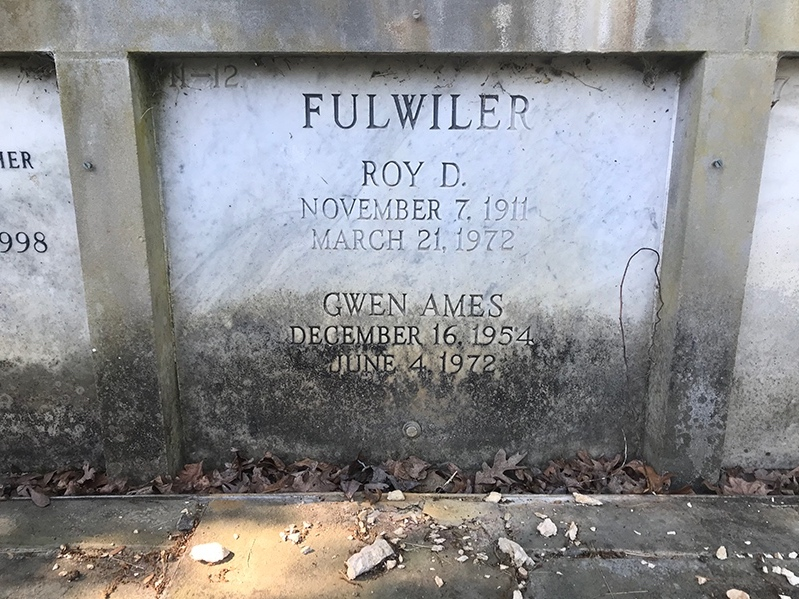
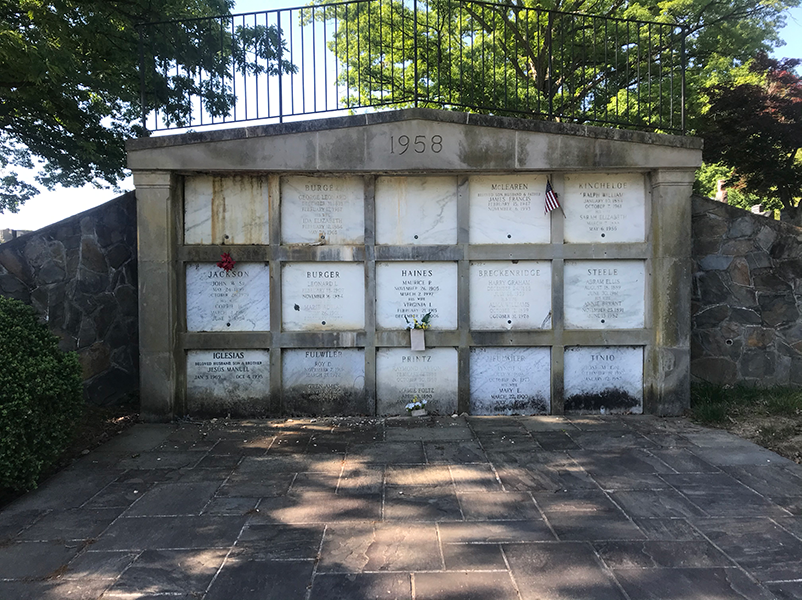
Following the funeral, Gwen Ames was interred in the mausoleum Chestnut Grove Cemetery in Herndon, across the street from Herndon High School where she'd been a junior.
Death in One of Reston's First Families
ArDee and Priscilla Ames moved with their then 10-year-old daughter into a townhome located at 11432 Waterview Cluster in Reston. It was 1965 and just a few years after Robert E. Simon Jr. founded the planned community in the Washington, D.C., suburbs.
ArDee Ames was a housing expert with the Department of Housing and Urban Development and served as a special assistant to Simon. In addition, he was one of the original board members when the Reston Community Association was formed in 1967, according to The Washington Post. His wife soon joined him as the RHA's information director.
Like her husband, Priscilla Ames became actively involved in Reston's early years. She volunteered at Lake Anne Hall and at the Common Grounds coffee shop, according to a 2004 Reston Connection story.
In the aftermath of Gwen Ames' death, the close-knit Reston community proved to be a source of solace for the couple. They voiced their gratitude for this support in a letter to The Reston Times. ["Special Thanks" by ArDee and Priscilla Ames, The Reston Times, June 15, 1972]
"You cannot imagine how much it has meant to us to have your comfort at a time like this, even when all words fail," they wrote. "It could only happen in Reston, a truly special town and special people."

Eventually, the couple would divorce. ArDee moved away, remarried, and had another daughter, according to Gwen Ames' cousin, Carol Hertle-Sena.
Priscilla Ames, however, stayed in Reston for the rest of her life. With her long-time companion Rev. Embry Rucker, she became a prominent community activist.
"They were very, very effective in Fairfax County," said Lynn Lillienthal, a close friend who had also moved to Reston in 1965. "They were very good friends of Martha Pennino, who was our supervisor. If they said something or they talked about whatever you wanted, it would happen."
In the late 1980s, the pair helped found the homeless shelter that now bears Rucker's name, according to Priscilla Ames' January 2016 obituary in Reston Now.
"She went on to be a big contributor to the community," Lillienthal said. "She knew everybody and she knew everything. She was sort of a bridge between the workers. She knew all the workers and she put people together. If someone needed to know someone, they went to her."
In addition, Priscilla Ames was an original volunteer at Reston-Herndon Fish and served on the Fairfax County Human Services Board. She also helped on the campaigns of state Sen. Janet Howell, Del. Ken Plum, and former Hunter Mill Supervisor Cathy Hudgins, according to Reston Now. She also received the Robert E. Simon Jr. Lifetime Achievement Award in 2011.
"She had a very wonderful life," Lillienthal said. "She was very sad after Embry died, because then she was alone."
A Community Responds
On Sunday, June 4, 1972, ArDee and Priscilla Ames returned to Reston from Fairfax Hospital around 4 a.m.
Fairfax County Police detectives had just wrapped us their interviews with those who had found Gwen Ames' body.
The Reston Times reported some of those gathered in Lake Anne Plaza that morning were speculating that the victim had suffered a heroin overdose, while others said she'd been murdered. ["Autopsy Shows Murder Caused Gwen's Death" The Reston Times, June 8, 1972]
Gwen Ames' parents told those who met them neither drugs nor alcohol appeared to be factors in her death, according to The Reston Times. They also said she had bruises around her neck.
Dr. William F. Enos, the county medical examiner, released his initial report on Wednesday, June 7. Although he was waiting on a final test of autopsy specimens, he said a drug-related death was unlikely. Instead, he classified the death as a homicide, according to The Washington Post, and the cause was suffocation by strangulation.
Police told The Reston Times they had a "great many suspects," though they declined to name any at the time.
On June 12, the Fairfax County Board of Supervisors unanimously approved a measure introduced by Centreville District Supervisor Martha Pennino authorizing a reward of up to $500 "for information leading to the arrest and conviction of the murderer of Gwen A. Ames, of Reston," according to board documents. The money came from the police department's discretionary funds.
Fairfax County Police began distributing posters throughout Reston and nearby communities, including Sterling Park, Greenbriar, Chantilly, Herndon, and Great Falls, according to the Reston Times. They were seeking information about the case as well as advertising the reward. ["Supervisors Okay Murder Reward," The Reston Times, June 15, 1972]
Cold Case Remains Active Investigation
Friday will be the 49th anniversary of Gwen Ames' death. To date, police have not identified a suspect.
Despite the passage of time and its status as a cold case, the investigation into Gwen Ames' homicide is still considered active by Fairfax County Police and the department does not share information on active investigations.
The case did resurface somewhat recently, when it was included in the Cold Case webpage FCPD launched last July. The idea behind the webpage was to generate new tips and let the victim survivors know that they haven't been forgotten, according to Lt. Ron Haugsdahl, who leads FCPD's Cold Case Unit.
"We have all their pictures up on the wall in our office," he said. "Every day, you walk by, you stand there and you look at it and go talk maybe about a particular case, 'What was the circumstances and cause?' A lot of it's history. They're older cases and sometimes they blur together a little bit because the situations are similar, but they're decades apart. But the main thing is that we are talking about them. We're working them."
Fairfax County Police classify a case as "cold" when the homicide detective investigating it moves on — through retirement or promotion — or there are no further leads that can be developed by the detectives in the active homicide unit.
TV crime shows may give the impression that all the detectives have to do with an older, unsolved case is to retest the evidence with the latest technology, but it's not that simple.
"Some evidence is tainted or had been tested with what we thought was the best technology of the day, and it didn't yield anything," Haugsdahl said. "Today we have better technology, but then you go back and try to retest that old evidence. There's just not enough, let's say DNA or anything in there to actually extract."
Another challenge detectives face is that many of the witnesses in these older cases have died or are unwilling to talk to the police.
"Now that doesn't mean we can't close the case without the witnesses, but you've got to have one of the other," Haugsdahl said. "You've got to have the evidence or you've got to have very strong witnesses."
While the clock continues to tick on these older cold cases, detectives are still able to close one occasionally.
In April 2020, Fairfax County's Cold Case Unit identified James "Jimmy" Edward as the individual responsible for killing 12-year-old Karen Lee Spencer on Nov. 29, 1972.
"In that case, there was two witnesses that actually cooperated and said that they heard from the suspect himself that he committed that murder," Haugsdahl said. Although Edward had died in 1997, the Commonwealth's Attorney said there was enough evidence to arrest and prosecute him.
Karen Lee Spencer was killed in 1972, the same year as Gwen Ames.
For the Reston community and family members like Carol Hertle-Sena in New York who still remember Gwen Ames, that link offers a small degree of hope that a killer may be identified one day and give them the closure they seek.
Haugsdahl confirmed that from time to time the Cold Case Unit will hear from family members checking on the status of a case. Some they hear frequently from, while others rarely reach out.
When the webpage was launched last year, detectives made every effort to reach out to the families of those listed there.
"Our victims are our number one focus and if notice goes out, we want them to know everything we're doing," Haugsdahl said. "We hope that if we ever have a big break in the case that the family, the next kin, survivors or the person that wants to be a spokesperson for that family is the first to know."
Hertle-Sena recently reached out to Detective Frank Flanagan, the officer in charge of investigating her cousin's case.
"My name is in their file," she said. "Detective Flanagan made sure that I would be the point of contact if anything should break. He said since her murder, there's been a few leads, but nothing concrete."
Gwen Ames died on a Sunday and her funeral took place the following Tuesday. The eulogy ArDee Ames read during the ceremony ended with a message for Gwen's classmates and friends in attendance.
"To the young people here today, I only ask that you think of Gwen from time to time, and help her death add a little bit more meaning and purpose to your own lives.
"Dear God, take care of Gwen."
The Reston Historic Trust & Museum provided assistance in the research of this story.
More information is available on the Fairfax County Police Department's Cold Case Webpage. Anyone with information about Gwen Ames' case or any case on the webpage may contact the Cold Case Unit by phone at 703-246-7511 or email at FCPDColdCase@fairfaxcounty.gov. Anonymous tips may be submitted to Fairfax County Crime Solvers by calling 1-866-411-TIPS or 1-866-411-8477 or texting FCCS plus the tip to 847411. Anonymous information may also be submitted online.
Get more local news delivered straight to your inbox. Sign up for free Patch newsletters and alerts.