Politics & Government
Reston Association To Update Pesticide Warning Signs In Response To Resident's Concerns
Reston Association will use larger signs and create a webpage after resident Amy Becker raised safety concerns about the Hook Road field.


RESTON, VA — The Reston Association is updating its communication procedures for pesticide applications following community transparency concerns, according to an email sent Monday by Acting Chief Executive Officer Peter Lusk.
In the message addressed to local resident Amy Becker, Lusk outlined several upcoming changes intended to improve how the association informs the public about chemical treatments in the community.
The policy shift comes after Becker, a Reston homeowner for more than 30 years, testified before the Reston Association Board of Directors during its May 1 meeting.
Find out what's happening in Restonfor free with the latest updates from Patch.
In her statement to the board, Becker argued that the association's current approach to applying pesticides, herbicides, and fertilizers lacked adequate notice and signage, leaving residents, children, and pets at risk. Becker called for immediate changes, specifically citing deficiencies in advance notification, ingredient disclosure, and the timing and placement of warning signs.
Becker’s decision to address the board was prompted by an afternoon incident outside her home on Waterford Square, directly across from the newly renovated Hook Road Recreation Area.
Find out what's happening in Restonfor free with the latest updates from Patch.
In an April 21 email to Patch, Becker said the baseball field was nearing completion after months of delays, with the perimeter fence down, new grass planted, and shrubbery being watered.
Also See ...
- Reston Community Center Honored By Fairfax County For Water Safety, Lifeguard Training
- RA Celebrates Completion Of Hook Road Ballfield Improvements
- Reston's Blaine Scully Joins Old Glory DC As Senior Advisor
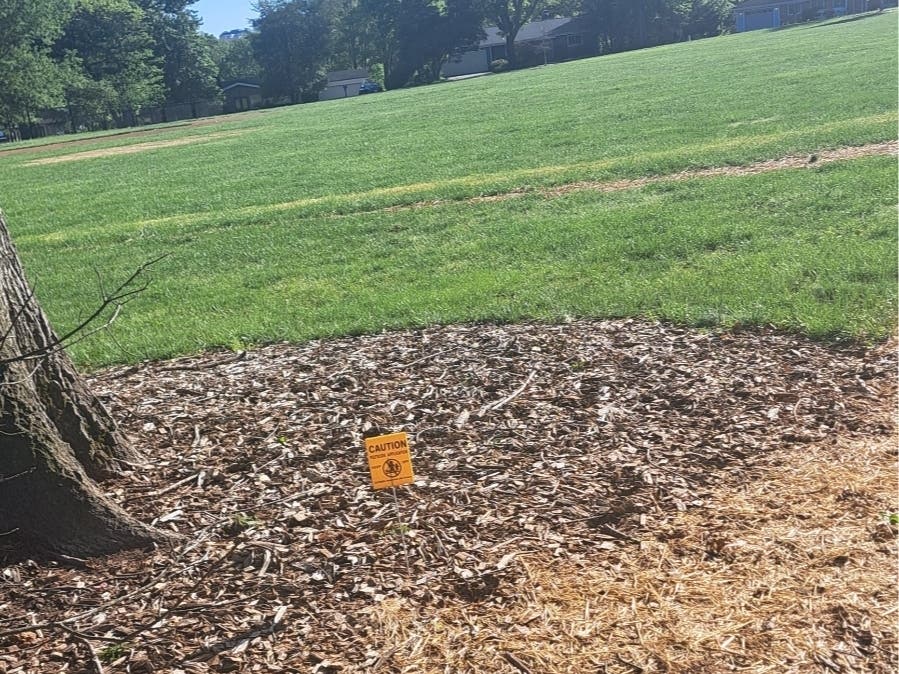
While observing the site, Becker noticed two small signs placed under separate, widely spaced trees announcing that pesticides had just been applied. Becker noted that the signs were not present earlier that morning.
"They are so small as to be unnoticed," Becker said, in the email. "And their placement does not inform as to what areas have been treated."
When Becker questioned a Reston Association staff member who was watering the grass about the location of the treatments, the staff member gestured and replied, "All over."
Becker expressed concern that the lack of visible signage left many local dog owners unaware that their pets were being exposed to treated grass. She noted that small children using the recreation area immediately following a treatment would face similar risks.
"More and larger warning signs should have been placed immediately after this treatment," Becker wrote, questioning what could be done to draw attention to the matter.
In response to those concerns, the Reston Association is currently rewriting its standard operating procedures to require the placement of larger warning signs at the specific date and time of any pesticide application.
Additionally, the organization is developing a dedicated webpage that will detail its application procedures and outline the specific reasons why spraying occurs. Future field signage will feature a QR code allowing community members to scan the code and access the webpage directly.
"I believe this helps to address the transparency concerns you’ve voiced to us," Lusk wrote to Becker.
Lusk stated that the association commits to completing the procedural and digital updates within the next few weeks and plans to confirm once the changes are fully implemented.
Get more local news delivered straight to your inbox. Sign up for free Patch newsletters and alerts.