Health & Fitness
Bees and Wine
If you find that you have mason bees nesting in your yard. don't reach for the insecticide! Instead, reach for a glass of wine, sit back, and enjoy watching these beneficial pollinators.
Hmmm... you may have noticed since I posted about putting my mason bee cocoons outside, I haven't had much else to say about them.
It's not that I haven't been trying, but... I haven't seen much activity from my bees. For the first week after my bees were emerging, I searched around my yard for them, but I very rarely spotted any of the blue Orchard Mason Bees.
Find out what's happening in West End Alexandriafor free with the latest updates from Patch.
And so far in my bee house, only one tube appears to be full (you can tell when you see a mud end-cap about 1/2" into the tube).
Find out what's happening in West End Alexandriafor free with the latest updates from Patch.
I learned from Denise Shreeve, owner of Our Native Bees, that during a cool Spring like we're having this year, minimal bee activity right now is normal.
Still... my search continued.
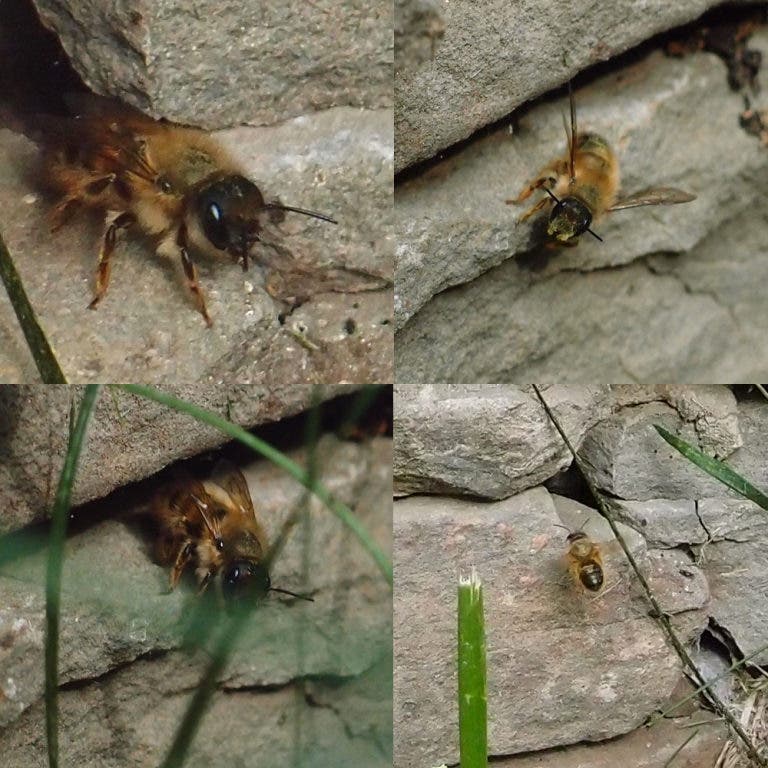
At last, after a few days, I finally found some mason bees! Not the blue Osmia lignaria that I released, but a different kind, a non native (but beneficial) mason bee: Osmia taurus.
I saw the first of these bees buzzing around a rock seating wall that we have in the yard. Curious, I followed the bee and watched as she crawled into a space between the rocks. Then another bee showed up and did the same. After about five minutes, one of them emerged, followed by another. Fascinating! I decided to pull up a chair and sit with my camera to watch the bees.
A few days later I was outside again, camera in hand, this time stalking a bumble bee. I see so few of them now (but carpenter bees sure are everywhere). I was standing on a spot of damp, bare ground and happened to see a little bee buzz down, flit around to a couple of different spots, and finally land. Then she started scratching wildly at the dirt. She didn't go to the dampest, muddiest place, but rather a spot that seemed to be barely wet at all. After a minute or two of scratching and scraping, she appeared to collect the dirt and then flew off with it.
Very cute!
(I was even lucky enough to get a video of the beautiful little bee:
http://www.youtube.com/watch?v=OwqZPUFxRrA)
A day later, I went back to look for the bees in that same spot and found that they had made very small (less than an inch deep) indents in the dirt. The bees seemed to prefer to scratch dirt from the walls of the indents, rather than the bottom. Similar to sitting near the bees' nest to watch them, it was just as interesting to sit near their version of a home improvement store and observe what they were doing. And of course, they didn't seem bothered by me at all. When I did occasionally move too close with my camera, the bees would quickly leave- they're not interested in starting a fight. Once I had my camera in position and remained still, they'd come back.
If you, too, find a mason bee nest in your yard, consider yourself very lucky to have these beneficial pollinators around! You won't see them nesting in the ground, but you may find them scratching at the bare ground in places, scrounging up some dirt for their nest. They won't cause damage to your property, because they can't- they don't have the physical ability to create holes, so they nest in existing holes. They'll be done with their nesting activity around June and then the adult bees will die, leaving the babies to develop in the nest until next Spring. And they're not aggressive at all- you can pull up a seat about a foot away from their nest and observe them as they go about their bee business, doing their little bee errands. You could sit there with a glass of wine in one hand, and your camera in the other, and enjoy an afternoon of bee-watching. There's something relaxing and peaceful about sitting amongst them as they come and go, occasionally flying a lap around you to check you out.