Health & Fitness
Birthday Bees, Please?
In hopes of finding Orchard Mason Bee cocoons on my birthday, instead of unwrapping typical birthday presents, I'm unwrapping bee nesting straws.
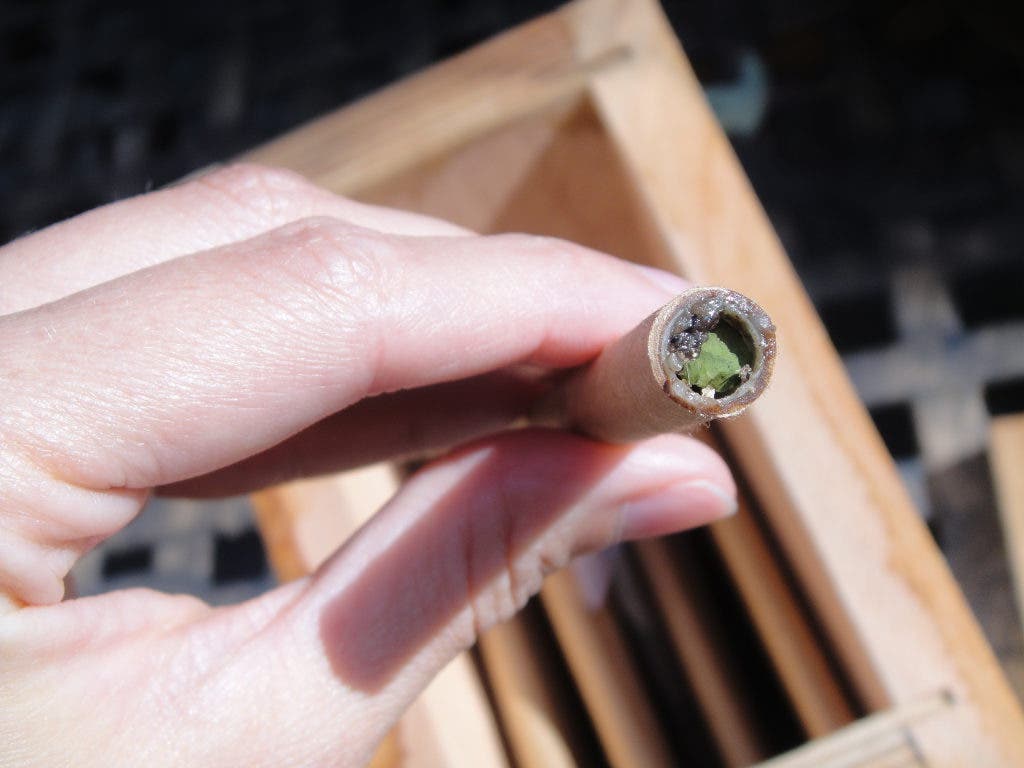


I've been planning this nature-inspired blog post for a couple weeks now.
Unfortunately, nature can be unpredictable, and if you don't know what you're doing, can be very hard to control.
Today is my birthday. All I wanted were some Orchard Mason Bees. I had it all planned out. Today was the day I was going to open my bee nesting tubes and find glorious, silken cocoons with bee babies inside ...
Find out what's happening in West End Alexandriafor free with the latest updates from Patch.
But let me back up a bit.
Unless you've been living under a rock or were in a government time capsule experiment à la "Idiocracy," you've likely heard that honey bees have been disappearing at an alarming rate since 2006. But what is news to most people is that other native bees and pollinators are in decline, too.
Find out what's happening in West End Alexandriafor free with the latest updates from Patch.
This has been attributed to a multitude of terrible things we're doing to the environment — and thus, to pollinators — including overuse of pesticides and herbicides, destroying pollinator habitat, introduction of invasive species ... the list goes on and on.
Some of us pollinator enthusiasts are working on ways to help out the less-often-talked-about native pollinators — that is, pollinators who weren't introduced to this continent (as honeybees were), but co-evolved over millions of years with the plants that originated here: bumble bees, orchard mason bees, leaf-cutter bees (did you even know those existed?), sweat bees, wasps and butterflies, too. Since bees are (in most cases) the most efficient pollinators, much focus has been placed on studying them.
Enter Denise Shreeve, of local McLean company Our Native Bees, who proudly refers to herself as an "enabler." She's designed a bee house specifically for beneficial solitary mason bees and leaf-cutter bees.
These are bees you want to have around your home — they are extremely efficient pollinators and they don't sting! The bees are so elusive and keep to themselves so much that most of us would never know they are ther and probably have never seen one before — including myself until earlier this year, when Denise pointed them out to me at one of her bee nesting sites.
These bees aren't capable of creating tubes or drilling holes. They have to take the time and energy from their busy day to scope out nesting sites for their baby bees in pre-existing tubes drilled and abandoned by other insects, or in hollowed out stems of dried plants. On top of that, they have to make many, many trips back and forth to the nesting site — the mason bees with mouthfuls of mud, and the leafcutters with sections of cut leaves — to build chambers in which they can lay their eggs.
Then they make more trips to the nesting site, with loads of pollen to leave in the chamber for the tiny baby bee to eat after the egg hatches. The saying "busy as a bee" doesn't begin to cover it!
Our Native Bees' Plan Bee house was created to provide these solitary bees with a number of properly sized tubes for their babies. The tubes are designed to keep moisture, mold and parasites out and keep baby bees safe. The house is well ventilated with plenty of space between the tubes. The hard outer cardboard tubes make it difficult for parasites to attack the baby bees. But one of the keys to the house is the inner paper tubes — these fit perfectly within the cardboard tubes. Each year you can remove the used tubes and replace them with fresh, clean tubes for new baby bees.
I hung up a Plan Bee house in my yard in late April of this year. For mason bees, it was late in the season — they are the first to emerge in the spring, when the very first blooms start to open. But I hoped the summer bees — the leafcutters — would find the house.
Two weeks ago I peeked into some of the nesting tubes and saw two things that excited me: some mud plugs from mason bees and bright green leaf pieces from leafcutter bees! I wasn't expecting any mud plugs at all since I hung the house so late in mason bee season, so that was a pleasant surprise. Only eight of my tubes were full, but for my first year, I considered that a success.
And today I decided to open my tubes. Happy birthday to me!
I left the leafcutter bees in their cardboard tubes, as directed by the instructions in the Our Native Bees October Newsletter.
Mason bee cocoons are a little more durable, so it's good to open your mason bee tubes (those capped with mud) to ensure healthy cocoons — you can dispose of pollen mites (if there are any), and the bee poop. I used the included dowel rod to push the paper tubes out of the cardboard tubes. I picked one up and carefully began to unwind the twisted paper of the tube. I knew what I was looking for from pictures I had seen at Denise's lecture, and on the Our Native Bees website. I unwound the paper past a perfectly formed mud plug ... and ... what I found wasn't a mason bee cocoon at all. It was nasty looking dead stuff with something that looked sort of like a small millipede. Bummer.
I unrolled further down the tube- when I held the tube up to the sun I could see that something was definitely in there! And as I unrolled, past another mud plug, I found ...
Some sort of larva.
Disgusting.
I moved on to the next tube and between the perfect looking mud plugs, I found more of these larvae.
All in all, I had three mud-plugged tubes which contained a total of 12 yellow larvae. I might have thought they were bees, had I not been educated by Denise on what I was supposed to be finding in there. But where did I go wrong? This wasn't a happy birthday at all. I dumped out the mess and left the larvae in a place where the birds could find them.
It turns out, these are parasitic Chalcid Wasp larvae. Ideally, what I should have done was remove the mud-capped tubes back in June, and stored them, covered in foil, in a protected place outdoors (like in a shed). That way the parasitic wasps wouldn't get to them, and the foil also keeps out other predators such as mice.
Lesson learned.
I'll tell you more about my Plan Bee house as the seasons change and I prepare it for new bees next year.