Health & Fitness
Preparing My Bee House for Spring Bees
Part 2 of my "Plan Bee House" series! I prep the bee house to be hung up for Spring.

Last fall, I posted about my Plan Bee House from Our Native Bees (located in McLean). At the end of the post, I promised to tell you more about my native bee house (and the native bees) throughout the changing seasons.
In October I had removed a few nesting straws with evidence of leafcutter bees inside them. I rubber-banded those together and kept them in my refrigerator, in the crisper drawer. I also received some mason bee cocoons from Denise (owner of Our Native Bees) as a belated-birthday gift, and those are hibernating in my fridge as well. The bees are kept in the fridge in case of an unusually warm winter- if the bees emerge before any flowers bloom, they will have nothing to eat and will all perish.
Today was "Spring Prep" day for my bee house. As directed by Our Native Bees' February Newsletter, it's time to give the bee house a protective coating of mineral oil in preparation for being hung up outside again. Mineral oil is non-toxic and odorless, and will keep the bee house conditioned and protect the wood from the elements. I have to admit I was a bit intimidated by this process... I'm a complete novice when it comes to anything related to wood. And would the process be messy? Would I buy the wrong product and ruin my bee house?
Find out what's happening in West End Alexandriafor free with the latest updates from Patch.
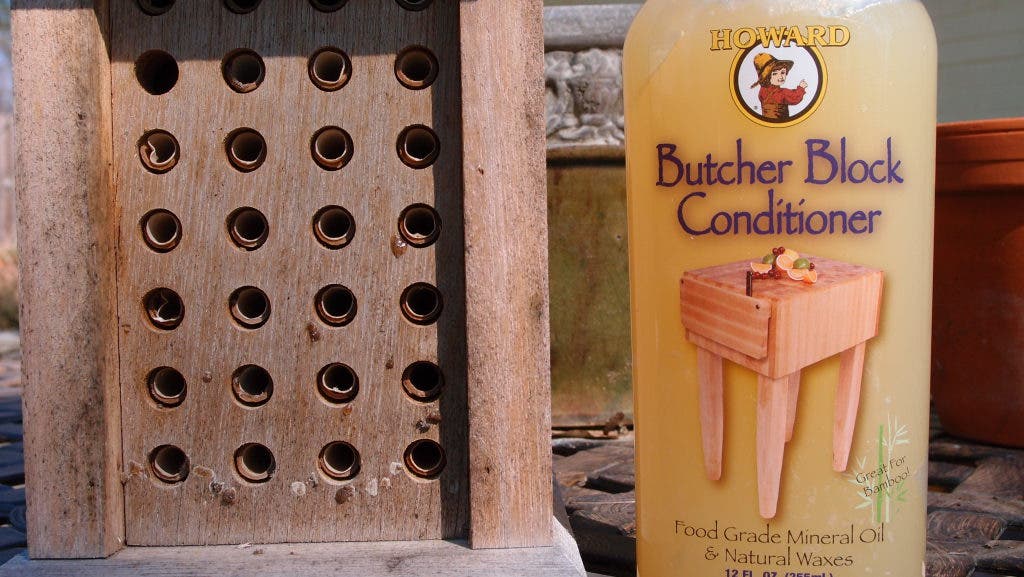
Last week I stopped by Home Depot and asked an employee where I could find mineral oil. I was directed to some bottles of butcher's block conditioning oil, which is non-toxic and food safe. There was one kind that was clear, and another kind that was sort of yellowish in color and opaque. It contained wax mixed with the mineral oil. I chose the one with wax, hoping it would help with waterproofing the wood.
Today I brought my bee house out from storage in my shed, lifted off the top, and removed all of the nesting straws. I rested the house on a rag on my table and squeezed some of the goop out of the bottle. Using another rag, I gently rubbed the oil/wax along the direction of the wood grain. Since last year I didn't have time to condition my bee house before I hung it, the wax and oil soaked into the wood very quickly! It took on a beautiful sheen.
Find out what's happening in West End Alexandriafor free with the latest updates from Patch.
I covered all of the surfaces and it was quite an easy process. It also wasn't messy, either- maybe because the oil with wax has a consistency almost like mayonnaise, so it doesn't run or drip. The whole process took about 10 or 15 minutes and I used less than 1/4th of the bottle (which cost $8). I think $8 for a few years worth of protection for my bee house seems pretty economical!
Next month I'll blog about hanging the bee house and releasing the hibernating bees.