Health & Fitness
Who Let the Bees Out? .......Me!
Now is the perfect time to observe Orchard Mason Bees! I placed my bee cocoons outside on Friday; by Monday some had already emerged.
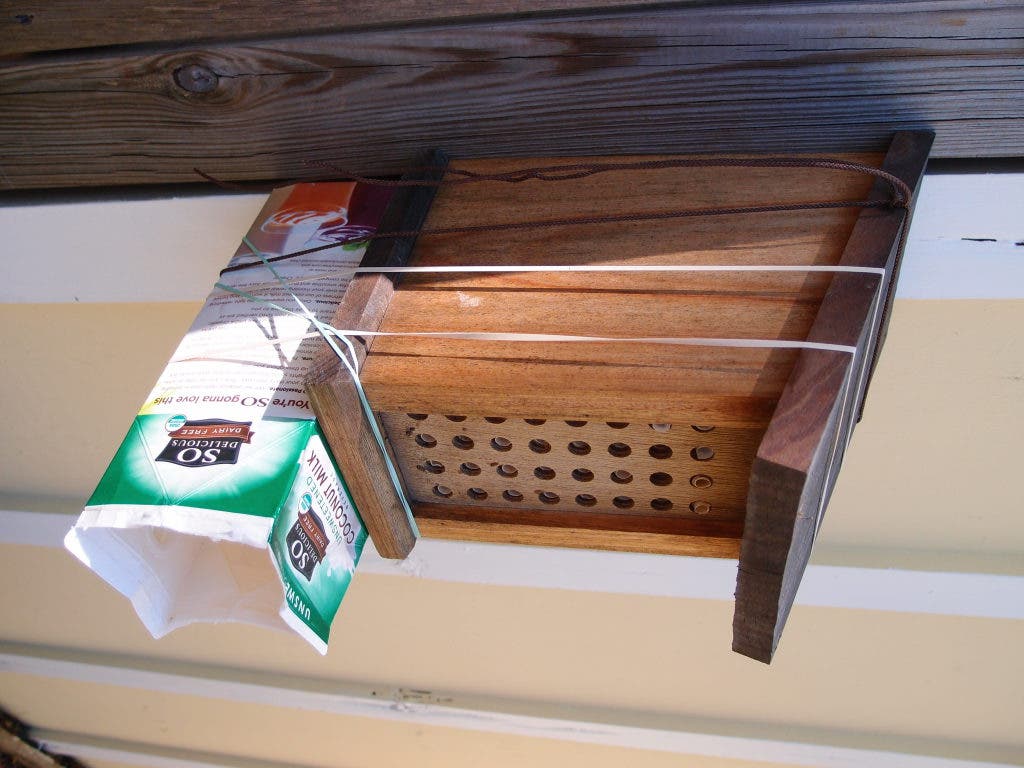


If you're following my blog on Patch, you'll know I recently hung up my "Plan Bee House" from McLean's Our Native Bees. I also had some orchard mason bee cocoons from Our Native Bees, and with the next week forecasted to be warm and beautiful, and plenty of blooming trees and flowers near my home, I knew it was the right time to release the bees.
(If this is your first year with your bee house, you won't have any cocoons to worry about. Just hang the house and provide a mud source!)
Before placing your cocoons outside, make sure your mud source is ready. The females use mud to seal individual chambers in which the baby bees will develop. In the photos, you can see the mud source I've provided. It's certainly nothing fancy! I used two plastic containers- the shallow kind that you would put under a potted plant to catch water. I added a couple of rocks and some dirt from my yard, then added water. If it's in a sunny place, check on it every so often- maybe twice a day- and add water as needed to keep it moist.
Find out what's happening in West End Alexandriafor free with the latest updates from Patch.
When you release your bee cocoons to the great outdoors, you'll want to protect them from predators like squirrels or birds. Here's how I released my bees.
Materials needed:
Find out what's happening in West End Alexandriafor free with the latest updates from Patch.
- Bee cocoons
- Small box (a cardboard/paper jewelry box works well; mine came in an appropriate box from Our Native Bees)
- Empty waxed carton with a spout (from something like milk or juice)
- Scissors
- Rope or twine, or strong Velcro (rubber bands are shown in the photo, but please don't use those- which I explain below.)
- Twigs and sticks
- Alligator clips
First, open the top of the waxed carton and thoroughly wash and dry the inside. The carton is going to serve as your bees' temporary home while they make their way out of their cocoons. Throw away the cap that closes the spout- the spout will be your bees' escape route to the outside.
Next, hang the carton. Make sure the spout is facing down, so rain won't get into the carton. I hung mine right on the bottom of my bee house. I used one piece of twine and several rubber bands, which you can see in my photo- but please note: a couple of days later I went outside to check on my carton (before I added my bee cocoons) and all of the rubber bands had snapped off. For this reason, I don't recommend using rubber bands. After seeing all of my rubber bands snapped off, I added an additional piece of string (a shoelace) to stabilize the carton. You don't want the carton falling off and blowing away, or sitting on the ground where ants and other things can easily get in there. You can also use velcro to secure the carton to the bee house. The carton can be used several years in a row, as long as it doesn't get damaged.
After your carton has been hung, wiggle it some to make sure it's sturdy. Once you're satisfied that it won't fall off of its hanging place, add a layer of small broken twigs to the bottom of the carton. This will serve as a floor for your box of bees, and if water does seep into the carton, your bee cocoons won't be soaking in it.
Now prepare the jewelry box.
Make two cuts along one side of the box and fold down the tab that you've made, making sort of an "off ramp" for the bees, leading them outside of the box.
Place your bee cocoons into the jewelry box and replace the lid. Make sure the bees can get out of the hole when the lid is on the box. You can place the lid on the box at an angle and tape it in the back (to keep it from sliding down over the hole), or, make your escape hole a little bigger if you need to.
Next, very carefully, place the box of bees into the carton, resting it on top of the twigs. Be very very careful not to tilt the box down and let the cocoons roll out of the escape hole! I made this mistake when I was placing the box into the carton, and a cocoon rolled out- they roll around very easily! Luckily I found it on the ground right away and placed it back into the box.
Now you've provided a dark place for your bees (which is what they're used to), and a bright hole to the outdoors for them to go towards when they've emerged from their cocoons!
Close the top of the carton with an alligator clip or two... and wait.
It will take your bees a day or two to start emerging. But after just a day, you can upclip the alligator clips and place your ear next to the opening, and you might hear something that sounds like Rice Crispies cereal.... that is the sound of the bees chewing their way out of their cocoons!
The males will emerge first, followed by the females. When the males emerge, they will spend their time foraging for nectar and hanging out around the carton, waiting for the females to emerge.
I placed my cocoons outside on Friday afternoon. Monday morning I opened the carton and removed the jewelry box to check on the activity inside. (If you remove the jewelry box from the carton, please be careful not to let the cocoons roll out.) I was so excited to see some empty cocoons (the smaller cocoons- the males), and a couple of female bees starting to chew their way out! As I watched, the holes they were making were growing fairly quickly, so I set the box down to continue observing them. I was able to witness a female orchard mason bee emerging and it was a fantastic thing to see. I captured a video of her, and was quite surprised that she was able to fly so easily within just a few seconds!
http://www.youtube.com/watch?v=GBprHBfIbcg (Video of bee emerging)
When I was done watching the bees, I replaced the box back into the carton and closed the carton with my alligator clips. After a few more days, all of the bees will have emerged and will begin the process of mating. The males will die after a little more than a week, and the females will continue to forage on nectar, then build individual chambers for their brood. The chambers consist of a mud wall, pollen food supply, and a baby bee egg.
After your bees have all emerged, you can remove your waxed carton. You can save the carton to use again next year. You can also save the jewelry box and your bee cocoons in the carton, and next Spring when it's time to hang your bee house again, place the empty cocoons inside the house- the smell of them will attract new mason bees.