Arts & Entertainment
Painter Henk Pander: World Without Artistic Expression Would be 'Lonely'
The life and work of Dutch-born, Portland-based artist Henk Pander is the subject of the film, "Painted Life – An Immigrant Artist's Journey," being shown Saturday at Sammamish City Hall.


Editor's note: This event is over. But feel free to read the interview with Henk Pander about his thoughts on art and creativity.
"Painted Life," a film by Henk Pander's son Jacob Pander, is part of a free Saturday program with the artist from 1 to 4 p.m. at . The Sammamish Arts Commission is sponsoring the event.
Local artists are invited to bring a painting or drawing for Henk Pander to critique. His work includes paintings of his memories of growing up in Nazi-occupied Holland, images of nature and contemporary portraits of Northwest firefighters.
Find out what's happening in Sammamish-Issaquahfor free with the latest updates from Patch.
Jacob Pander describes the development of his film, which captures his father at work. "'Painted Life' began as a short personal film that was framed around documenting my dad painting a large-scale studio oil painting. After doing several interviews with him about his process, suddenly a much deeper story began to emerge about his relationship with his father, immigration, memories of World War II and other layers," he said.
"What started as a short film evolved and spanned nearly five years of documentation in Portland, throughout the American Southwest, and eventually back to the family roots in the Netherlands.”
Find out what's happening in Sammamish-Issaquahfor free with the latest updates from Patch.
Pander added that the film started as a documentary about making a painting "but eventually became a story about a first-generation immigrant’s experience living in a new culture and perceiving it though the eyes of an artist."
He remains influenced by his father's work. "There is a strong rigor and seriousness to my father's process and work, mixed with a contrarian mischief at times, and a youthful spirit, wanting to see what's over the next horizon. I think all of these things continue to have an influence on my work and approach to life in general," he said.
Sammamish Patch interviewed Henk Pander regarding his life, his work and his advice to young artists who are struggling with how to launch a career while paying the bills.
Q: What should local artists bring to be critiqued on Saturday?
A: They should bring whatever they feel would be worthwhile to receive feedback on and remember I'm not a teacher.
Q: You speak in your son's film about your own training as an artist. How can our readers who are parents encourage artistic creativity in their own kids?
A: My upbringing was unusual because I grew up in a world of painting with a father who was a highly-skilled artist, with art being a profession. Becoming an artist takes discipline. Parents who value creativity should expose a child from an early age to all types of culture including museums, plays and music.
Pander also recalls his father “modeling” how to be an artist to his prodigy son at a very early age.
I have sketchbooks that go back to age four or five. I was given sketchbooks by my father, who always had his own sketchbook in his pocket. And by high school we were going out to the countryside and painting together.
Q: What is the role of art to a community? And what does an artist need from his or her community?
A: A world without music, art and expression would be a lonely world. If a community values the arts, it should make sure the artists are supported so they can do what they are good at, versus painting in the middle of the night after working all day at a job like teaching.
Artists also need community, Pander said, to create their best work.
Nobody works on an island. If you haven’t seen a painting in the world, how would you know how you measure up?
Q: How does being an immigrant and belonging to two countries, and none at all at the same time, influence your work?
A: The curious thing about being an immigrant is that the distance and alienation you experience makes it possible to look at things fresh.
Q: Your son's film has some beautiful scenes of you traveling to the Southwest to paint. What value is travel in general to artists?
A: I'm a traveler by definition. Seeing the world, sorting out what it means to be alive requires travel. I continue to make the effort to travel because I don't want to become a provincial artist who only works in Portland.
Q: What are some of the reoccurring themes of your work?
A: Death and entropy – the way things sort of turn into chaos. I'm a romantic painter with a melancholy nature. I'm also an academic painter who likes to paint big, contemporary paintings and figures with some sense of drama.
Pander also says that war has become a reoccurring theme in his work over the years. He has visited various battlefields and places associated with war both abroad, and closer to home including Hanford. His work reflects a theme.
War is not unusual, but in fact, it often happens. Having peace is what is unusual and should be cherished.
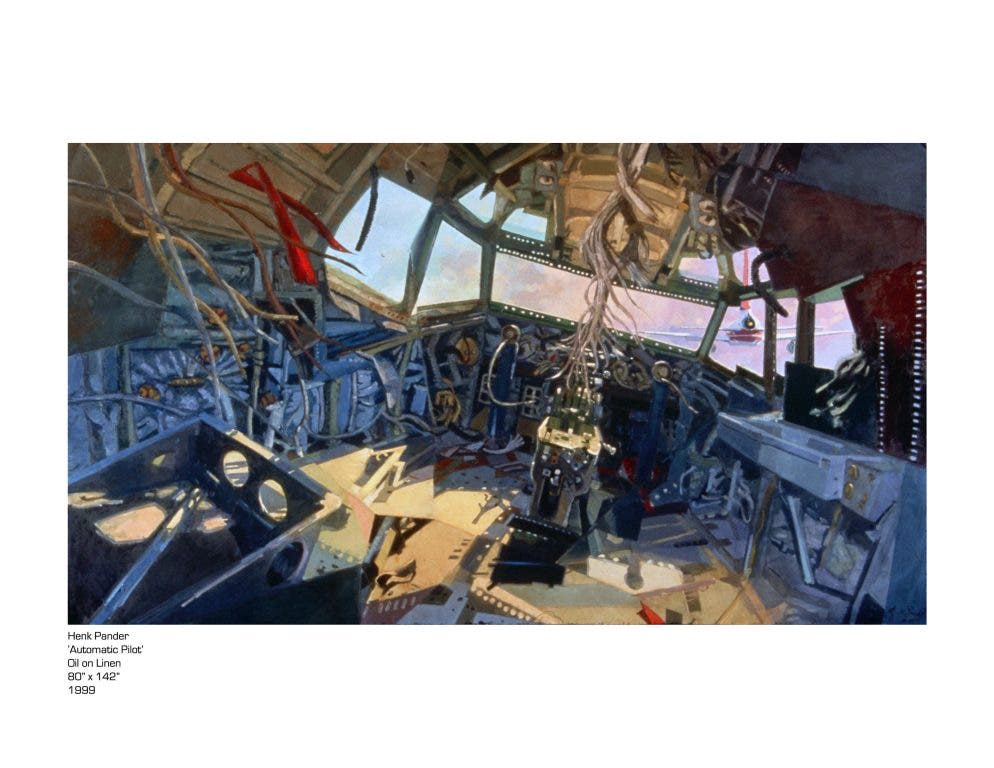
Q: What is the value of working outdoors, as you are often depicted doing in unusual locations in the film, including in an airport of long abandoned airplanes and fighter jets?
A: I always like to paint and work outdoors. It involves an enormous amount of skill to do it.
Q: What influence has living in the Northwest, particularly in Portland, had on your work over the years?
A: It has had quite a bit of influence. I was lucky when I came here. Portland was small when I came here and everything was accessible. There were lots of opportunities, creating theater sets and pieces for civic auditoriums, that I would never have happened for me in a big city like Amsterdam.
Pander followed Jacob's mother to Portland, where she had family ties, after Jacob and his brother were born in the Netherlands.
I had to live by my wits then – because of the difficulties – which meant I had to grow. I had to learn the language and culture. You become bigger when you overcome those challenges.
I don’t know any Dutch artist making large-scale war paintings. Being an immigrant – the physical and culture distance – definitely has had an impact on my work. And the scale of the land here has influenced me to create larger works. I had a show recently in Holland and there was great admiration for those larger-scale works. I realized that I have become an American artist.
He particularly loves the beauty of the Northwest.
If you have an imagination you don’t have to go far around here to be inspired as it is incredibly beautiful.
Q: Like many artists, you have been the subject of controversy. What is your advice to emerging artist who also struggle when their art is not universally "liked?" How can artists find a balance between work that is authentic and reflects their own unique world view while still being "commercial" enough to sell their work and make a living?
A: If your art is like everyone else's you are doing something wrong. Art is the only profession where you can become a public target. It's not that way for lawyers or doctors. Everyone has opinions and sometimes people are catty. You often have a thick skin. You have to have a sense of who you are.
Q: You have been a working artist all your life with a celebrated body of work. What is your advice to young artists who are struggling to establish their careers?
A: I'm versatile. I can illustrate books, paint portraits and theater sets. So develop a broad skill set. You also have to have discipline. Don't let yourself be distracted. Even as you are interviewing me now I'm looking at a painting I’m working on, thinking about what I’m going to do next. You have to be OK sometimes with going hungry and worrying about the bills.