
The Sammamish Plateau Water and Sewer District is aware that many of our customers have received responses from the Department of Ecology. Below are our factual responses to those statements.
Ecology Statement: “Issaquah committed to replacing stormwater infiltration lost by the building of the Issaquah Highlands development. Infiltrating treated stormwater is consistent with the1999 Issaquah Creek Valley Ground Water Management Plan.”
District Facts: This Plan states, under the Summary of Technical Findings and Recommendations: “Given the location of the municipal wells, the Lower Issaquah Creek Valley is a vulnerable aquifer system.” Section 2.2.3 says “Past and present storm water management practices account for some ground water quantity and quality problems. Ground water quality may be affected if storm water containing contaminants is recharged intentionally or inadvertently.” Furthermore, the conceptual understanding of the groundwater recharge and pathway under pre-developed conditions established by Issaquah Highlands developer Port Blakely was determined to be incorrect after an evaluation of the 2004 Camp Creek Slide event. The Camp Creek Slide was a mudslide in Issaquah that closed the westbound ramp of I-90 at the Sunset Way interchange. This technical review of this incident revealed that there was not a direct connection and pathway of surface water infiltrated at the development to the Lower Issaquah Valley Aquifer (LIVA). To the District’s knowledge, despite this major discovery, no re-evaluation of the groundwater recharge was performed to design and build a stormwater infiltration facility that mimics pre-development conditions.
Find out what's happening in Sammamish-Issaquahfor free with the latest updates from Patch.
Ecology Statement: “Ecology required a permit for this stormwater infiltration project in response to the concerns of the District and Issaquah expressed through their appeals and negotiations over various Ecology actions in the last 10 years.”
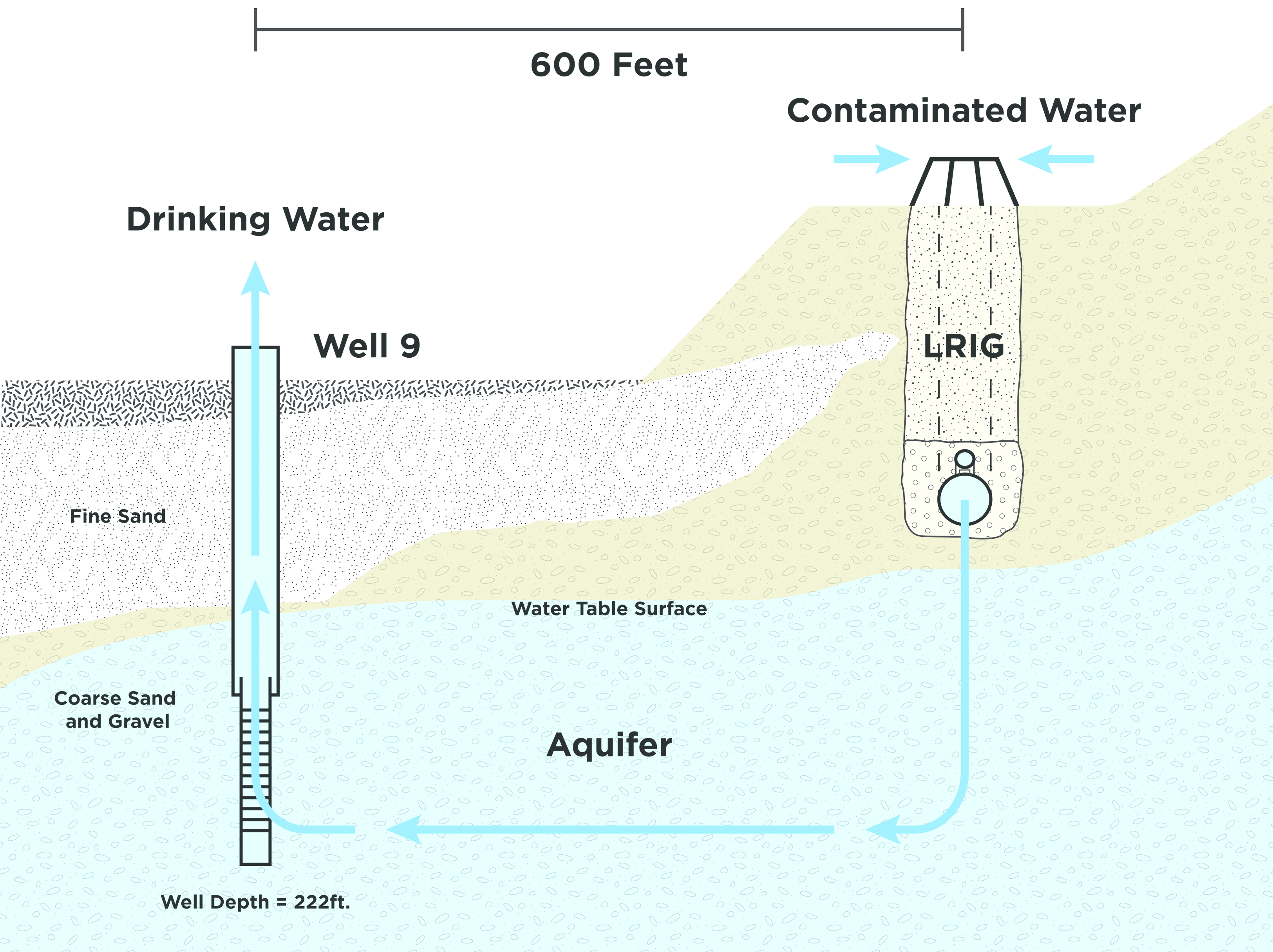
District Facts: The District’s concerns were serious. Fecal coliform bacteria had been detected in a District monitoring well, indicating that the LRIG had failed to adequately filter out this bacteria. Additional sampling under Ecology’s two year Agreed Order to the City has revealed that the current filtration system insufficiently treats fecal coliform and, may actually be adding fecal coliform and elevated levels of organics that are likely to plug the aquifer and change its geochemical condition. Due to this facility’s location, in terms of its underground site conditions and the proximity to a high capacity production well, and the documented deficiencies in its current treatment system, a permit alone does not suffice for mitigating the risks associated with the operation of this facility.
Find out what's happening in Sammamish-Issaquahfor free with the latest updates from Patch.
Ecology Statement: “Issaquah uses the system in the rainy season. The permit would require Issaquah to continue to pre-treat its stormwater, monitor the stormwater and nearby groundwater, and take corrective actions in response to any problems detected.”
District Facts: The District has proven through decades of scientific monitoring of aquifer levels that this aquifer does not need artificial groundwater recharge during the rainy season. Because the soils surrounding this aquifer are highly porous sand and gravel beds and the storage of this aquifer system are relatively small, the winter rainfall and extensive uplands surrounding the Lower Issaquah Basin more than adequately recharge the groundwater to the LIVA. Our water level monitoring data show that the response to the injection of the stormwater is instantaneous. This means the assumed enhancements to stream flows do not occur during the summer months when streams are in need of base flow enhancement, but instead occur during the time of injection when the streams are at, or near flood stage, clearly not a time to be adding to stream flow. It is not worth the risk of injecting contaminated stormwater when the enhancement objectives of replenishing the aquifer and enhancing stream flows are not realized and are not needed during the wet season when the system operates.
Ecology Statement: “In the ground, the soil itself provides additional filtration. Infiltration of stormwater is used routinely in Washington in areas where groundwater is the drinking water source including Issaquah, Sammamish, Redmond, and Spokane.”
District Facts: In an ideal situation, the soil would be of a less porous composition and a greater depth year round to more fully filter harmful bacteria from the stormwater. In the unique case of the LRIG, however, the depth of soil claimed by Issaquah is highly debatable as the aquifer’s water level rises considerably during the winter months, diminishing to a much shallower depth the amount of soil left to do the filtering. Additionally, no other injection well in the state is located within such close proximity to a large municipal well as the LRIG is to District Well 9.
Ecology Statement: “The permit will require monitoring and needed changes regardless of who owns the nearby wells and piping systems.”
District Facts: Ecology is aware of Issaquah’s intent to take over the District’s well using a process called assumption. Official records show that Issaquah’s intent behind the assumption action is to gain control of the wells. This would effectively silence the District’s concerns and role in protecting this groundwater resource. More alarming is the fact that once in Issaquah’s control, public records show that their intention is to get the LRIG “Rule Authorized” which means Ecology would no longer have oversight and Issaquah would be left to self-monitor all injection activities. Once that happens, Issaquah intends to dramatically increase the amount of water injected, essentially pushing more stormwater into the aquifer. The District has pointed out concerns based on scientific fact for this particular practice in this unique situation.
Ecology Statement: “Issaquah withdraws water from this same aquifer and also needs to protect its use as a water supply.”
District Facts: Issaquah’s wells are not located in the more highly productive portions of the aquifer, which is where the LRIG stormwater flow will be injected. The City’s wells are also not in the direct flow path of the stormwater injected at the LRIG. The water chemistry and pH levels are dramatically different and the Issaquah wells are miles away from the District wells.
Ecology Statement: “In 2007 the District, Issaquah, and Ecology met over the District's concerns about the LRIG. In 2008, Issaquah agreed to stop discharge into the infiltration pipe and direct the treated stormwater to the North Fork of Issaquah Creek while they completed water quality testing and a well assessment.”
District Facts: As mentioned previously, this concern stemmed from the substantial fecal coliform detection in the District’s monitoring well, demonstrating that the bacteria had indeed entered the aquifer. Ecology forced Issaquah to stop injecting and divert stormwater to the North Fork of Issaquah Creek, previously listed on King County’s list of streams seriously stressed by fecal coliform contamination.
Ecology Statement: “The Order included a final outcome of requiring a permit for Issaquah to operate the system or simply allowing its use without a permit. No other municipal stormwater infiltration system has been required to obtain a permit in the state.”
District Fact: Ecology issued an Agreed Order #7142 on November 5, 2009, which forced the City to comply with state regulations to avoid degradation of the groundwater source. Ecology determined that there was a risk that discharges from the LRIG could potentially pollute the groundwater. No other infiltration system in the state requires a permit because no other infiltration system sits on top of highly porous soils and in such close proximity to a major municipal drinking water source.
Ecology Statement: “The LRIG is located at least 25 feet above the ground water level…”
District Facts: This measurement is highly debatable, since the groundwater level rises considerably during the rainy season, seriously diminishing the amount of soil left to filter contaminants from the water before reaching the aquifer. During the rainy season, the depth of this soil zone can be a much shallower depth than the 25 foot state requirement, which does not provide an adequate layer for the treatment of contaminants.
Ecology Statement: “Ecology required Issaquah to apply for permit coverage on the application with title, 'Industrial Discharge to Ground' because it was the closest match for this unique situation.”
District Facts: The permit application title is “Application for a State Waste Discharge Permit to Discharge Industrial Wastewater to Ground Water by Land Treatment or Application.” In this unique situation, the District feels that more adequate pre-treatment options should be considered.
Ecology Statement: “The District's letter stated that Highlands runoff ‘carries serious pollutants.’ The runoff does have pollutants at levels below state drinking water standards, with the exception of iron and coliform bacteria. All treated stormwater contains contaminants at low levels, as does drinking water…”
District Facts: Groundwater drawn from the District wells is far more pure than the state’s drinking water standards. To suggest that it is acceptable to degrade an aquifer to “drinking water standards” goes against Washington state law, which forbids the degradation of a groundwater source. Ecology also confirms the District’s greatest concern of the high fecal coliform content in the stormwater.
Ecology Statement: “Total coliform bacteria has a drinking water standard of zero and is the contaminant of primary concern. In prior operation, total coliform bacteria was detected in a monitoring well thirty feet away from the infiltration pipe. Bacteria levels dropped by 99% or more in that thirty feet of travel through the soil. The District's closest well is over 500 feet from the infiltration pipe. The soil has shown excellent bacteria removal in the past at higher flows than now proposed.”
District Facts: Ecology does not mention that it was fecal coliform that was discovered, not total coliform. There is simply too much uncertainty with the stormwater pollutant load from the LRIG, and also with the groundwater travel times during the period during which Issaquah collected these samples to make the treatment assumption that Ecology is presenting in this statement. The sampling methods that Issaquah used to collect the data show that the standard method of sampling for evaluating stormwater treatment effectiveness was not used. Additionally, groundwater travel times were not incorporated into this evaluation of bacteria removal. It may be that the bacterial load entering and recorded in the stormwater sample had not yet reached its peak at the monitoring well down slope when the groundwater sample was collected. Clearly, there are significant complexities and unknowns associated with effectively monitoring the LRIG for protectiveness and mitigating its risks. What we do know is that the LRIG system has failed before, and the treatment technology remains unchanged from the last failure in 2008, when fecal coliform and iron entered the aquifer. Combined with fluctuating aquifer levels reducing the soil treatment area (the vadose zone), and the expectation that the facility will last for decades without contaminants loading in the narrow vadose layer, there are just too many uncertainties involved to assure that a contamination event will not occur.
Ecology Statement: “I hope you will consider the value of replacing the groundwater taken out of the aquifer with concerns over proper control of contaminants. Permitting the LRIG will provide the proper oversight to strike that balance.”
District Facts: Until Ecology and Issaquah change the technology or add additional pre-treatment to the stormwater, it will continue to a highly risky way of disposing of stormwater underground. Its proximity to a major municipal groundwater resource that delivers drinking water to thousands of residents in Sammamish, Issaquah and parts of King County is an ongoing concern. The District feels it is a hazard, since the LRIG already failed in 2008. Since nothing has changed in the LRIG system, history has a high likelihood of repeating itself. Further, a more thorough evaluation of the hydrogeology of the area should be performed before making such generalized statements about the benefits of City’s stormwater management. To the District’s knowledge, neither Ecology nor the City have evaluated the recharge lost to the LIVA from the impervious surface of this area.