Health & Fitness
'Medicare For All' Movement Growing In Puget Sound
The U.S. healthcare system is bad and getting worse, say organizers making a new push for universal medical coverage.


SEATTLE, WA - Greg Strauss of Westport, Conn., lost his right foot in April after an accident on a yacht. Now faced with a long recovery, and the sudden need for a prosthetic foot, Strauss has turned to the website GoFundMe to raise $200,000 - about the amount his health insurance will leave him stuck with.
GoFundMe is loaded with stories likes Strauss's. Over the last year, some 250,000 people have used GoFundMe for medical fundraisers, the website boasts.
But, a growing political campaign wants to show Americans a different way to do healthcare. The Democratic Socialists of America (DSA) group has started a national "Medicare for all" campaign. M4A would create a single-payer, government-run health insurance system that would replace the entire private health insurance industry.
Find out what's happening in Seattlefor free with the latest updates from Patch.
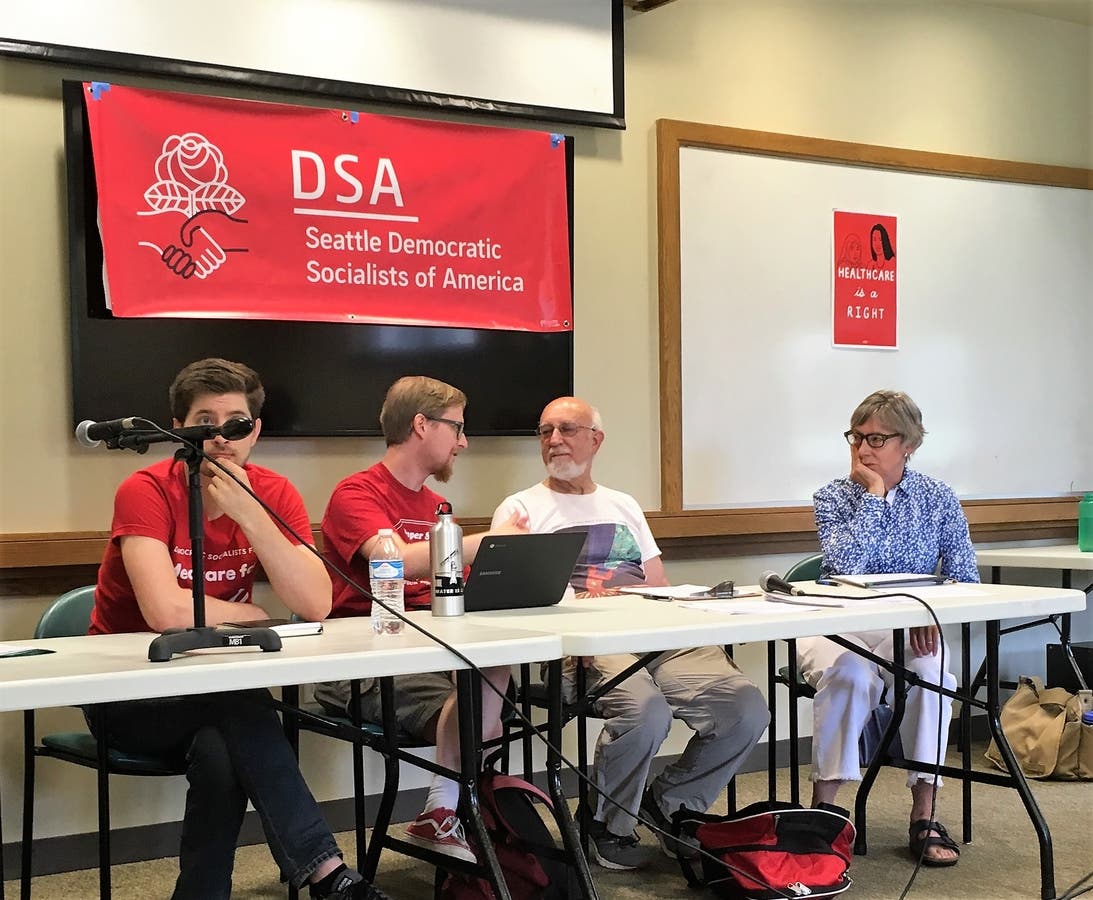
In Puget Sound, DSA organizers have been out canvassing for months. On Sunday, the group hosted a forum in Seattle for people who are curious about M4A. The forum began with one revealing question.
"How many of you have had trouble paying medical bills?" DSA organizer Paul Alexander asked the few dozen gathered at the meeting room at the Columbia City branch of the Seattle Public Library. A majority raised their hands.
Find out what's happening in Seattlefor free with the latest updates from Patch.
The panel - comprised of DSA organizer Andrej Markovčič, Swedish physician Dr. James Squire, Martha L. Schmidt from the Seattle National Lawyers Guild, and Stan Strasner from the Seattle Education Association - talked about why so many people have trouble paying for healthcare, and why the system needs to change.
Squire offered perhaps the starkest reason for change: people are dying unnecessarily.
Around the time of the 2008 financial collapse, Squire, who specializes in addiction recovery, had two patients who lost their health insurance. Without it, they stopped going to treatment and later died.
"Healthcare has become a commodity," he said. "What this means is people are going to die."
Schmidt said that the M4A push needs to come from a human rights angle. When healthcare is seen as a human right, she said, it's harder to prevent people from getting it.
Markovčič said that DSA's M4A plan has five points: a single healthcare program for everyone; comprehensive coverage for any medical need, including dental and vision care; no payment required when you go to get care, no copays either; universal coverage for everyone, including immigrants; and a jobs program for workers transitioning out of the healthcare industry.
Before Sunday's forum, M4A volunteers went door-to-door in Seattle's Othello neighborhood talking about the initiative. Seattle DSA M4A spokesman Chuck McKeever said people have a lot of questions, but many agree M4A makes sense.
One of the most frequent questions organizers get about M4A: Who is going to pay for it?
In late July, the Mercatus Center, a Libertarian think-tank funded by Charles and David Koch, published a study estimating that M4A would cost $32.6 trillion over the first 10 years. The study also predicted total healthcare spending - federal and private combined - would rise to about $4 trillion by 2022, and over $6 trillion by 2031. At that rate, all healthcare spending would actually exceed that $32.6 trillion M4A estimate
"We should't pursue M4A just because it costs less," Markovčič said. "But it just so happens that it's cheaper.
There are several M4A bills at the federal level. U.S. Rep. John Conyers, D-Detroit, has introduced one in every session of Congress for years. U.S. Sen. Bernie Sanders introduced an M4A bill last September. U.S. Rep. Pramila Jayapal in July formed a caucus of members of Congress who support Medicare for all.
But getting a bill passed, even a perfect one, isn't the goal of the M4A movement. Organizers want to create a political apparatus that would defend universal healthcare from attempts to weaken it. The panel compared movement to the recent head tax debate in Seattle: Amazon and other large corporations were able to get the head tax repealed by threatening Seattle city officials. The tax could've succeeded if there was a similarly powerful group advocating for it.
"We want to make M4A a litmus test, and we need to make [politicians] answer on it," Markovčič said.
Photo by Neal McNamara/Patch
Get more local news delivered straight to your inbox. Sign up for free Patch newsletters and alerts.