Health & Fitness
As Coronavirus Surges In WA, Health Officials Sound The Alarm
"This situation is extraordinarily urgent, and we're running out of time to change direction," said Dr. Kathy Lofy, state health officer.


OLYMPIA, WA — Washington's top health officials have issued an urgent call to action as coronavirus case counts and transmission rates continue to soar, and the holiday season is fast approaching.
The Washington State Department of Health hosted a news conference Tuesday afternoon, sharing details from the state's latest situation report and flagging several concerning markers found among recent data.
"I am extremely concerned about what seems to be an accelerating trend in the spread of COVID-19," said Dr. Kathy Lofy, the state health officer. "Immediate action is needed from all of us to avoid new restrictions and prevent our hospitals from becoming overwhelmed. This situation is extraordinarily urgent, and we're running out of time to change direction."
Find out what's happening in Seattlefor free with the latest updates from Patch.
The state's new report, which only accounts for activity through Oct. 30, found rapid disease spread across Washington, along with a rise in hospitalizations. In recent days, those trends have only grown.
Across the United States, hospitalizations reached an all-time high Tuesday, surprassing the peak recorded in mid-April.
Find out what's happening in Seattlefor free with the latest updates from Patch.
Key takeaways from the statewide situation report:
- Disease is spreading rapidly across Washington. The best estimates of the reproductive number (how many new people each COVID-19 patient will infect) are 1.29 in western Washington and 1.36 in eastern Washington as of Oct. 30. The goal is a number well below 1.0, which would mean COVID-19 transmission is declining.
- From mid-to-late October, case counts and hospitalizations have increased in both western and eastern Washington. Although some of the increase in cases through early October is related to increased testing volumes, more recent case counts in both eastern and western Washington have increased, despite testing volumes being flat.
- Hospitalizations will continue to rise in western Washington even if cases start to plateau. Hospital admissions in western Washington have been increasing since the start of October. Because patients may stay in the hospital for up to several weeks, hospital occupancy will continue to rise for some time after hospital admissions level off.
While state and local health leaders have been sounding the alarm about intensifying coronavirus activity since late September, Lofy said the latest numbers are even more alarming.
Washington has logged more than 1,000 cases for seven consecutive days:
Nov. 4: 1,469 cases*
Nov. 5: 1,070 cases
Nov. 6: 1,691 cases*
Nov. 7: 1,770 cases*
Nov. 8: 1,320 cases
Nov. 9: 1,239 cases
Nov. 10: 1,441 cases
*New daily records
"We have the highest number of cases that we've ever had, and our case counts are accelerating," Lofy said. "Unfortunately, this accelerated growth in case counts is widespread, occurring in both western and eastern Washington, as shown in the two graphs on the left that have essentially become vertical over the last two weeks."
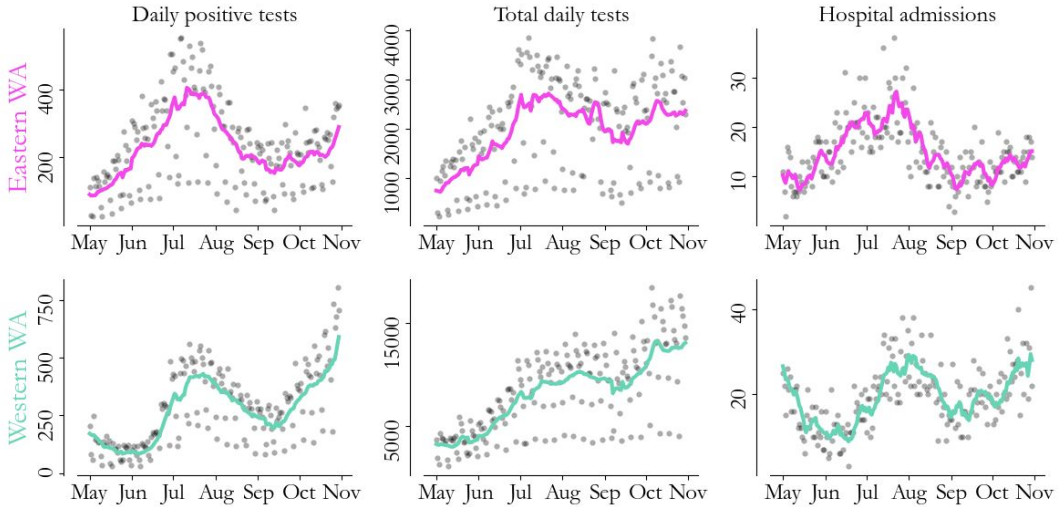
State health officials said the spike in illness runs parallel with "essentially flat" testing rates, indicating an increase in transmission not attributable to better detection. Recent cases have been distributed among age groups, increasing chances for infections in older people and those with underlying health conditions who are most likely to suffer serious and life-threatening complications.
While transmission sources can vary widely, the primary mission among health officials now is getting people to cut back on their social lives.
"We all need to do our part to flatten the curve once again," Lofy said. "Ideally, we should probably all stop socializing for the next several weeks to try to slow down the disease that is rapidly spreading through our state. If you need to socialize, please limit your social contacts to no more than five people outside of your household per week, and keep your social interactions as short as possible."
Tuesday's briefing included health officers from the state's three most populous counties, all of whom reported a surge in cases and other risk indicators.
In King County, Dr. Jeff Duchin referenced warning signs he has highlighted for weeks. Now, the county is nearing 400 new cases every day, and hospitalizations are up 30 percent.
"COVID-19 is a viral wildfire, and we are the fuel," Duchin said. "Let's not throw more human lives on the fire."
Duchin echoed his colleagues' pleas to significantly curb in-person interactions and a rededication to proven public health measures to avoid further community spread.
"At this time we all need to cut back on nonessential activities and contact with others outside the home," Duchin said. "Make interactions brief, wear masks whenever with non-household members, avoid crowded indoor spaces, pay attention to increasing ventilation and generally do things safer, smaller and smarter."
In Pierce County, Dr. Anthony Chen said 11 of the last 14 days included case counts above 100, including a record of 226 illnesses reported Saturday. The county's 14-day rate of cases per 100,000 residents has ballooned to more than six times the target threshold.
In Snohomish County, Dr. Chris Spitters said the case rate surged by 50 percent between Oct. 31 and Nov. 1, and the county's testing positivity rate hit 6 percent over the last month. Similarly, the number of COVID-19 patients in Snohomish County hospitals have nearly doubled in the last week, up to 44 Tuesday, with six people requiring ventilators.
"With hospitalizations generally trailing two to three weeks after transmission occurs, the recent spike in cases suggests that we are in the beginning of a surge in demand for hospital care that may become overwhelming — and I submit will become overwhelming — if we don't change our course immediately," Spitters said. "Not after the holidays, not next week, not tomorrow — now."
Beyond the immediate concern of hospital bed availability, Spitters said, high community spread also threatens available staffing levels if health care workers become infected in their daily lives. The result of both can impact the ability of all residents to seek and receive treatment for any condition.
"We are deeply concerned about an impending crisis, and you should be concerned, too," Spitters said. "While I think we are already in the beginning of such a hospital surge and alarm bells do seem to be sounding, I believe, with a concerted effort, we can alter the course we're on now."
Heading toward the holidays, when gatherings among family and friends become even more likely, health officials are pleading with Washingtonians to place firm limits on their social activities and try to put them on pause altogether.
"Our neighbors in Canada celebrated their Thanksgiving about a month ago and saw large increases in cases following that," said Lacy Fehrenbach, the state's deputy secretary for COVID-19 Response. "We cannot afford that in Washington state. Any in-person gathering is risky right now, both for those that attend that gathering and because it can further accelerate the spread of the pandemic."
To avoid such a spike, health experts recommend holiday celebrations only include those living under the same roof.
"The safest Thanksgiving is the one celebrated only with the people in your immediate household," Fehrenbach said. "For those of you that want to have a small Thanksgiving, please make it outdoors, please limit it to no more than five people outside your household, and you should seriously consider a full quarantine for the two weeks prior, which starts very soon."
Even if those standards can be met, Fehrenbach said, they must be combined with other precautions, such as wearing face coverings and keeping physically distant, to further reduce the likelihood of infection. The state has assembled a list of low-risk alternatives to traditional celebrations and a safety checklist to consult for those who choose to gather.
In the days ahead, health officials will keep a close eye on the status of each county's health care system, a key indicator that will inform whether more mandatory measures could be instituted. Officials said Tuesday they hoped extreme measures would not be necessary and case counts could come down by voluntary community action.
"We do not want to take further actions that will further hurt our economy; but, unfortunately, if we continue on this trajectory, at some point we may need to," Lofy said. "We are talking about really all potential actions that we could take, some more dramatic than others. We don't want to take any, [and] we really hope people can change their behaviors."
While the actions required now are urgent, officials say, seeing the results will take time, and require sustained commitment to ensure success.
"No matter what we do, it could take weeks or more to turn this current COVID trend around," Duchin said. "The cases and illnesses we are seeing today are a direct result of our behaviors and activities a few weeks ago. What we do today determines where we will be two to three weeks from now."
Washington coronavirus links and information:
- Washington coronavirus dashboard
- State risk assessment dashboard
- Reducing coronavirus risk indoors: recommendations for fall and winter
- Celebrations during COVID-19
- Safer gatherings checklist
- Find a coronavirus testing location
- Why is the flu vaccine so important this year?
Steps to reduce the spread of COVID-19, from the Washington State Department of Health:
- Limit in-person gatherings as much as you can. That means reducing the number of times you gather, how many people attend and how long you spend together. Gather outside if possible, or open windows and doors to maximize ventilation inside.
- Always wear a face covering when you’re around people who don’t live with you. This includes close friends and family. It may feel awkward to do this around people we know well and trust, but many people get COVID-19 from someone who doesn’t have symptoms yet. Even if you’re keeping some physical distance, it’s still a good idea to wear a face covering.
- Talk to your family and friends about alternate ways to celebrate the holidays. Brainstorm ideas for virtual celebrations so you can still enjoy spending time together without putting each other at risk.
- Make a safety plan for in-person gatherings. Have a conversation with your family and friends about what you’re going to do to reduce risk of spreading COVID-19 when you gather.
- Stay home if you’re sick or have been exposed to COVID-19. If you’re feeling a little under the weather but aren’t sure if you’re getting sick, take the cautious approach and protect others by staying home.
- Keep up your good hygiene habits. Wash or sanitize your hands often and avoid touching your face.
Get more local news delivered straight to your inbox. Sign up for free Patch newsletters and alerts.