Schools
Hudson High School Forensics Team Excels at State
The Hudson High School forensics team recently returned from another successful experience at the state meet in Madison.
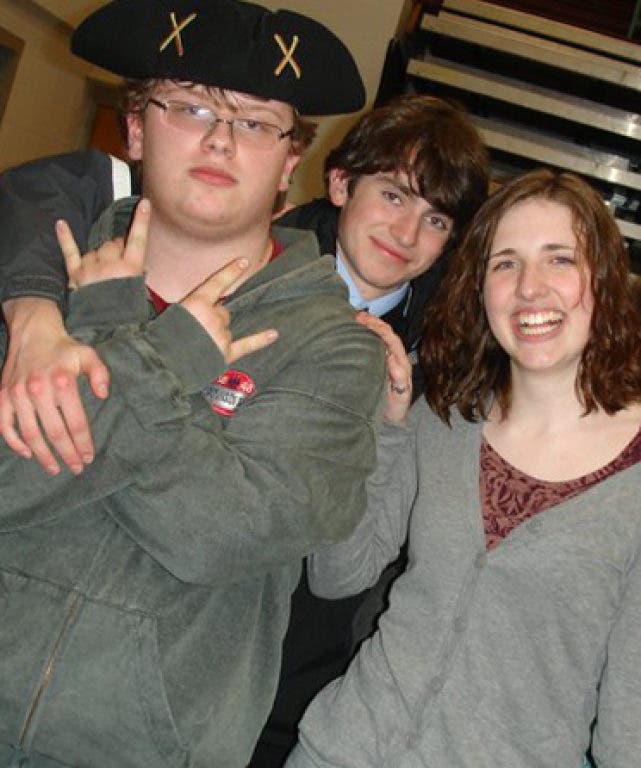


Stepping into Nikki Benson’s classroom at Hudson High School at 2:45 on a late April afternoon is a bit like stepping backstage at a comic opera. A whir of activity, laughter, and controlled chaos are the rule as young people come and go, huddle together in corners of the room, and buzz around Benson’s desk.
They are students at the school, of course, but not just students. These students are part of the Hudson High School forensics team. Hudson teachers Nikki Benson and Craig Lewis are the team’s coaches and the students have come to Benson’s room to ask questions and to solicit advice—to tweak their performances the day before they head to Madison for the state forensics competition.
For the uninitiated, forensics sounds like something it decidedly is not. There are no crime-scenes or dead bodies in Benson or Lewis’s classrooms. Not unless they are part of a script. As Coach Lewis explains, “high school forensics, and the science of forensics have their roots in the same word, but that’s where the similarity ends.” The word forensic comes from the Latin forensis, meaning "of or before the forum."
Find out what's happening in Hudsonfor free with the latest updates from Patch.
That describes fairly well what takes place in high school forensics, stand before judge and say your lines, read your poem, act out your scene. And no matter how much advice Coach Benson and Coach Lewis offer, when push comes to shove, it's up to the students to perform, literally.
Benson’s calendar can attest to the nearly non-stop, after school forensics practice in her class room, especially in the weeks leading up to the state finals in late April. She and Lewis take their coaching seriously and are dedicated to these students, and to forensics as an art. It’s a major time commitment for both coaches and they’ve been doing it a long time. Benson has been a coach at the school for seven years, Lewis for more than 30.
Find out what's happening in Hudsonfor free with the latest updates from Patch.
Together, their respective classrooms in the west wing of the school are gathering points, and creative centers for Hudson forensics. Members of the team come there to practice and recite and rehearse and listen and emote. Forensics requires all of those and more.
When Benson is asked to explain high school forensics to the lay person, she sums it up succinctly and definitely. “Forensics is competitive speech and acting.”
That sounds like a simple thing to accomplish, but imagine you are alone in cold, nearly empty room, standing in front of a judge who will offer no mercy if you stumble or err or “um.”
Or perhaps you are part of a small group; two or three or four students who must act out a scene from a written work, but you are allowed no props, no costumes, no make-up, no lighting. It’s just you and the judge; your every nuance being scrutinized and critically examined.
Then there is Group Interpretation. In “Group Interp” you and the members of your group will not be allowed to interact with each other as you perform. You must convey your intent through modulation and inflection. You must work from a script, and you must direct all of your vocalizations toward some unseen, offstage entity—a peculiar and compelling scenario.
Or maybe you’ve come to read a classic poem, or a little-known poem, or maybe even a poem of your own creation. You might have chosen to tell a story or act out a scene from a play or a movie, without the benefit of a script.
In all cases you must understand your topic, and make the performance cogent, natural, entertaining, and fluid. That’s forensics. It’s a daunting proposition, at least for most of us.
Many adults list public speaking as one of their greatest fears. Those who overcome that fear are respected, and sometimes idolized, by those who cannot. That’s how politicians and celebrities come to be.
The students who join Benson and Lewis’s team pursue making speeches as a competitive sport. It’s hard to imagine there being a more worthwhile skill for life after high school.
So, the students attracted to forensics are naturally outgoing, extroverts, right? Lewis says no. ”Some of my best forensics competitors are really very shy.”
Benson agrees. “We have students in forensics who are naturally shy,” she continues, “and sometimes their parents will suggest they join the team to become more confident in themselves.”
Evidently it works. To the casual observer there in Benson’s after-school training session, the students, all of them, appear confident to the point of bursting. And they grow in confidence with each performance.
You might also assume that there would be limited appeal for such a subjective, and potentially ego-bruising competition, but this year 35 students at Hudson High School participated in the program. And this year 33 of them qualified to compete in Madison.
That’s a first for Hudson High School—the entire available team qualified for state.
The only two who didn’t go to Madison this year were students who were unable to compete in the required district competition.
It’s the biggest forensics group Benson has taken to state in her seven years of coaching. Lewis recalls that in 1993, 39 students went to the state competition, but that wasn’t the entire team—not everyone qualified. This year’s team has set a new standard.
And with team members from every year class at the school, the forensics program seems well-established for now and into the future.
The high school forensics season runs from November through April, with the main competitive season running from January through April. It is administered and regulated by the Wisconsin High School Forensics Association, an organization that has been in existence since 1895 and is the oldest association of its kind in the nation. With 387 member schools and over 15,000 students participating, High school forensics is alive and well in Wisconsin, and in Hudson.
They not only regulate the competitions and maintain the rules, but they also set the topics allowed—topics which can change from season to season.
A big part of Benson and Lewis's coaching involves helping students pick a topic, and a discipline, which suits them. The categories may change from year to year, but the constant is the method. Follow the method, understand your topic, present with confidence, and you will do well.
The 2010-2011 season just ended and Benson and Lewis report, with a distinct sense of pride, that the Hudson High School team excelled. Of the 33 participants, 15 earned gold medals, 13 silver, and five bronze. With success like that, and with such energetic coaches, it’s easy to see why the program is perennially popular at the school.
When Coach Lewis is asked why he has devoted so many years to Hudson High School forensics, he replies, “I guess it’s a continuation of my own youth.” Lewis was a forensics competitor in both High School and college. He has been a coach ever since, and he was a judge for many years too. Clearly he still enjoys watching the competitors grow and flourish. “It will be time to quit,” he expounds, “when a grandchild of one of my original forensics kids joins the team.”
You get the sense that Lewis is both looking forward to and dreading that day, but with the equally dedicated Coach Benson at the school, it’s apparent the program is in good hands for now and into the future.