Sports
Drat, It's Time to Put the Boat Away
There are some simple things you can do now to winterize your boat so it's ready next spring.

I hate to even think about putting the boat away for the winter. It happens every year, and every year I hem and haw and find excuses not to do it. It’s just one of those ugly tasks that have to get done before the freezing winds of November sends me burrowing into another long winter.
Winterizing my fishing boat is one of the least pleasant things I do during the course of the year, but the alternative is even uglier.
The reality is, if I don’t properly prepare the boat before storing it for the winter, next spring I won’t be a happy camper when I discover that my outboard is nothing but an expensive weight hanging on the transom.
Find out what's happening in Hudsonfor free with the latest updates from Patch.
Fortunately, there are some quick, relatively painless things you can do now which will ensure you have no surprises next spring when you have a line forming behind you at the boat ramp.
The simplest of all the things you can do is to run your engine dry to empty to fuel system. Gasoline deteriorates surprisingly quickly, and can turn into a varnish-like substance guaranteed to prevent starting, and encourage profanity, next spring.
Find out what's happening in Hudsonfor free with the latest updates from Patch.
By disconnecting the fuel line and allowing the motor to run out of gas, you are effectively removing the potential problem.
You can add a fuel “stabilizer” to the system as an alternatives, but unless you run the engine for some time after introducing the additive to the tank, it won’t make it’s way into the carburetor or injector system.
Personally, I keep a stabilizing product in the fuel tank all summer, and I run the motor dry at the end of the season. It’s cheap enough insurance.
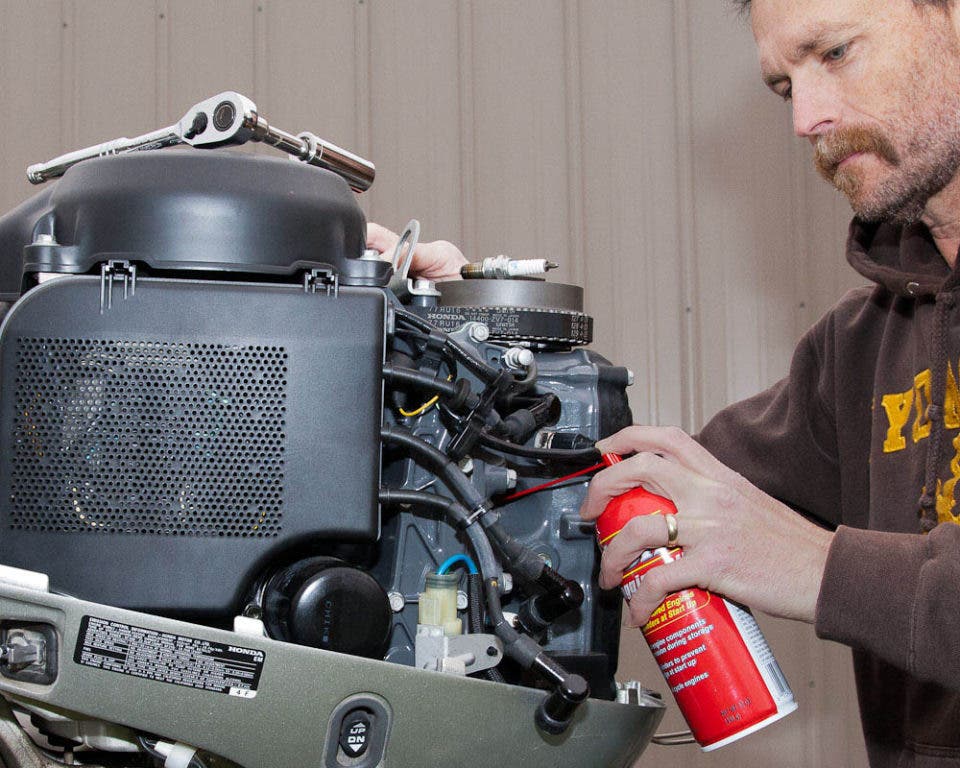
After, I run the motor dry, I fog the cylinders. This sounds suspiciously like a job for a mechanic, which I most certainly am not, but it’s really just a matter of removing the spark plugs and spraying a “fogging oil” into the cylinders. I then turn the engine by hand to spread the oil evenly on the cylinder walls, preventing corrosion from developing inside the engine during storage.
Some people will also introduce fogging oil into the fuel intake system by cranking the engine and spraying the fogging oil into the intake manifold or carb. I prefer to simply run the intake side dry.
The lower unit needs some consideration at this time of year also. At the very least, you should pull the propeller and make certain that the seals around the prop shaft are intact. Fishing line wrapped around a propeller does a very efficient job of corrupting the seals which keep water out of the system.
You can usually determine if any water has entered the system by looking at the lower unit gear case lube. If it is milky looking, or foamy, there is water present and the seals should be checked and replaced as needed.
The lower unit lube should be replaced yearly as a matter of course, and this is a good time to do it. Kits are available from marine dealers which make this a fairly simple procedure. The main point is, you don’t want to put the boat away with water in the lower unit. That’s a recipe for disaster as the water will expand as it freezes, leading to all kinds of potential, and expensive, damage.
Which brings up the point that all the water in your boat should be removed. Livewells, built-in coolers, bilges, pumps, can all trap water which will do bad things to delicate systems when it freezes. Drain everything completely, and sponge out the water that remains.
I also lube all the grease fittings on the engine mounting and steering systems. There can be a surprising number on modern outboards and I/O drives. New lube in these fitting will force out any trapped water.
Lastly, I check all the bulbs and wiring harnesses on the trailer. Trailer lights are notoriously fragile—not really a surprise given their working environment. But they do need to be checked frequently, including at the end of the season.
I repack my trailer bearings every other year. If you trailer your boat extensively, bearings should be checked and maintained more often than that.
Repacking bearing isn’t necessarily a difficult job, but you need to know how to do it properly, so you might consider using a professional. Indeed, we have an abundance of marinas and boating experts in our area who can help with any or all boat winterizing projects.
I’ve only touched on the high points here. There are many more things you might consider, and many of these will be specific to your boat and motor. And, it really doesn’t matter if you do the work, or you leave it to the pros. What matters is that it gets done properly so you don’t have any unpleasant surprises next spring, when open water beckons.