Community Corner
Unnatural Invasion: Non-native Plants and Animals Threaten Our Woods and Waters
The list of invasive species in Wisconsin is maintained by the state's Department of Natural Resources and it's in the hundreds now. It is likely to grow.


Some 45 years ago, when I started fishing with my grandfather, we would grab his little car-top boat, a three-horse outboard, pick a lake, and go fishing. We usually found a bait shop somewhere along the way to our final destination, bought minnows, and fished.
When we were done fishing for the day, we’d dump the leftover minnows in the lake and head home, frequently with a pail full of live, flopping fish, and lake water. That’s just the way we did it, and we didn’t think twice about putting those minnows in a lake which may or may not have been a suitable dumping grounds.
In retrospect, of course, it was the wrong thing to do. We had no idea whether that dumped bait bucket contained minnows native to the lake we were fishing. We didn’t know if any of those minnows were sick minnows, with a potent virus that might harm the very species we were after.
Find out what's happening in Hudsonfor free with the latest updates from Patch.
We also didn't know that by bringing home live fish and distant lake water, we might also be bringing home plants, and animals in various stages of development—plants and animals we certainly didn't want to spread around.
We didn’t have a concept of “invasive species” way back then. Boy, have times changed.
Find out what's happening in Hudsonfor free with the latest updates from Patch.
Ever since the upper-Mississippi lock and dam system was finished, and since the St Lawrence Seaway opened in 1959, the country has become a newfound home to an ever-widening variety of plant and animal species. Some were species deemed undesirable, like the Asian lady beetle, but some were truly toxic, like Grecian foxglove, a flowering plant which is now spreading at an alarming rate just across the river in Washington County, MN.
Of course, we can't blame the locks, or the seaway entirely—there were plenty of invasive species long before the 1950s—but nationally, the rate increased exponentially when ocean going vessels hit the Great Lakes and the upper-Mississippi.
In fact, so many new invasive species regularly show up here in our region that it’s almost impossible to keep up with them. The well-known offenders are things like grass carp, common buckthorn, zebra mussels, Eurasian water milfoil, gypsy moths, purple loosestrife, emerald ash borers, et al.
There is also a fish-killing virus called VHS (viral hemorrhagic septicemia) which hasn't yet been found in our immediate area, but it is in Wisconsin, so there's cause for alarm—and vigilance. In fact, most of the current bait disposal laws on the books are meant to prevent the spread of this potent and fatal disease.
The list of invasive species in Wisconsin is maintained by the state's Department of Natural Resources and it's in the hundreds now. It is likely to grow.
It would be nice to think that given our central location on the continent, invasives from around the world would be slow to make their way to our area, but the truth is, the St. Croix River sits in a great position to be assaulted from the north and the south.
As you already know, the wild and lovely St. Croix is connected directly to the Gulf of Mexico via the Mississippi River, so anything coming up river in the bilges of ocean going vessels has the ability to make it here.
But it may surprise you to learn that on the north end, up near Solon Springs, the headwaters of the St. Croix are just a couple hundred yards from the headwaters of the Bois Brule River. The Brule connects to Lake Superior, and the St. Lawrence Seaway, and ultimately the Atlantic Ocean. Biologically speaking, that couple hundred yards is just a hop, skip and jump for anything living in the Great Lakes.
The St. Croix River has already seen it’s share of invasive species, including zebra mussels, rusty crayfish, and more recently, the big head carp, a fish that does it’s damage by consuming enormous quantities of plankton relied on by native species.
Fortunately, we have yet to see the spectacularly airborne, and potentially dangerous, flying fish—the silver carp. Silver carp, when disturbed by passing boats, frequently take to the air en masse. And when they fly, they really fly, leaping many feet above the surface of the water.
People in boats have been seriously injured by the flying carp, which can weigh up to 60 pounds. They haven’t quite gotten to us yet, but they’re in the Mississippi, so they’re coming.
As much as invasive species of the animal kind concern me, personally, it’s the plants, both aquatic and terrestrial, that scare me most; largely because they can spread so far, so fast. And, as goes the vegetation, so goes the entire ecosystem.
My awareness of the problem began many years ago with the arrival of Eurasian milfoil, which literally choked out the native weedbeds, and the fishing, on some of my favorite lakes. Now we have hundreds of plant species threatening native species both on land and in our lakes and rivers.
Some of the undesirable species were brought here deliberately as ornamental plants; some came by accident, in bundles of desirable plants or, in the case of aquatic plants, in the bilges of ocean going ships, or even in pet shop aquariums.
Regardless of how they got here, these non-native, invasive species have become such a threat that we’ve had to change the way we use our boats, and transport our fish, and buy our bait.
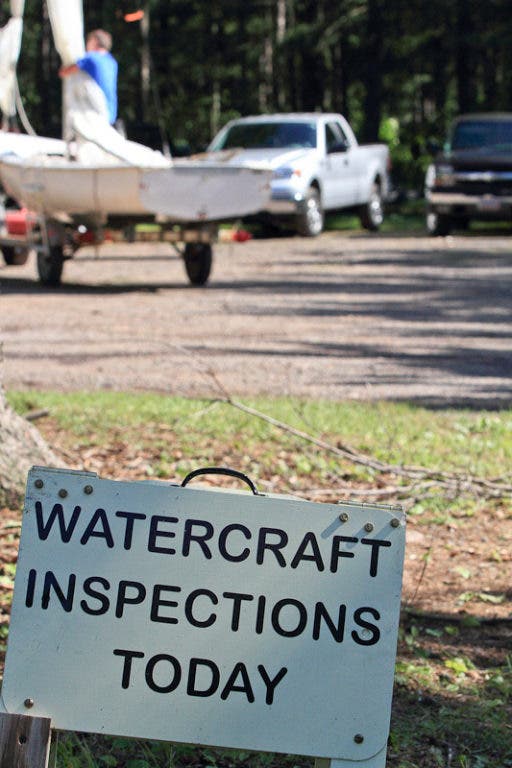
Every boat landing around is now marked with information about aquatic invasives, and the DNR, and local Lake associations set up boat inspection check points on busy weekends to make sure boaters know what to look for.
It’s certainly no fun to dump perfectly good bait in the garbage, or to remove every drop of water from your livewells and bilges, and every scrap of vegetation from your keel and your trailer, but the alternative is even less appealing—rivers and lakes choked with matted foriegn weeds, lower units and docks covered in non-native crustaceans, and exotic critters killing off or starving out our precious native species.
It’s all become a necessary nuisance, unfortunately, but it’s the price we pay for living in a global village.
