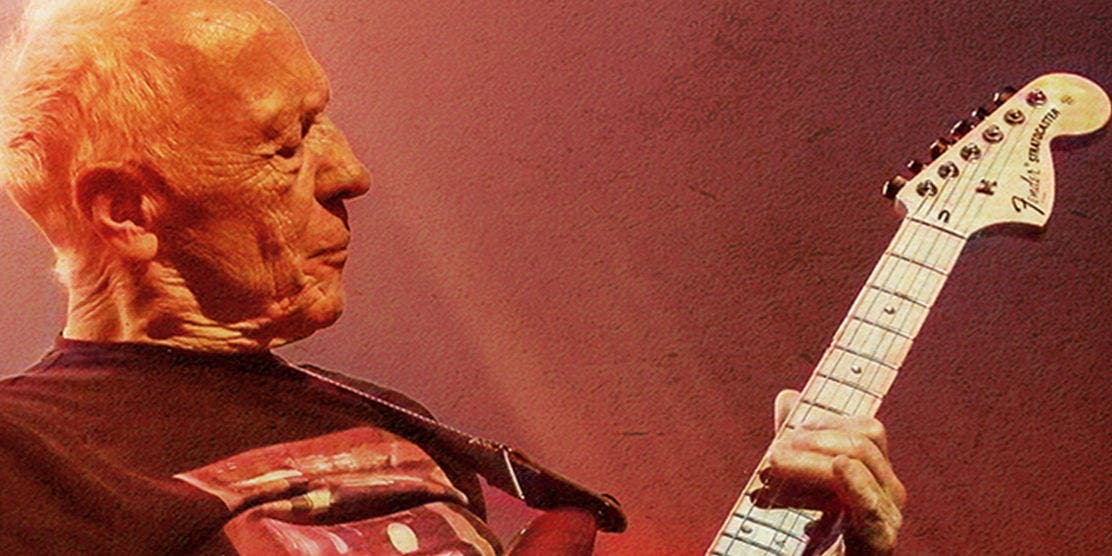
Even now, as he reaches his eighth decade, with a lifetime of accolades and a seminal body of music behind him, Robin Trower is still chasing the biggest high he knows. It always starts the same way, with a road-scuffed Fender Stratocaster and a revved-up Marshall amplifier, those skilful fingers exploring the fretboard until a riff sticks and a new song ignites. And from the cultural flashpoint of Sixties London with Procol Harum, through 1974’s stadium-filling Bridge Of Sighs, right up to this year’s acclaimed Come And Find Me, it’s these addictive moments of creation that have kept the guitarist vital, relevant and contemporary while his peers trade on past glories.
“Some people say I’m driven, but I think it’s just the love of doing it,” reflects Trower of a multi-million-selling solo catalogue fast approaching thirty releases (and that’s before you compute his collaborations with everyone from Jack Bruce to Bryan Ferry). “I play guitar every day and just through messing around, ideas happen. I can never feel the songs coming. But all of a sudden, you get a sliver of an idea and you think, ‘Oh, what’s this…?’”
Right now, Trower stands on the cusp of a whirlwind year that will see him put down heavy miles across America and the UK (“I’m chomping at the bit, because I had to cancel a US tour last year due to an operation”). At the grand vintage of 80, however, this latest tour represents a mere stretch of the long road travelled. In his mind’s eye, Trower can still see his Southend-on-Sea childhood in the ’50s, and feel the formative influence of guitar players from across the water. “Rock ‘n’ roll,” he says, “was my first love. I’m still drawing on that first love for Come And Find Me.”
When he reaches right back, Trower’s earliest memory of that rebel movement is hearing Elvis sideman Scotty Moore (“He probably had the best sound of any rock ‘n’ roll player at the time”). Next came a life-changing spin of a friend’s imported single, which happened to be B.B. King’s 3 O’ Clock Blues (“I just remember hearing the bends and vibrato and thinking, ‘How the hell is he doing that?’”). Albert King’s Crosscut Saw, Jimi Hendrix’s Machine Gun, James Brown’s Live At The Apollo: all of them informed Trower’s musical personality as he made his first moves in 1959 with R&B hopefuls The Paramounts.
The big time beckoned in 1967 when Trower joined A Whiter Shade Of Pale hitmakers Procol Harum, and many guitarists would have clung to that enviable position for life. Trower acknowledges his good fortune at being at the epicentre of that late-’60s youthquake (“I still think it was the epitome of UK popular music and rock ‘n’ roll”). But Procol’s band dynamic could never contain all his ideas, and after five acclaimed albums, Trower rolled the dice on a solo career. “It was something I had to do,” he told Classic Rock. “But it could have all gone awry.”
Needless to say, the history books have vindicated him. By 1974, Trower was a major star in the land whose music had inspired him, with Bridge Of Sighs’ heavy soul achieving Gold US sales and influencing future luminaries like Steve Lukather, Metallica and countless more. “When I hear Bridge Of Sighs, it’s like the earth under my feet is moving,” the highly rated Canadian bluesman Philip Sayce told Guitarist in 2024. “It’s like a chest is heaving.”
Trower himself is still proud of that deathless record (“I recognise the potency, especially with Jimmy Dewar’s fantastic vocals”). Yet the veteran doesn’t dine out on Bridge Of Sighs – or his other hit albums of the late-’70s like For Earth Below, Long Misty Days and In City Dreams – preferring to march ever onward. Stick a pin in his catalogue over the past decade alone and you’ll find projects from 2020’s United State Of Mind supergroup alongside Maxi Priest to the pairing with New York vocalist Sari Schorr on 2023’s Joyful Sky. “She’s dynamite,” he says of the latter, “and I’ll Be Moving On is a particular favourite of mine from that album.”
Tracked last year during four separate sessions at Newbury’s Studio 91 (the setting for all Trower’s recent solo albums), the genesis of Come And Find Me speaks volumes about the guitarist’s late-period momentum and high standards. “Here’s the thing, I had enough material for two albums,” he reflects. “I must have recorded 18 songs, all finished. I honed that down to ten songs, but when I listened back to the album again a few months later, it didn’t quite hang together. So I recorded some new songs, knocked others off the previous running order. A lot of work went into Come And Find Me – but it really does hang together well now.”