Politics & Government
Election 2018: Wisconsin Gov. Scott Walker 'Battle Tested'
As Wisconsin Gov. Scott Walker gears up for a third term, the 2018 election has already produced a wide field of Democratic candidates.


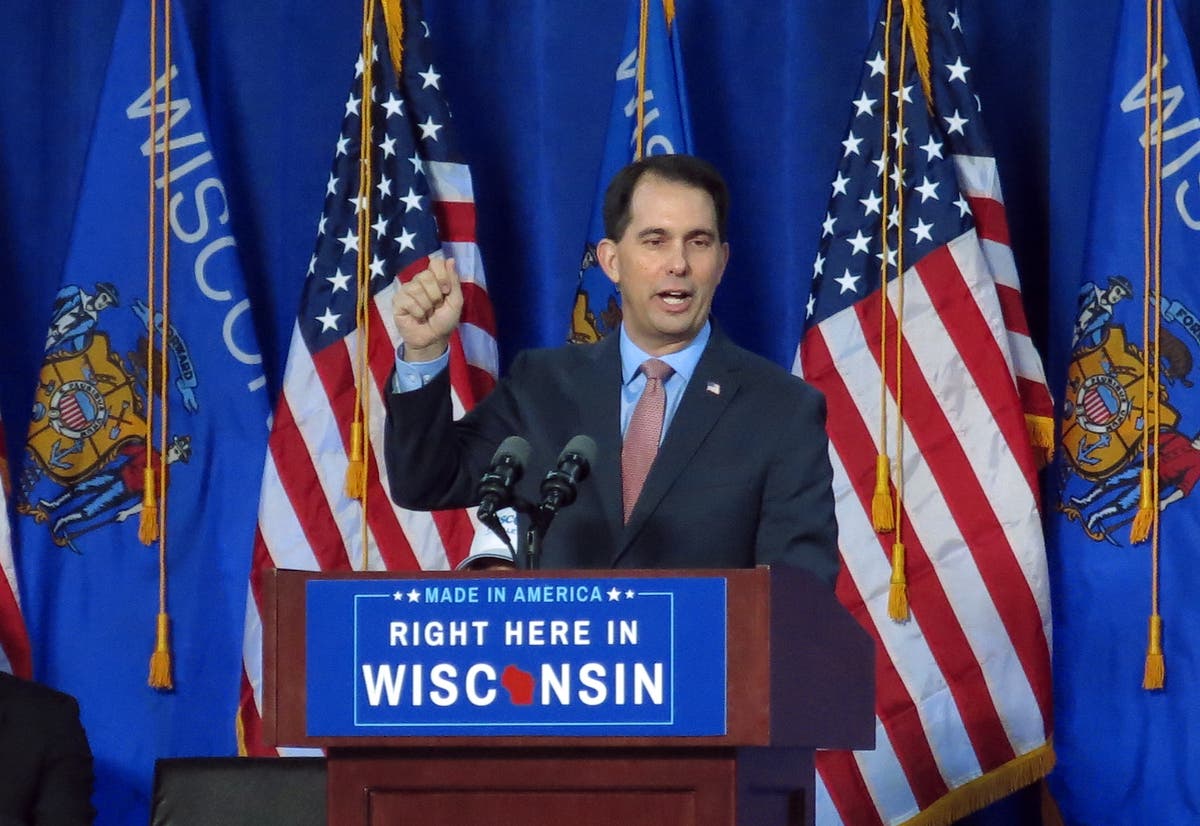
Wisconsin Gov. Scott Walker's political path has seemingly never been easy.
He survived mass protests that consumed the state capitol building after proposing and passing Act 10, which limited the ability of public workers of the ability to collectively bargain drew mass protests and demonstrations.
The next year, Walker survived his own recall election by defeating Democratic Opponent Tom Barrett in a rematch of the 2010 election.
Find out what's happening in Waukeshafor free with the latest updates from Patch.
Walker put forward a proposal to bring Voter ID to Wisconsin in January 2011. After five years, Voter ID survived many legal challenges before becoming law.
In January 2015, Walker set up a presidential campaign called "Our American Revival." Facing eroding political support and dwindling expenses, Walker suspended his campaign by September, and threw his support behind presumptive nominee Donald Trump.
Find out what's happening in Waukeshafor free with the latest updates from Patch.
He survived two John Doe investigations, both of which went on for years as prosecutors investigated Walker's recall campaign financing and at-work campaign activity by Walker staff members when he was Milwaukee County Executive.
Battle Tested
As Walker gears up his 2018 gubernatorial campaign, Walker has assembled a list of accomplishments - some of which have been largely praised while others seem controversial.
"We've got an incredible organization," Walker said in a Washington Examiner report. "We're strong. We've been battle-tested."
First is his passing of a $3 billion incentive package to lure Taiwanese electronics manufacturer Foxconn to build and operate a $5 billion electronics plant in Racine County. It's the largest financial package ever doled out to a company, and it's not due to break even for 25 years.
Walker toured the state in December to tout his tax reform policies which eliminated the state portion of the property tax bill — the first year this has happened since 1931.
"Because of the growth we've had in the budget, because of the positive economy, the fact that more people are working than before - all those things put us in a good position. Not only to cover this, but, as I mentioned, to put more dollars in our classrooms than ever before, to make all the other investments we've done this budget,"
In early January, Walker reportedly adopted a major idea from his Democratic opponents to propose $80 million in funding to overhaul the state's youth prison system.
According to the Journal Sentinel, Walker is proposing to break up the Lincoln Hills School for Boys to convert the Northwoods facility into an adult medium-security prison, while shifting teenage inmates to a series of smaller, regional locations. Lincoln Hills was the subject of a wide-ranging federal investigation into excessive force by authorities.
In a statement to Patch.com, Walker says his political accomplishments geared toward working families are the hallmarks of his successes in the Badger State. “Today there are more people working than ever before, property and income taxes will be lower in 2018 than they were in 2010, and we’re making historic investments in our classrooms. We’ve come a long way together in the fight for hard-working families, but there’s more to be done and I’m ready to keep moving Wisconsin forward with more bold reform.”
When Patch asked Gov. Walker's campaign to prioritize his administration's accomplishments, they put together the following points:
- Making historic investments in state classrooms, with more actual dollars in K-12 education than ever before — $200 more per student this year and $204 more per student next year.
- Helping to stabilize health care and increase access to affordable health care, now, everyone living in poverty is covered under BadgerCare for the first time in Wisconsin’s history.
- Balancing the state budget without raising taxes and turning Wisconsin’s $3.6 billion deficit into a surplus.
- Leading Wisconsin’s economic comeback, with more Wisconsinites working than ever before and near-record low unemployment.
- Cutting taxes some $8 billion since taking office, including the elimination of an entire tax – the state property tax.
- Reducing property and income taxes so they’re lower in 2018 than in 2010.
- Taking Wisconsin from the Bottom 10 for business to the Top 10 for business, for the first time ever.
- Encouraging major job creation in Wisconsin, including the largest economic development project in state history – Foxconn Technology Group.
- Freezing University of Wisconsin tuition six years in a row to help students and hard-working Wisconsin families afford a quality education.
Democrats Lining Up
As of January, a total of 15 Democratic candidates have lined up to challenge Walker this fall. But first, they'll have to stand out in a crowded field that contains leading public officials, litigators and business professionals.
One of the most notable Democrats to join the fray is longtime Madison Mayor Paul Soglin. Soglin, 72, officially launched his gubernatorial campaign on Jan. 10, and told Wispolitics.com that he had been considering a bid since at least June. He was first elected mayor in 1973 and has held the office off and on since for a total of two decades, Wispolitics reported.
Milwaukee Attorney Matt Flynn, 70, is a former chairman of the Democratic Party of Wisconsin, and sees himself as a fiscal conservative.
"The governor of the state is the CEO of the state," Flynn said during a recent interview with the Madison Capital Times. "Management of money is an important thing. My mentor in Democratic politics was Bill Proxmire, and like Proxmire, I’m extremely conservative about waste and anything to do with the administration of money. It has to be scrupulously honest and not wasteful. But it also has to be compassionate."
Mahlon Mitchell, 40, is the leader of the state's firefighter union, who last ran for public office during the 2012 recall elections. He lost to Rebecca Kleefisch for the Lieutenant Governor's post, yet garnered 1.2 million votes in that election - the most of any of his Democratic primary challengers in any election.
According to the Wisconsin State Journal, at 40 years old, Mitchell is the first major Democratic contender who is younger than Gov. Scott Walker, who recently turned 50. Mitchell, like Walker, grew up in Delavan and attended Delavan-Darien High School.
“I’m running for governor because after eight years of Scott Walker, it’s time for change,” Mitchell said in a statement to the Wisconsin State Journal.
State Sen. Kathleen Vinehout was elected in 2006 to the state senate from Wisconsin’s 31st Senate District, a large mostly rural district in the western part of the state. She was re-elected in 2010 and is serving her second four-year term.
Vinehout said Republican control has diminished the quality of government in the state. " Voting has been made more difficult. Restrictions on lobbying and campaign contributions have been eased. Oversight of elections has been turned over to a partisan appointed board. Speed and secrecy in the passing of controversial laws has become commonplace," she said.
Vinehout said she is a proponent of changing the state's school funding formulary. "Since the formula was first enacted, our demographics have changed, our economy has changed. It is time we rethink the way we fund schools. Tinkering around the edges is not enough," she said.
Primary Election Date:
August 14, 2018
General Election Date:
November 6, 2018
Primary candidates
According to Ballotpedia, here are the Democratic, Republican and Independent candidates for Wisconsin Governor for the 2018 gubernatorial election.
- Nick De Leon
- Michele Doolan
- Tony Evers, state superintendent of schools
- Matt Flynn
- Andy Gronik
- Bob Harlow
- Andrew Lust
- Mike McCabe
- Mahlon Mitchell
- Kelda Roys, former state representative
- Jeff Rumbaugh
- Paul Soglin, mayor of Madison
- Kathleen Vinehout, state senator
- Dana Wachs, state representative
- Ramona Whiteaker
- Scott Walker - Incumbent
- Ryan Cason
- Jefferson Carpenter
- Robbie Hoffman
- Timothy Jesse
- Travis Swenby
Patch photo by Scott Anderson
Get more local news delivered straight to your inbox. Sign up for free Patch newsletters and alerts.