Politics & Government
US Abortion Rate Falls To Lowest Point In Decades; Wisconsin Falls Lower
The authors of a new study show exactly how far U.S. abortion rates have dropped. In Wisconsin, those rates are even lower.



MILWAUKEE, WI — The rate of abortions in the United States has fallen to its lowest level since Roe v. Wade, the controversial 1973 Supreme Court ruling that prevented states from outlawing the procedure, according to a new study from the Guttmacher Institute.
The Guttmacher Institute is a research and policy organization that works on reproductive health issues and advocates for legal abortion. For the study, Rachel Jones and Jenna Jerman, researchers with the institute, surveyed all abortion providers for the years 2013 and 2014.
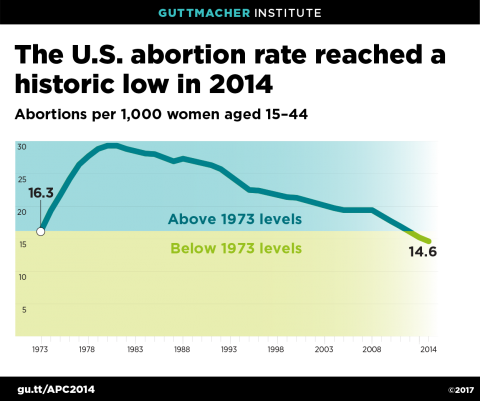
They estimate that in 2014, there were 926,200 abortions performed in the United States, a 12 percent drop from 2011.That amounts to 14.6 abortions performed per 1,000 women that year; this is below the 1973 rate of 16.3 per 1,000 women and well below the peak in 1980-81 of 29.3 per 1,000 women.The Guttmacher Institute's findings are in line with a 2015 survey from the Associated Press.
Find out what's happening in Waukeshafor free with the latest updates from Patch.
In Wisconsin
In Wisconsin, the number of abortions performed - regardless of whether the patient was an in-state resident or out-of-state resident that traveled to Wisconsin, has experienced both a rise and a fall since the early 1970's.
Find out what's happening in Waukeshafor free with the latest updates from Patch.
According to data compiled by the department of health and human services, the highest year for abortions in Wisconsin was in the year 1980, when more than 21,000 abortion were performed in the state. That total amounted to a staggering statistic: for every 100 live births, there were 29 abortions.
Today's rate is about one-quarter of the 1980 figures, with the state recording 5,660 abortions in Wisconsin in 2015 - approximately 8 for every 100 live births.
In 1980, Wisconsin recorded 20 abortions for every 1,000 women. In 2015, that number also dropped significantly to 5 abortions for every 1,000 women.
Here is a year-by-year account of abortions in Wisconsin.
| Year | Number of Induced Abortions in Wisconsin | Number per every 100 live births | |
| 1974 | 10,920 | 16 | |
| 1975 | 12,319 | 18 | |
| 1976 | 14,213 | 23 | |
| 1977 | 16,133 | 23 | |
| 1978 | 17,764 | 26 | |
| 1979 | 20,035 | 27 | |
| 1980 | 21,754 | 29 | |
| 1981 | 20,819 | 28 | |
| 1982 | 19,412 | 25 | |
| 1983 | 18,866 | 25 | |
| 1984 | 18,836 | 25 | |
| 1985 | 17,309 | 23 | |
| 1986 | 17,454 | 24 | |
| 1987 | 17,318 | 24 | |
| 1988 | 17986 | 25 | |
| 1989 | 17575 | 25 | |
| 1990 | 16848 | 23 | |
| 1991 | 16237 | 23 | |
| 1992 | 15549 | 22 | |
| 1993 | 14671 | 21 | |
| 1994 | 13396 | 20 | |
| 1995 | 12782 | 19 | |
| 1996 | 13673 | 20 | |
| 1997 | 13218 | 20 | |
| 1998 | 11681 | 18 | |
| 1999 | 11013 | 16 | |
| 2000 | 11040 | 16 | |
| 2001 | 10925 | 16 | |
| 2002 | 10489 | 15 | |
| 2003 | 10557 | 16 | |
| 2004 | 9943 | 14 | |
| 2005 | 9817 | 14 | |
| 2006 | 9580 | 14 | |
| 2007 | 8267 | 14 | |
| 2008 | 8229 | 11 | |
| 2009 | 8542 | 12 | |
| 2010 | 7825 | 11 | |
| 2011 | 7249 | 11 | |
| 2012 | 6927 | 10 | |
| 2013 | 6462 | 10 | |
| 2014 | 5800 | 9 | |
| 2015 | 5660 | 8 |
According to the Guttmacher Institute, in Wisconsin, the following regulations on abortion were in effect as of January 1, 2017:
- A woman must receive state-directed counseling that includes information designed to discourage her from having an abortion, and then wait 24 hours before the procedure is provided. Counseling must be provided in person and must take place before the waiting period begins, thereby necessitating two trips to the facility.
- Health plans offered in the state’s health exchange under the Affordable Care Act can only cover abortion if the woman's life is endangered, her physical health is severely compromised, or in cases of rape or incest.
- The use of telemedicine to administer medication abortion is prohibited.
- The parent of a minor must consent before an abortion is provided.
- Public funding is available for abortion only in cases of life endangerment, rape and incest, and when the procedure is necessary to prevent long-lasting damage to the woman's physical health.
- A woman must undergo an ultrasound before obtaining an abortion; the provider must show and describe the image to the woman.
- An abortion may be performed at 20 or more weeks postfertilization (22 weeks after the woman’s last menstrual period) only if the woman’s life is endangered or her physical health is severely compromised. This law is based on the assertion, which is inconsistent with scientific evidence and has been rejected by the medical community, that a fetus can feel pain at that point in pregnancy.
Photo credit: Pixabay
Get more local news delivered straight to your inbox. Sign up for free Patch newsletters and alerts.