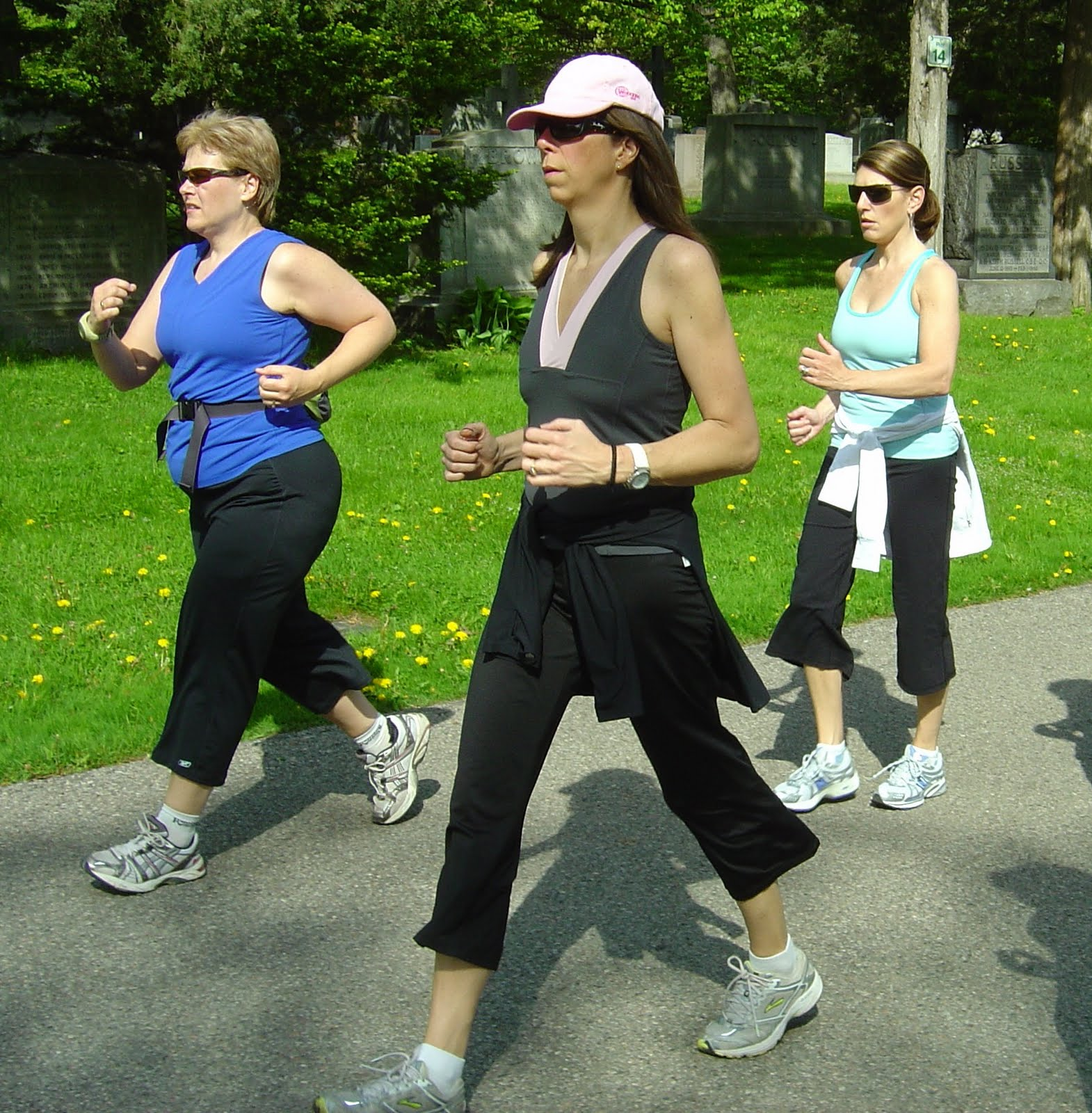
The basic fundamentals associated with walking are not difficult to master. As we age our stance, pace and cadence will change. Just to make sure we start out on the right foot (no pun intended) here are some simple walking guidelines.
Good Posture: A good posture is the key to walking correctly.
- Keep your spine aligned. It is important to remember that your center of gravity must be centered in order to have good balance.
- Abdomen in. Constricting your abdominals will automatically has some great benefits. It gives you better posture, works on your abdominal muscles, and lifts your chest which will open up for easier breathing.
- Shoulders back. Consider this; you want to open up that chest to invite fresh oxygen in with every breath you take so get those shoulders back and keep them back.
- Head up. Keeping the spine aligned also means keeping the skull in an upright position.
Swing those arms. Not only does this give you momentum, but the more you move your arms the greater the energy expelled as you include upper body muscles in your workout! This has extended your workout to include your biceps, shoulder, and even lateral muscles. For greater fitness walk carry a light hand weight or use walking sticks. Focus on moving naturally swinging your arm with a slight bend at the elbow. Move each arm with the opposite leg. Avoid extreme swinging or pumping so that your arms do not cross in front of your chest when you walk.
Find out what's happening in Waukeshafor free with the latest updates from Patch.
Flawless Footwork. Before you begin make sure that you are using comfortable walking shoes. To avoid corns & calluses, double-up on socks. If you wear orthotics make sure that they are in good condition. Keep your feet facing forward, lift the knee raising the moving foot completely off the ground and then bring back down landing the foot heel to toe to avoid shuffling or dragging your feet. Your body tends to move in the direction that your feet are headed, so make sure you know where your feet are headed to avoid spills.
Know Your Route – Before you walk out the door it is important to know where you are headed. Get in your car and take a test drive of your route to make sure you know the specific area and distance you will be walking. Look for potential stumbling blocks that could ruin your walk such as dogs that are not fenced in their yards, bad terrain and secluded areas. If you are serious about integrating fitness as a regular routine in your day make sure that you avoid any roadblocks, literally. Make note of any construction or heavy traffic. Busy streets work well if you are walking at odd hours of the day or unfamiliar with the neighborhood, but for the most part, consider the quality of the air you are taking in with each breath. Don’t be afraid to mix it up and try a different route, terrain, or even add intervals to avoid boredom.
Find out what's happening in Waukeshafor free with the latest updates from Patch.
Track Your Distance – Keep a log of how far you walk and make a note of the specific days of the week you walk. Distance can be measured easily by jumping in your car and driving your route while you keep track of the mileage. Use websites like mapmyrun.com that can put your route on a map and show you exactly how far you are going. It’s not rocket science. If you are truly a beginner and can only go a block, go that block. The following week try adding another block to your routine. Before you know it you won’t be measuring your workout in blocks but in miles. Just remember that everyone has to start somewhere.
Pace, Cadence, Stance – The more you walk, the more you will start to get into a rhythm. This rhythm can help you keep up a steady pace, but it can also hinder you as your body becomes acclimated to it and it becomes a comfortable routine. Remember that your goal is to get in better shape. Walking at the same pace over and over again will not give you the maximum results. Studies have shown that by increasing your pace from 3.8 mph to 4.0 mph will obviously bump up your calorie expenditure. But an increase from 4.0 to 4.2 exponentially gives greater calorie expenditure. Using a pedometer can help you keep track of your steps and challenge yourself as you advance. Don’t forget to use your arms. Remember that walking faster may mean shorter strides but not at the sake of misaligned posture.
Dress for the Weather – It is always best to dress in layers. The longer you walk the warmer you will become. Wear something that can be easily slipped off like a light, zipper jacket. Look for clothing made with material like Dri-fit® which moves the perspiration away from your skin into the material itself. Are you on a tight budget? That’s not a problem … cotton works just fine. Make sure you don’t forget the importance of layers. Remember sunglasses and sunscreen to help protect you from ultraviolet rays. On cold days, a good knit cap and gloves will be a necessary part of your gear.
What to Carry – Many running shirts and jackets have pockets strategically placed for an MP3 player or a phone. As a walker you should be aware of your surroundings so make sure that if you decide to walk while wearing headphones that the music is low enough that you can hear a dog growl or a person talking without difficulty. If you do not want to carry a phone, make sure you are carrying some type of personal identification. RoadID.com is a great website that allows you to customize an identification bracelet with pertinent data such as contact information or medical alerts. If you are not familiar with the area, or if you are walking in remote areas, always carry a deterrent like pepper spray or a natural deterrent using Citronella oil to discourage loose dogs. If you’re walking buddy is a dog, don’t forget doggy bags and/or treats. Last but not least, remember to keep hydrated. If it is hot and/or humid, or if you are walking a long distance, prepare ahead of time to avoid dehydration.
So now you know the basics and you’re ready to take the first step to fitness. The benefits of exercise are limitless. Not only will exercise help with weight loss, fighting disease, and your quality of life, but it also builds relieves stress & improves confidence. As always, if you haven’t exercised for some time, you should talk to your doctor before starting a new exercise routine. Leo Babauta, the author of Zenhabits.net, says it best when he writes, “Just get started. There are times when you don’t feel like heading out the door for a run, or figuring out your budget, or whatever it is your supposed to do that day for your goal. Well instead of thinking how hard it is, and how long it will take, tell yourself that you just have to start.”
Sources:
Clain, J., (2013). Benefits You should Know About Morning Walk. B4tea. Retrieved on August 23, 2013 from http://b4tea.blogspot.com/2011/08/benefits-you-should-know-about-morning...