Politics & Government
Central City Master Plan Unveiled
Better signage, housing redevelopment and more highlighted for the area.
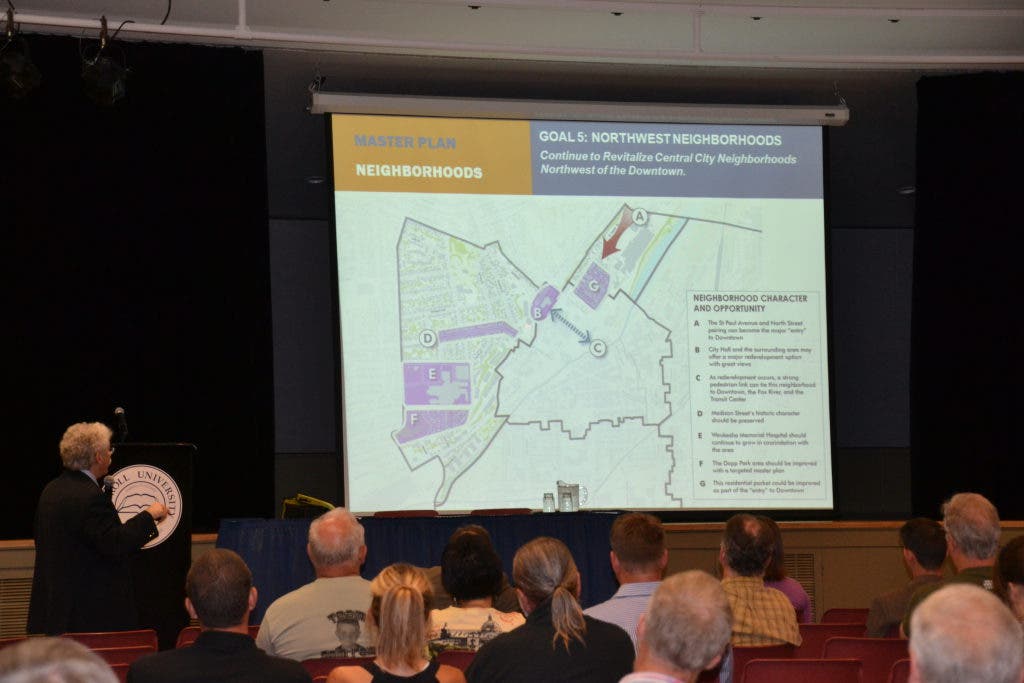


About 50 people attended the unveiling of a draft master plan for redevelopment of the Waukesha central city area.
The draft was presented by Larry Witzling, principal planner from Graef, the consulting team chosen by the city to develop the central city master plan.
“Hopefully this plan becomes a bit of blueprint for you to use and follow over the next 10 years or so,” Witzling said.
Find out what's happening in Waukeshafor free with the latest updates from Patch.
City officials and Graef consultants are looking for feedback from the community regarding the draft concepts and its recommendations before preparing a final version of the plan for adoption. Online and hard copy versions of the draft plan will be available next week through the city’s Community Development Department.
Public input is important in the planning process, according to Witzling.
Find out what's happening in Waukeshafor free with the latest updates from Patch.
“This is a very critical moment in the professional planning process. This is when we have some ideas, when we put them down on paper, where we actually say what we think should happen, and there’s still time to change it, significantly change it… this is the time to get those suggestions,” Witzling said.
“Our job as consultants is to stick our necks out and tell you what we think should happen," Witzling said. "It’s not your job to agree with us. In fact, it’s your job to tell us what doesn’t agree with you.”
After the draft is finalized, it will go to the city’s Redevelopment Authority for approval, then the Plan Commission and, finally, the Common Council, according to Jennifer Andrews, city community development specialist. The final product is expected to be ready in the fall, she said.
The Central City Plan includes information from the market-based strategic plan developed by Gruen Gruen and Associates but Witzling said that while there is some overlap, there are also differences. Those recommendations were made by economists for the economic well-being of the area and not urban designers, he said.
The plan is not just for the downtown but it’s also a plan for the surrounding neighborhoods, according to Witzling, precise boundaries of which were determined through discussion and looking at sites and neighborhood characteristics.
Witzling gave attendees a guided tour of the plan, beginning with a vision statement. The plan includes goals for the downtown area, goals for the surrounding neighborhoods, goals for arterial roads that lead into downtown and a chapter, as yet unwritten, on implementation of the plan.
The vision statement was that Waukesha’s downtown and surrounding neighborhoods should “become known in the Midwest as a premier model of an exciting, vibrant and livable city,” according to the draft.
Witzling said that Waukesha has a lot of strengths to build on in making this vision achievable.
“We think this is very, very possible. We working in quite a few different cities and Waukesha has some advantages, amenities and qualities that really don’t exist in a lot of other cities in Wisconsin,” he said.
Witzling outlined a set of principles for achieving that vision: balancing cost and benefits, maintaining and improving design quality, creating high quality environments for multiple population groups, conserving the past through preservation of key buildings and streets and initiating investments for a sustainable future.
“Things are already happening [in the downtown] that are really very good. We intend to build on that,” he said.
The first goal outlined in the plan is to create a complete integrated and coherent street system for a positive experience for driving, bicycling and walking.
A number of comments at previous meetings highlighted the need for better signage of the downtown and access to pedestrian pathways, biking paths and parking. But also important is to better define the rough triangular area for visitors with cohesive street design. Witzling discussed “artscaping” a couple blocks of the area to make it more cohesive.
The second goal was regarding residential communities, where the consultants saw “major” opportunities for redevelopment and rehabilitation, including adding a grocery store to the area, new multi-family housing and mix of residential uses for different population groups. Witzling acknowledged that this goal may be somewhat controversial, especially regarding different housing types.
The third goal, which has to do with economic vitality, was to reestablish the downtown area as the business, social and cultural heart of the city.
One way this could be accomplished, according to the plan, is with redevelopment of the area bordered by Barstow, the river, St. Paul Avenue and Broadway, including Bank St., into a more-multifunctional use area, capitalizing on access to the river and employing flexible uses possibly co-locating private and public uses. The area provides a “spectacular site” for long-term redevelopment, Witzling said.
The fourth goal was revitalizing the surrounding neighborhoods, including redevelopment and rehabilitation, and continuing and expanding support for community-based organizations. The city should find some way to support that action, according to Witzling.
The next goals focused on specific neighborhoods surrounding downtown Waukesha – the northwest area which includes Waukesha Memorial; the south, which includes the library, churches and multi-family housing areas; and the east, which includes the YMCA and La Casa de Esperanza, to name a few explanatory landmarks for the areas.
The northwest area goal focuses on improving St. Paul, linking isolated neighborhoods (also suggested for other areas), better integrating the hospital to the neighborhood and rehabilitating certain areas.
In the south area, Witzling said there are opportunities for improvement regarding bike paths and also regarding redevelopment of the Jackson Court area.
They are recommending that the Jackson Court area “be redeveloped incrementally in a way that fosters single family, detached housing,” that it not necessarily be done all at one time.
The east area provides “major” opportunities for redevelopment, according to Witzling, with opportunities in areas along White Rock, Frame Park and Broadway. The redevelopment plan of this area is “very complicated,” he said, because there are so many small pieces to consider, like the redevelopment of Spring Park, a neat little park that is isolated from the surrounding area, he said.
The last goal discussed would be to create memorable pathways into the area, allowing for better, clearer access to the downtown from the freeway system. The consultants looked at very specific traffic solutions for this area of concern.