Politics & Government
ANALYSIS: Northport Ambitions, History Set Stage For Property Tax Vote
Here's a detailed look at recent arguments and possible outcomes for the City of Northport in its push for its own school system.


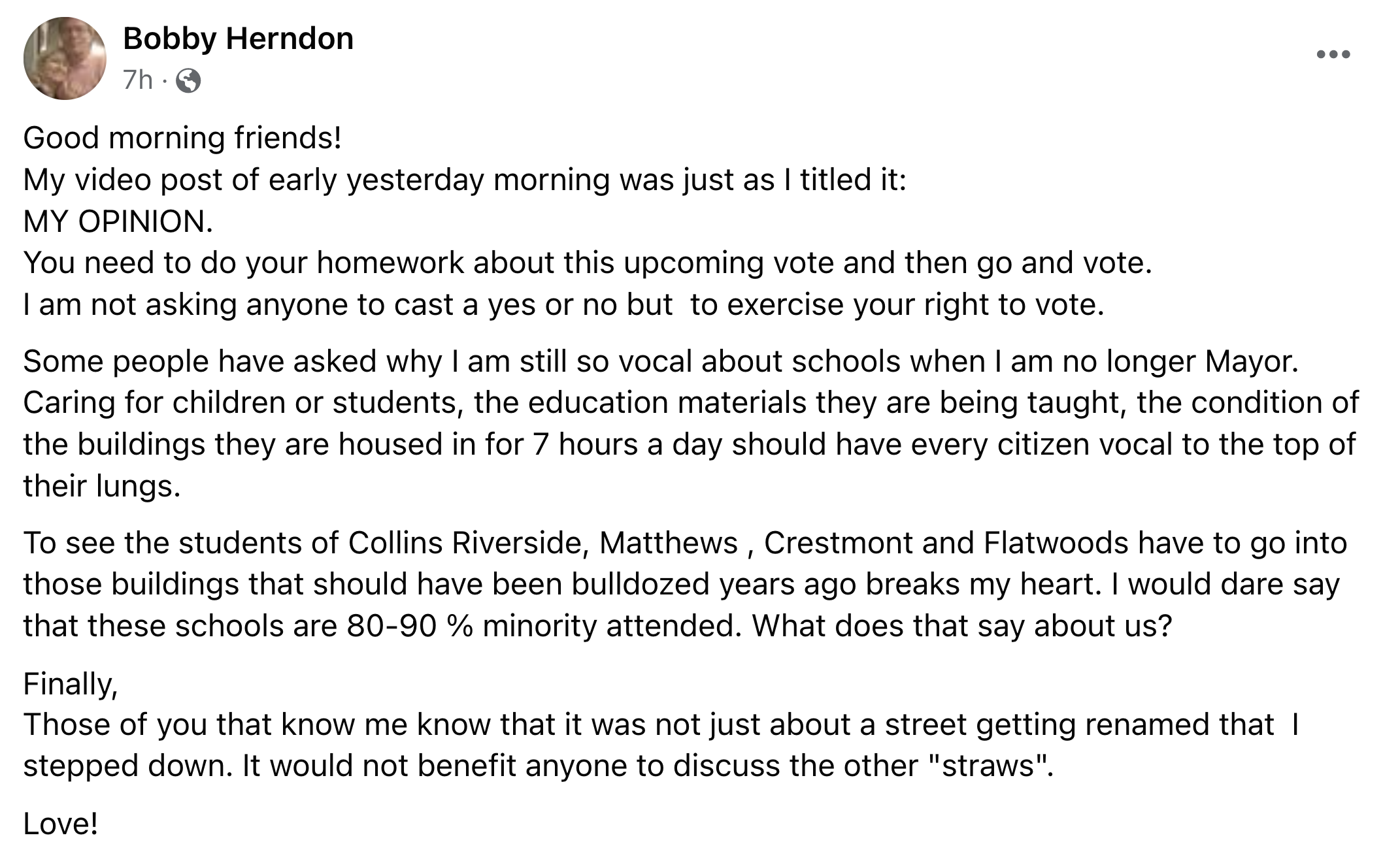
NORTHPORT, AL — On Sunday, former Northport Mayor Bobby Herndon took to social media to speak out in opposition against a proposed property tax increase on the special election ballot next month that, if approved, would provide additional funding to the Tuscaloosa County School System (TCSS).
Click here to subscribe to our free Tuscaloosa Daily newsletter and breaking news alerts
In his arguments, Herndon — who resigned abruptly at the end of the last calendar year — proposed several alternatives to benefit schools within the Northport city limits.
Find out what's happening in Tuscaloosafor free with the latest updates from Patch.
Despite not being in office for almost a month, the hypotheticals posed immediately began to be considered by both the general public and city officials working to make sense of where Northport stands in relation to the laws on the books.
Herndon's successor, John Hinton, is a Tuscaloosa County School System retiree, and has been understandably reserved in his comments on the matter as he feels out a new office.
Find out what's happening in Tuscaloosafor free with the latest updates from Patch.
But in the limbo leading up to Feb. 14, Herndon returned to the public arena to provide a rehashing of his longtime talking points in the lead-up.
Among the proposals was a kind of backhanded compromise in pondering the creation of a "Northport district" within the city limits that would be under the control of TCSS. The catch would be that the property tax revenue generated within the Northport city limits would be allocated solely to Northport schools.
Based on Patch's past reporting, this unrealistic olive branch seems far and away the least likely available option when considering Herndon and a revolving door cadre of other city officials have, at multiple turns over the years, accused TCSS leaders of lying, while hurling sustained criticism of how the county school system has managed its funding.
Worth noting, also, is that these barbs from Herndon have changed little over numerous county boards of education and city council administrations during his decades of public service, including his own time as a council member. And indeed, little progress was made over the years on the most-needed improvements for Northport schools and sustaining the momentum in the push, which seemed subject to election cycles and county school board decisions to pacify Northport officials.
Conversely, Herndon has voiced plenty of reasonable concerns echoed by majorities in his community, such as the need for an auditorium at Tuscaloosa County High School, the lack of attention given to Collins-Riverside Middle School and subpar pay for athletic coaches.
Some Northport officials in Herndon's camp have argued that the $24 million Northport Intermediate School, the newest school in the county, did little to combat problems with overcrowding and facilities for elementary and middle schools within the city limits.
Instead, officials like District 2 Councilman Woodrow Washington III — one of three members of the Council's Public Outreach Committee who represents the only majority-Black council district — have insisted on numerous occasions that such a decision by the county school system only resulted in more students being bused out of their community to go to school on the other side of town.
Another option Herndon presented, however, cast a cloud of uncertainty as he encouraged the Northport City Council to unilaterally pass a 5-mill property tax increase to serve as a partial funding mechanism for a Northport city school system.
Herndon claimed that, after talks with the Tuscaloosa County Tax Assessors Office, such a measure would result in an additional $2 million in additional revenue for the city, which would be complimented by the city's 1-cent sales tax and the desire of some in City Hall to try and secure the city's portion of the county's 1-cent sales tax.
According to the Alabama League of Municipalities, "all cities and towns of the state are authorized to levy a five-mill tax upon real and personal property located within their limits computed on the value as assessed for state and county taxation. No referendum is required for the levy of this tax."
For Herndon's proposal from outside of City Hall, the Northport City Council may just have the ability to do so, but that is where the big question presents itself for officials.
In looking back through history and speaking extensively to officials in Northport City Hall and the County Tax Assessors Office, here's a look at what we've found with respect to the progression of Northport's Ad Valorem taxes.
- 1917 - Tuscaloosa County levies first ad valorem tax after measure is approved by voters.
- 1944 - Northport's millage rate was at 5 mills.
- 1967 - Northport City Council levies 30-year, 5-mill increase to Ad Valorem tax.
- 1987 - Countywide property tax increase referendum fails.
- 1996 - Second attempt at countywide property tax increase referendum fails by 2-to-1 margin.
- 1998 - Voters in Northport approve the continuation of the 5-mill increase after sunset of 1967 millage increase. The measure passed in four of the five voting precincts, failing only by a narrow margin at the Flatwoods Elementary precinct.
The initial 30-year tax was earmarked for construction of the Northport City Hall and Civic Center, along with the development of the city's water system. The vote in 1998, however, dedicated the money to education and public safety, with city officials barred from allocating any of the money to the city's general fund.
The late Wayne Rose, Northport's former mayor, argued at the time that Northport faced a revenue shortfall due to its previous financial commitments for the Tuscaloosa toll bridge, construction of a new Tuscaloosa County High School and renovations to Bryant-Denny Stadium.
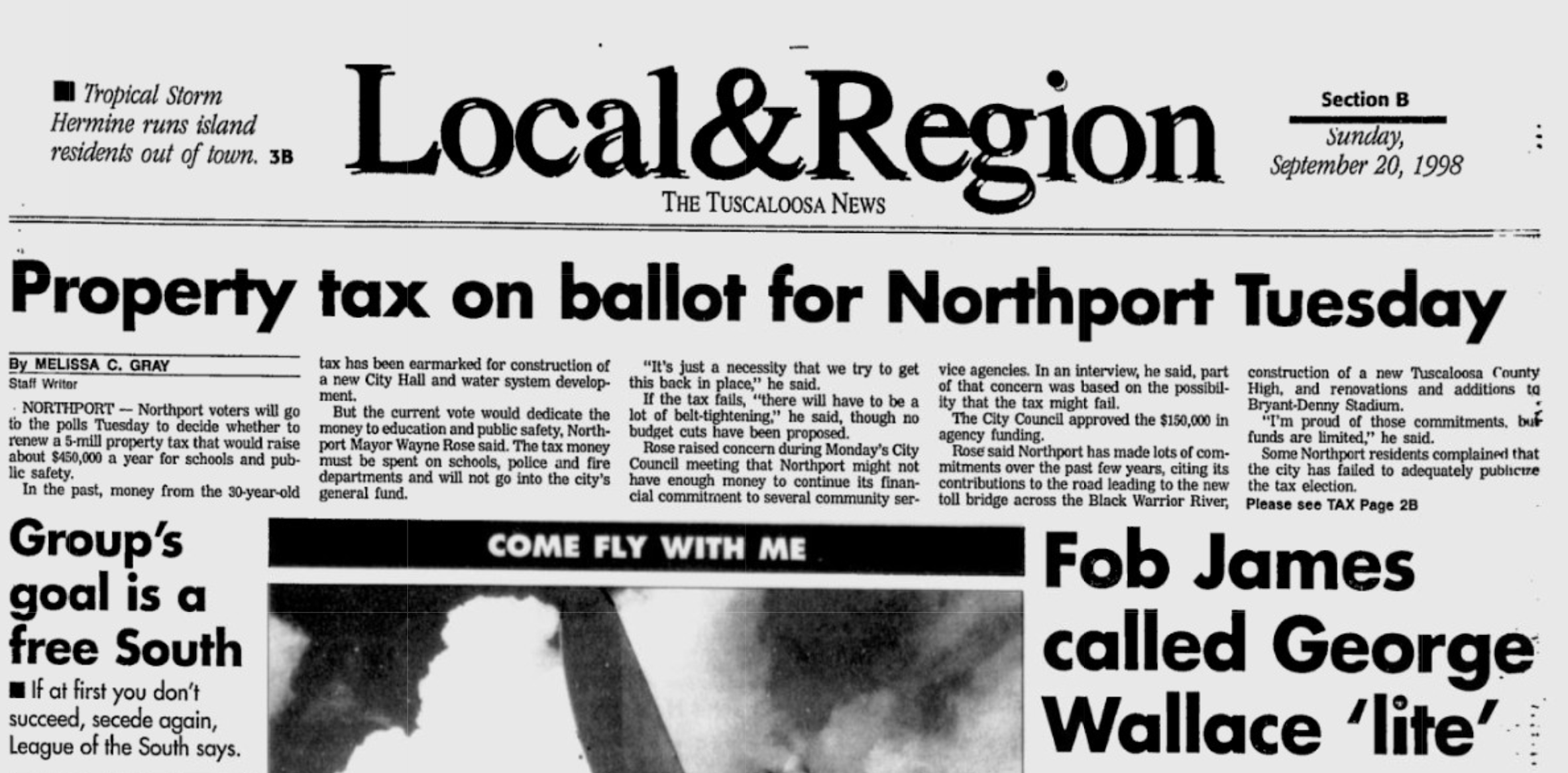
It was during this time that the Tuscaloosa County School System and former superintendent Joyce Sellers, aided Northport in the door-to-door campaign to shore up support for the measure, which ultimately passed at the ballot box on Sept. 22, 1998 by a vote of 670-340. This stands in stark contrast to the adversarial relationship of TCSS and Northport City Hall at present.
But now we reach the real question: Can Northport's City Council raise the millage rate inside the city limits without a vote by the public?
The way the opaque Alabama law is written states: "If a municipality has established its ad valorem tax by ordinance [such as a unilateral vote of the City Council], providing that it shall be in force from year to year until repealed or amended, then the governing body would not be required to take any further action on the subject except to amend or repeal."
Tuscaloosa County Tax Assessor Leigh Ann Fair told Patch that, based on her knowledge, the 5 mills currently on the books for Northport is the only millage the council could enact without a vote. As is the case with complex issues, Fair acknowledged the possibility of loopholes or obscure changes to the law that might refute that interpretation, but her office isn't familiar with any, which underscores the uphill battle Northport is likely to face in trying to pool the funding for its own school system.
And at present, other school systems — like the Butler County School School System in 2018 — sought a similar 30-year ad valorem and made a case for why it had chosen such a timeframe, saying other counties and municipalities of a similar mindset had opted for ad valorem taxes locked in for 25 to 30 years, based on various localized rationale.
This would seem to indicate that the authority would rest with the City of Northport, given that it was reportedly the citizens and not the City Council to continue the 5-mill increase in the 1990s.
And this is where we reach our legal impasse, with officials on both sides of the school system issue scrambling to interpret nuances in state code to validate their positions.
At the end of the day, though, Fair said she would not be the authority to determine the legal status for Northport. Instead, she explained that she would either enlist the services of the Tuscaloosa County Attorney's Office and the Alabama Department of Revenue, should the need for legal interpretation arise.
With a little less than two weeks before a countywide referendum open to all registered voters other than those zoned for Tuscaloosa City Schools, it's worth noting that a failure of the countywide referendum on Valentine's Day would surely reinvigorate Northport officials to push harder for the growing city to break away from TCSS.
"Those of you who know me know that [my resignation] was not just about a street getting renamed that I stepped down. It would not benefit anyone to discuss the other 'straws.'"
- Former Northport Mayor Bobby Herndon in a Facebook post on Monday, Jan. 30
NEW BAGGAGE AND LIMITED OPTIONS
Herndon's other proposed option encouraged the city to try and pry its share of the county's 1-cent sales tax revenue from TCSS if it manages to start its own city school system.
This is also an unlikely prospect — one that many sources have insisted would most certainly see the City of Northport faced with an inevitable courtroom showdown over the funding structure previously set by the legislature when it first went into place. Those same sources also view such an attempt as quixotic and ill-fated.
And yet, perhaps the most illuminating development brought about by Herndon's video on Sunday was his subsequent admission in the aftermath on Monday that his sudden decision to step down from office "was not just about a street getting renamed that I stepped down. It would not benefit anyone to discuss the other 'straws'."
While it should have been obvious on its face that night in November, his seemingly hasty decision to resign, based on his post Monday, was not made the night he tendered it after the proposal for the renaming of 28th Street to "Benevolent Way" was shot down.
No, and, in fact, Patch has reported sources in city hall who claimed he had threatened to resign on numerous occasions for unspecified reasons — all in the lead-up to the results of the second feasibility study being returned.
And never mind Herndon's signature was on the approved ordinance change that barred his own request after he presented it with only one signature on a petition. And despite Herndon still holding veto authority as mayor that he did not exercise when he signed the ordinance he would ultimately resign over.
Herndon claimed the Council pulled a fast one on "Gullible Bobby" — a term he has often used for himself when speaking on his past dealings with the county school system. But as Patch previously reported, his own handwriting on the one-page ordinance change order almost immediately discredited such claims and indicated something at work behind the scenes that prompted his sudden decision.
As Patch previously reported, the timing of Herndon's resignation seemed to align with the city receiving the results of a second feasibility study conducted regarding a Northport school system.
The main question from taxpayers remains unanswered to this day as to what the estimated cost of a Northport school system would be. The first study and its public presentation were widely panned for only telling those in support of a city school system what they wanted to hear.
And to the critics' points, this reporter failed to note a single potential drawback presented in the initial study in June 2021.
ALSO READ: Takeaways From Northport City School System Feasibility Study
Under a new city administrator, however, the City of Northport sought a second opinion on the feasibility study last year, the results of which have yet to be made public.
City officials have insisted that the delay in releasing the study's findings was prompted by Herndon's resignation and the ongoing work to fill the open District 3 seat previously occupied by current Mayor John Hinton. The results are being withheld, they claim, out of fairness to the incoming council member.
District 4 Councilwoman Jamie Dykes chairs the Public Outreach Committee tasked with maintaining relationships with local schools and has been a vocal proponent for Northport breaking away from TCSS.
Dykes told Patch that while she understands the community is anxious for the results, it is the opinion of the committee, Council and city administrator that it is "not fair" to move forward on the issue without having the open District 3 council seat filled.
"I applaud [TCSS Superintendent Keri Johnson] for taking this step to offset the shortfall in funding for education," she said. "I am a teacher by trade and most of my friends still teach or are administrators and I know the needs are so great within our schools — for both teachers and students. Our students and our citizens deserve better. They deserve more."
ALSO READ: Seven Candidates Apply For Open Northport Council Seat
Here's a look at the funding mechanisms Northport has at its disposal to start its own city school System.
- Bond issuance? This seems unlikely due to the fact that Northport has finally reached firm financial footing after nearing the point of bankruptcy just a few years ago. With numerous large-scale initiatives currently in the works that will require some borrowing, it does not seem likely that this fiscally conservative City Council would be willing to go to the bond market anytime soon to fund a school system.
- Property tax increase passed by voters if Feb. 14 measure fails. Historically, this measure has failed to gain enough support to pass, other than in 1998 when Northport voters chose to continue with the millage rate in place that did not add any increases.
- Revenue generated from city's 1-cent sales tax. In the three fiscal years since it was implemented, the city has generated roughly $19 million in revenue from its 1-cent sales tax, nearly all of which has already been allocated. Of this funding, the city has been able to provide schools in Northport with $300,000 a year for different needs, but the numbers are fair too underwhelming to be a primary funding mechanism in the foreseeable future unless the council breaks its covenant for how the revenue would be spent when the measure was passed.
- The city getting what it views as its share of the county's 1-cent sales tax that is earmarked to partially fund the Tuscaloosa County School System. Passed in 1951, the special sales tax was initially intended to see 20% of its revenue go to Druid City Hospital for care of the indigent, while the remaining 80% would be split between the county school system and the City of Tuscaloosa's school system. Three-quarters of a century ago, many in the county argued that too much of the funding was given to the City of Tuscaloosa, which was the larger school system at the time. Much has changed since then, including the structure of the sales tax itself and, as previously stated, this seems to be one of the least-likely routes to funding a Northport city school system.
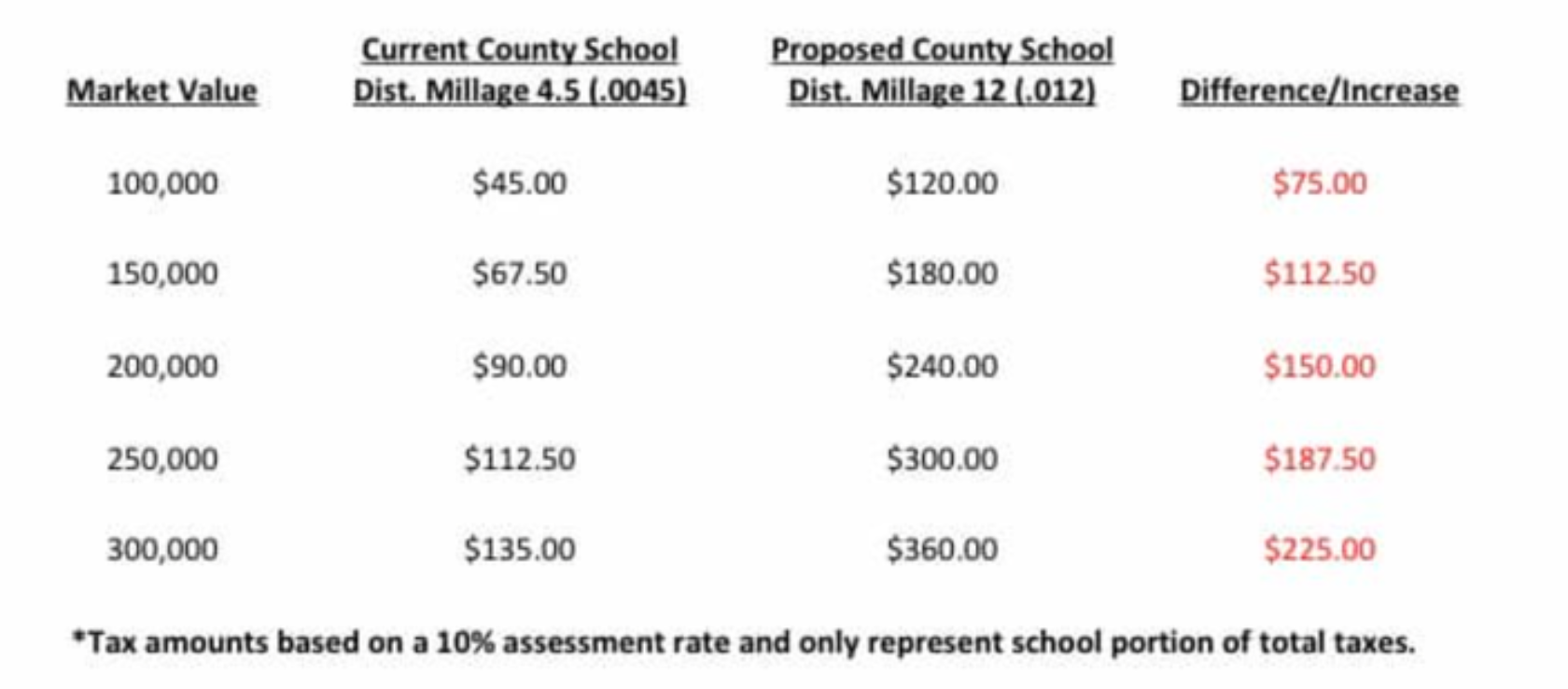
Here's a breakdown of how the proposed property tax increase would impact homeowners in the two county school tax districts.
The last two attempts to receive support at the ballot box for similar countywide property tax increases — 1987 and 1996 — both failed by 2-to-1 margins when brought to a vote.
The prevailing sentiment from political insiders on the Valentine's Day ballot isn't much different, as the Tuscaloosa County Farmers Federation has come out in staunch opposition of the measure and going so far as to place out maroon and white campaign signs urging "NO!" and arguing against "NO NEW PROPERTY TAX."
Yet, Tuscaloosa County's current millage rate is at the minimum mandated by the state and has not been changed since it was first implemented in 1917 — the same year the Zimmerman Telegram prompted the United States to enter the first World War.
Over a century later, TCSS insists that Tuscaloosa County's rate of growth is maxing out its available resources at a time when several schools, especially north of the Black Warrior River, are in desperate need of renovations or completely new buildings.
Other areas, such as Lake View, Big Sandy and Samantha, are also growing at rates that are unsustainable for their current educational facilities. For example, TCSS confirms some students at Walker Elementary in the Northside school zone have to eat lunch in their classrooms due to a lack of space in the school's cafeteria.
In the eastern part of the county, Lake View Elementary was opened only a few years ago and reached near-capacity almost immediately. Big Sandy is zoned for the rapidly growing Hillcrest school zone in a part of the county where development is steadily building out to bridge the short travel gap between Tuscaloosa and Moundville.
TCSS Superintendent Keri Johnson explained last week that, apart from several large-scale capital projects, the added revenue would also fund more school resource officers and building security improvements, along with providing more pre-K services for the county school system and dual enrollment scholarships similar to those touted by Tuscaloosa City Schools.
Other proposed systemwide benefits include:
- Smaller class sizes.
- More electives and career tech options.
- Art and music classes for elementary schools.
- Increased mental health resources.
- Construction of a centrally-located performing arts venue.
Click here for the most recent look at the proposed capital projects that would be funded by the proposed TCSS property tax increase.
The polls open at 7 a.m. on Tuesday, Feb. 14, and will close at 7 p.m.
Have a news tip or suggestion on how I can improve Tuscaloosa Patch? Maybe you're interested in having your business become one of the latest sponsors for Tuscaloosa Patch? Email all inquiries to me at ryan.phillips@patch.com.
Get more local news delivered straight to your inbox. Sign up for free Patch newsletters and alerts.