Politics & Government
ANALYSIS: Understanding The Tuscaloosa Public Library's Funding Crisis
Here's our in-depth look at the contentious issue of funding for the Tuscaloosa Public Library.


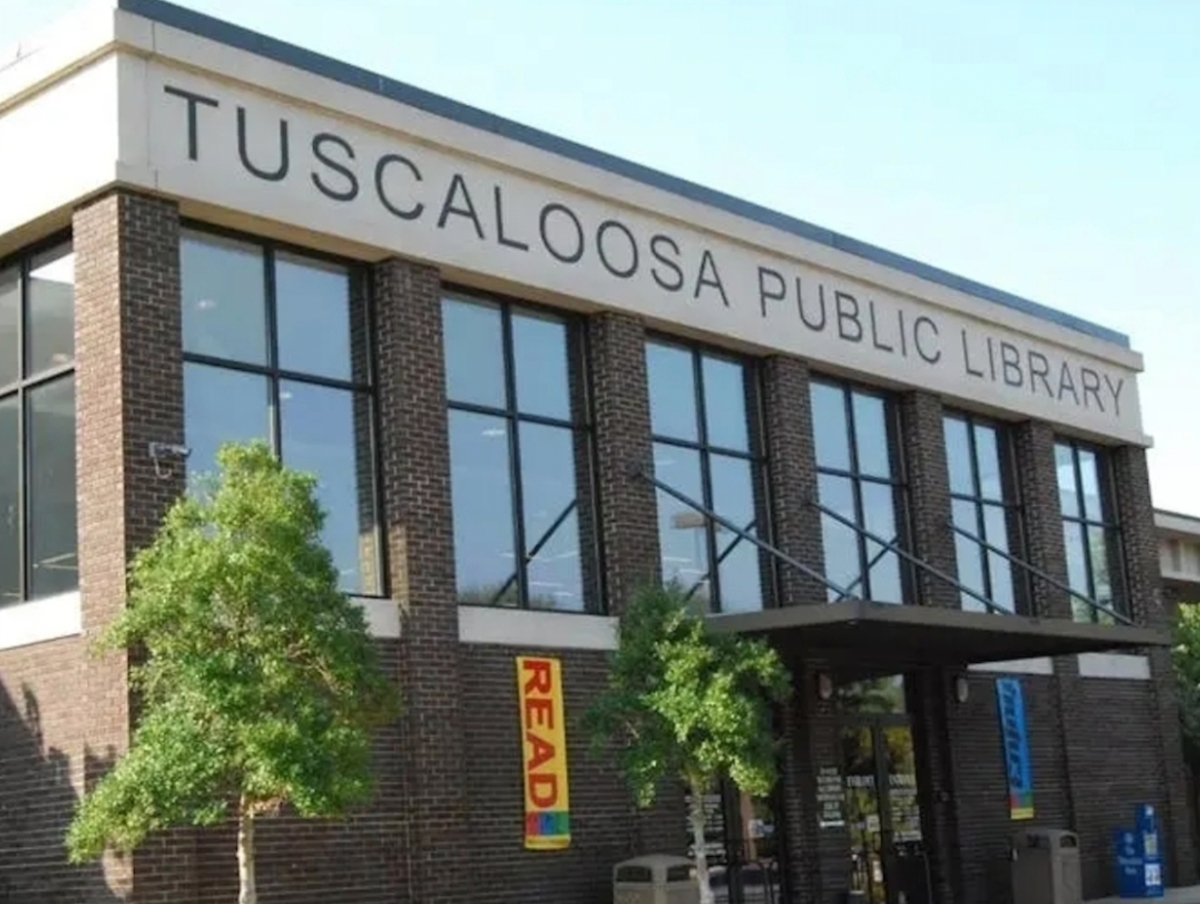
TUSCALOOSA, AL — The first honest try at establishing a public library in Tuscaloosa County can be traced back to a failed attempt in 1879 when a group of Tuscaloosa businessmen donated a bunch of old books for a "Library Room" on the second floor of a local drug store.
Click here to subscribe to our free daily newsletter and breaking news alerts.
According to the Tuscaloosa Public Library's website, the businessmen hoped to provide "a comfortable space where 'young men' could 'read, talk, crack jokes,' or play drafts, backgammon, or chess, thus passing their idle time, if not advantageously, certainly free from all evil influences.”
Find out what's happening in Tuscaloosafor free with the latest updates from Patch.
This attempt failed after only two years due to a lack of interest but serves as an appropriate anecdote when discussing the evolution of library services in Tuscaloosa over the years and the myriad issues that have arisen out of the nuance over the last century.
Indeed, as Patch reported earlier this week, the Tuscaloosa Public Library announced that its Board of Trustees had opted to make substantial cuts to services and hours, along with the closure of one of its branches, as part of the latest round of cost-saving measures to keep the library's finances in the black.
Find out what's happening in Tuscaloosafor free with the latest updates from Patch.
The announcement resulted in substantial backlash against the three elected bodies that fund the Tuscaloosa Public Library System — the City of Tuscaloosa, Tuscaloosa County and the City of Northport — as accusations flew relating to funding and why the different entities were not doing more to support the library system.
So, in an effort to peel back all the layers of such a contentious and complex issue for the public, Tuscaloosa Patch spoke at length with all parties involved in an effort to provide accountability and transparency on the topic.
Roof Leaks and Politics
Tuscaloosa Public Library Board of Trustees Treasurer and Tuscaloosa attorney Bryan Winter was quick to point out the 13 leaks in the roof of the library's Main Branch on Jack Warner Parkway when asked about the current financial troubles facing the public library system.
It's just one of many examples, but one that he says underscores the ongoing nature of the library system's financial woes.
In short, it's always something.
It was also a situation discussed in meetings across the political spectrum and one that was readily addressed by the powers that be, with each governing body approving the necessary funding for not just the expensive roof repairs on an aging building, but a full replacement of the Main Branch's HVAC system.
This reporter can confirm that nary an eyelash was batted when the requests were made.
"Last year they had an issue with their roof, they approached us and we were able to resolve that issue," Maddox said in an interview with Patch as he discussed the city's part in providing funding for the repairs. "I thought that was really the beginning of something where you were going to get more equity and funding. I'm worried that the way this is being rolled out could jeopardize the progress being made. It may feel good to shame, but in the end, if you take this to its logical conclusion, how does that become a net positive for the Tuscaloosa County Public Library? I'm worried the process of this is designed to create political reverberations and not success."
For their share of the renovations, Northport kicked in $378,000, while the Tuscaloosa County Commission contributed $1.13 million and the City of Tuscaloosa gave $1.1 million.
No one argued that these were immediate, pressing needs for the library's Main Branch, but they were ultimately costs that came in addition to the annual funding provided by the three governmental partners.
In total, the City of Tuscaloosa in fiscal year 2024 committed $3.2 million to the library system, along with $2.67 million from the county and $554,000 from Northport.
Apart from funding for the Main Branch, though, the City of Tuscaloosa also contributed $694,250 for improvements at the Weaver-Bolden Branch.
"The Tuscaloosa Public Library is very grateful that the elected leaders of the City of Tuscaloosa, Tuscaloosa County, and Northport have agreed to meet in the next few weeks and address these issues and develop a long-term, sustainable funding plan for the library," Winter told Patch. "The Tuscaloosa Public Library appreciates the service and support of all of our dedicated public servants and look forward to working with them."
Still, the recent announcement of reduced hours, along with cuts to programming and services, blindsided many local leaders from the three funding partners, who confirmed as much when asked by Tuscaloosa Patch about communications prior to the announcement.
"The biggest concern I have with this is the process," Maddox explained. "It appears that, although they emailed the council on Friday, they left me off the copy of notifications that they were going to be making these cuts. I was made aware through the media reports. The process concerned me because I believe if the library would have asked Probate Judge Rob Robertson, Northport City Administrator Glenda Webb and myself to sit down and discuss this with them, we would have been more than happy to do so."
Instead, Maddox and other representatives from the funding partners lamented actions on the part of the library's Board of Trustees to "bully" and "publicly shame" TPL's largest benefactors into providing more funding.
"I'm really just very disheartened this was the approach," Maddox said. "It wasn't the right timing, it wasn't the right approach and it really, to me, worked against the good will established for the last six months [between the funding partners and the library system]. There was some real momentum."
And never mind that the library system, immediately prior to announcing sweeping cuts to programs such as Overdrive/Libby — online resources accessed by an average of 3,500 users a month — approved a substantial pay raise for employees in an effort to attract and retain better employees.
Indeed, the library's Board of Trustees approved an 8.6% cost of living adjustment raise for employees to complement a 1.5% step raise for the current budget year.
In an email exchange obtained by Patch through a public records request, Tuscaloosa Public Library Executive Director Jennifer Pearson told Maddox that the pay raise was in line with what the city had done for its employees. This, she said, followed a pay plan and scale established by the library system that closely follows the City of Tuscaloosa.
Pearson has not responded to numerous attempts to be reached for comment by Tuscaloosa Patch and was reportedly out on planned leave at the time of this story.
"Similar to the city, and all employers, TPL is struggling to recruit and retain qualified employees," Pearson told the mayor. "In fact, TPL has lost two more employees to UA in the last few months."
Some public officials, however, took issue with the fact that the library system approved substantial pay raises for its employees, despite subsequently announcing a hiring freeze and deep cuts to services and programming.
And this is where some officials, like Probate Judge Rob Robertson, are beginning to ask for transparency
"They need to be explaining the whole case," Robertson told Patch of his concerns relating to the library's finances. "When we did our budget, we funded a whole roof project and that was a pressing need. But I agreed to sit down with them and hear their concerns. I just wish this was done during budget time."
For example, according to the library's approved budget for FY24, the TPL Board of Trustees approved just over $2.5 million in salaries and benefits for employees at the Main Branch and the Weaver-Bolden Branch. This dwarfs the library system's next-largest expense for books and materials, which saw a little more than $500,000 budgeted for the current fiscal year.
"Regardless of how deserving the library employees are of any kind of pay increase, to grant a $250,000 pay increase and then cut services is just the wrong approach," Maddox told Patch. "If the City of Tuscaloosa or Northport or the county would have granted employees pay increases, then turned around and cut services, there would be riots."
When comparing budgets year-over-year, the TPL Board of Trustees approved an increase in salaries and benefits of nearly $145,000 for employees of the Main Branch from last year to the current fiscal year, while the Weaver-Bolden Branch saw salaries and benefits increase by roughly $133,000. The raises were implemented, despite leaving numerous positions unfilled, along with the expected cost savings once the system closes its under-utilized Brown Branch in Taylorville.
What's more, data provided by the library system shows a 26.5% increase in salaries since 2019, with raises provided every year other than 2021 — a year where the City of Tuscaloosa also did not provide raises due to the economic uncertainty caused by the COVID-19 pandemic.
When looking at the hiring freeze, Winter told Patch that the library system has lost a total of 27 different positions since 2014, ranging from part-time book shelvers to administrative positions. And in an effort to curb costs, the library in recent years has opted not to fill open positions originally included in its budget.
As Pearson pointed out in an email to the City of Tuscaloosa, public libraries that serve populations of Tuscaloosa's size are considered minimally staffed at .25 full-time equivalent employees (FTE) per 1,000 population. With that in mind, she said the Tuscaloosa Public Library is currently staffed at .18 FTE per 1,000.
"Last year we didn't hire eight positions that were open and this year we didn't hire nine positions that were open," Winter told Patch.
She went on to explain that the library system is also required to keep its Main Branch open a minimum of 50 hours per week or else it will lose its annual state funding, which came in at $307,000 for the current fiscal year.
This is an important talking point for library officials like Winter, who insist the pay raises were given to keep in line with raises offered by the City of Tuscaloosa — the funding partner whose citizens make up nearly half (48%) of all checkouts for the library.
The City of Tuscaloosa is also the biggest user of the online platforms Libby/Overdrive, with city figures showing 60,640 titles accessed by city residents, which represents 38% of total users, followed by Tuscaloosa County at 36% and Northport at 26% of the 159,390 titles accessed during the last year.
Still, Winter was quick to point out that the library doesn't want to fund itself on the backs of its employees and expressed the hope that area leaders will see the value in providing more than some library leaders view as historically level funding.
And if you ask certain library officials, they'll likely tell you the situation is more pressing and dire than many realize, with the system depleting its reserves over the last seven years by over $1 million to cover budget deficits, leaving roughly $300,000 in undesignated reserves.
This complicates the debate further when folded in with the fact that the library system did away with late fines as a source of revenue in 2022, along with the lack of any real financial contingency apart from the local sources being chided for not contributing enough.
For instance, while Northport has consistently been on the receiving end of criticism for not paying what is viewed as its fair share for countywide services such as parks and recreation, the current City Council has increased its funding for the library in each of the last four budget cycles, according to District 1 Councilwoman and Finance Committee Chair Christy Bobo.
Bobo insisted in an interview with Patch that the increased funding, while not at the level provided by the two larger funding partners, still underscores the premium placed on the library system by city leaders. She then pointed out that since the city provided $50,000 in funding to the library system in 2020, the amount has increased to $176,000 for the most recent fiscal year — a notion also applauded by county and City of Tuscaloosa leaders.
But like the Tuscaloosa City Council and the County Commission, each funding partner has numerous departments and outside agencies to fund. And since the cuts in programming and hours were announced shortly after each funding partner had finalized their fiscal year 2024 budgets, that money would either have to come from discretionary sources or snatched from financial commitments to other departments and outside agencies.
"I believe it's in the realm of possibility that there could have been a supplement in funding," Maddox told Patch this week. "But in hearing those discussions, the library granted this pay increase and decided to cut services, so there certainly were going to be questions about that. With taxpayer money, there are no protected classes."
Nevertheless, local elected leaders recognize the issues, but across the board seem to lament how the announcement of cuts was carried out earlier this week — especially as the funding partners have invested thousands in new digital book kiosks to help expand access to the library to those in underserved parts of the community.
Some officials have insisted this approach is the future of library services, as old, costly models are replaced by streamlined systems more accommodating to the digital age.
This is also why it came as a surprise to many when the TPL Board of Trustees opted to cut access to Libby/Overdrive.
According to data provided to the mayor's office by the library system's executive director, Overdrive makes up a large percentage of our overall usage, but print is still in higher demand — a notion that underscores the need for kiosks that provide hard copies of books to library patrons.
Maddox then credited library leadership in the past with warning local elected officials about the evolving nature of library services in a digital age.
However, the mayor said little has been done to lay the groundwork for what the future of library services will look like in the next several decades.
"You're explaining the status quo but we want to see something dynamic for the future," he said.
Have a news tip or suggestion on how I can improve Tuscaloosa Patch? Maybe you're interested in having your business become one of the latest sponsors for Tuscaloosa Patch? Email all inquiries to me at ryan.phillips@patch.com
Get more local news delivered straight to your inbox. Sign up for free Patch newsletters and alerts.