Schools
VOTER GUIDE: Answering Your FAQs About Valentine's Day Property Tax Vote
We've compiled a list of all of the questions asked by all sides in the lead up to the property tax increase vote on Tuesday's ballot


TUSCALOOSA, AL — A large segment of voters in Tuscaloosa County will cast ballots on Tuesday, Feb. 14, to decide on a proposed property tax increase that, if passed, would provide additional funding to the Tuscaloosa County School System (TCSS).
Click here to subscribe to our free daily newsletter and breaking news alerts.
Millage rates can be a complicated issue for many to understand, especially those who may only rent their homes as opposed to owning numerous tracts of land or rental properties.
Find out what's happening in Tuscaloosafor free with the latest updates from Patch.
As Patch has previously reported, competing narratives within the debate have generated much confusion, while dividing many who appear to be simply misinformed on the nuances of what's at stake at the ballot box.
With this in mind, while using our past reporting and sources as a guide, Patch has compiled an easy-to-understand list of answers to Frequently Asked Questions we have received from our beloved readers and members of the community, along with adding context to other talking points.
Find out what's happening in Tuscaloosafor free with the latest updates from Patch.
What are we voting on?
All registered voters in Tuscaloosa County not zoned for Tuscaloosa City Schools will vote on the property tax increase as a whole for the Tuscaloosa County School System. On the ballot, this will include the opportunity to vote for two related measures: for or against a 5-mill increase and also for or against a 3-mill increase.
The two separate measures appear as such on the special election ballot due to the different amendments to the Constitution of Alabama 1901.
Here's a look at the sample ballot:
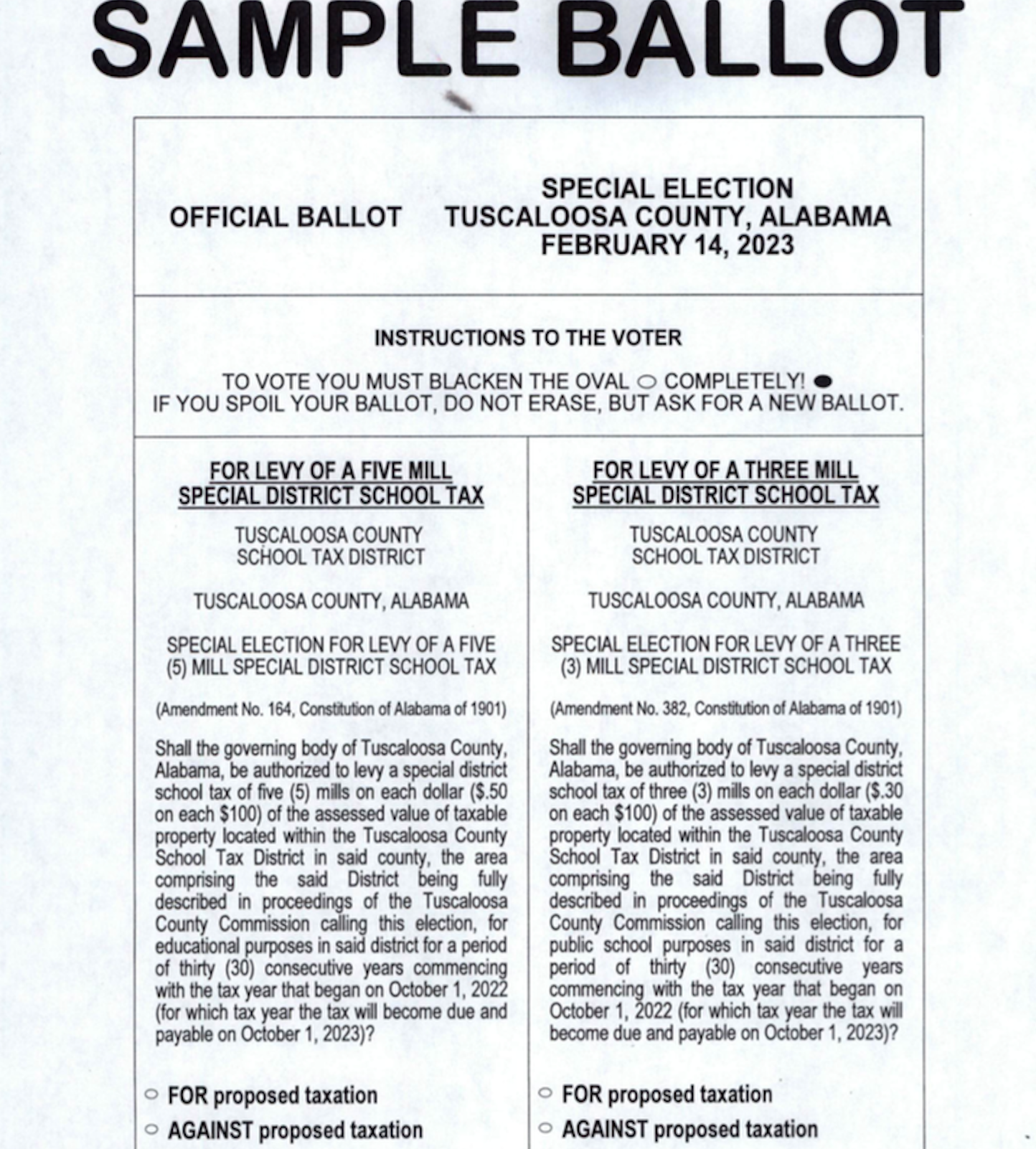
At present, the Tuscaloosa County Tax Assessor's Office says the county school districts are levied at 4.5 mills, but when adding the 5.5-mill levy for the countywide school rate, the total comes out to the state-mandated minimum of 10 mills. These countywide school tax dollars get dispersed to both county schools and Tuscaloosa City Schools and is not up for any kind of change on Tuesday's ballot, according to the Tuscaloosa County Tax Assessor's Office.
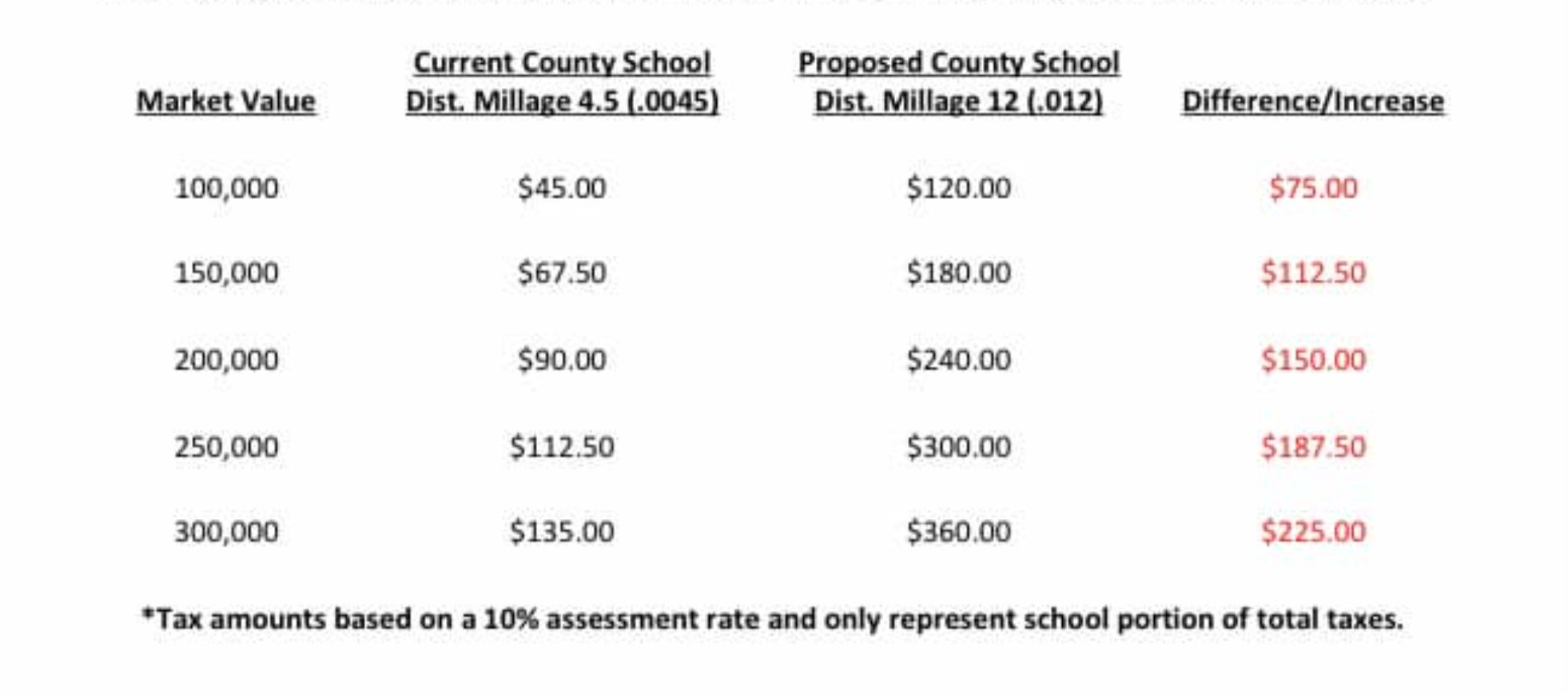
If the 8-mill increase measure passes on Tuesday, property with a $100,000 market value would generate an additional $75 in costs on the owner's annual tax bill, which is based on a class 3, 10% assessment rate.
TCSS has said the revenue generated from the property tax increase would be used for facility improvements, new buildings, adding additional school resource officers (SROs) and upgrading security measures at its older school buildings.
Pay raises for teachers are determined by a state salary schedule and would not be impacted for better or for worse as it relates to the measure on the ballot.
Polls open at 7 a.m. and will close at 7 p.m.
Why a property tax increase?
This has been one of the most consistent questions received by Tuscaloosa Patch and, simply put, it's the only option the school system has to raise local money for capital improvements.
It's worth noting that while the school system cannot openly campaign in support of the property tax increase or buy advertising with taxpayer dollars to support the cause, the county school system does reserve the right to request the County Commission to let the people decide at the ballot box when it comes to any property tax increases to fund local schools.
The last time Tuscaloosa County voters approved a property tax increase to fund schools was in 1917 — the year the very first school property tax was implemented.
TCSS estimates that if the property tax increase is passed, it would provide $15 million a year in additional revenue.
What is a mill?
The Alabama Association of School Boards defines a single mill as equaling: "one-thousandth of a dollar ($1 for every $1,000 of value) and is used to calculate property tax based on the assessed value of a property. Assessed property values differ from jurisdiction to jurisdiction. So, what a mill is equal to in value for your system may be vastly different from what the value of a mill might be in another system."
What do we get if it passes?
Apart from the county school system using the additional revenue to build new facilities and expand on others, TCSS officials have said the increased funding would provide for smaller class sizes; more electives and career tech options; increased mental health resources; and Construction of a centrally-located performing arts venue.
Click here for the most recent look at the proposed capital projects that would be funded by the proposed TCSS property tax increase.
Will this impact the cost of my vehicle tag?
As pointed out by the Tuscaloosa County Tax Assessor's Office, the proposed tax increase would impact homestead property, vacant property, rental property, business personal property, mineral rights, public utilities and motor vehicles, which all operate under the same levied millage rates.
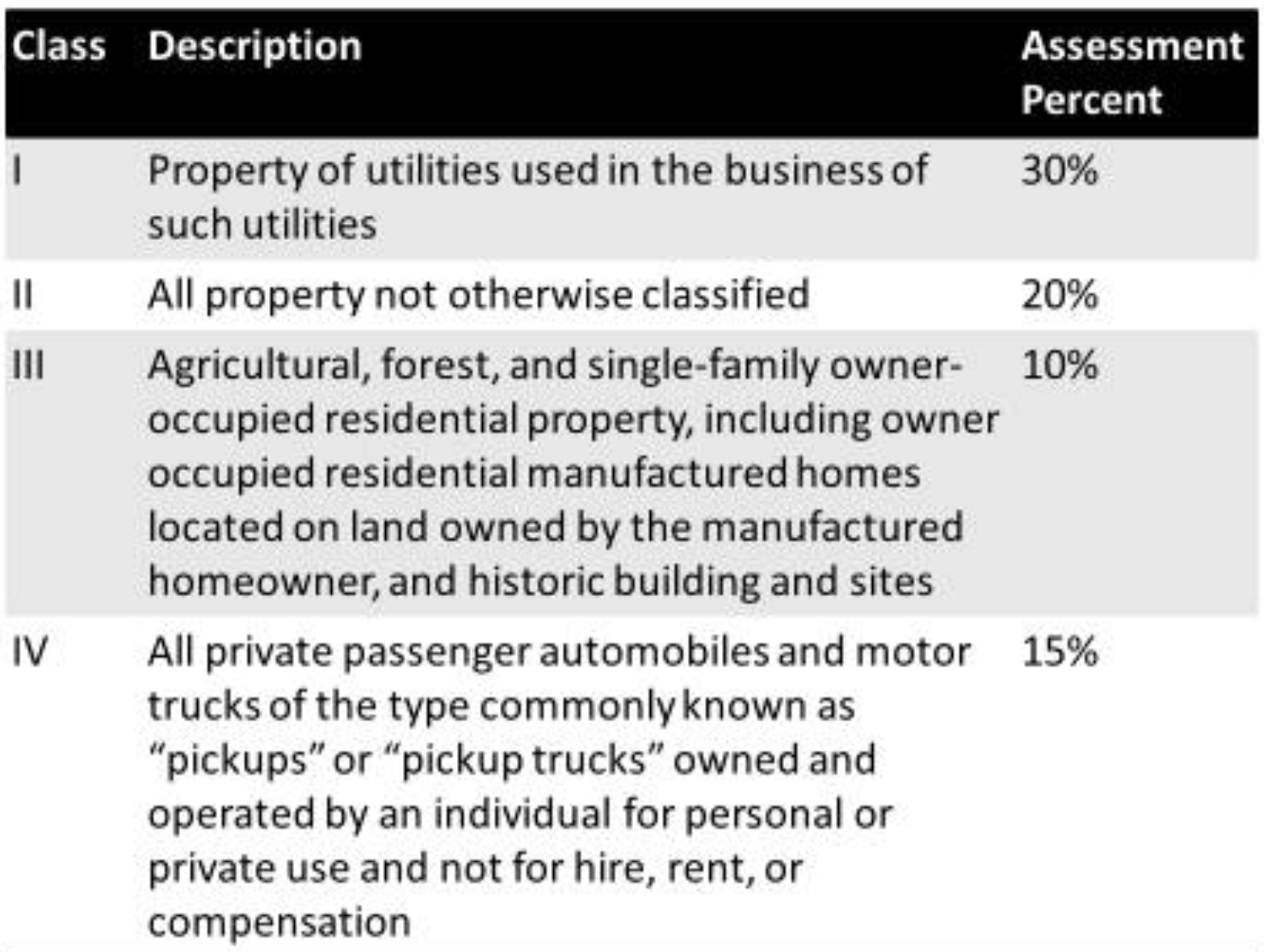
While most residential property is considered Class III with a 10% assessment rate, vehicles are Class IV and carry a 15% assessment rate.
Why is the vote being held on Valentine's Day?
TCSS Superintendent Keri Johnson explained the rationale for the special election date, saying the Valentine's Day election date was chosen because the votes have to be certified by the legislature at a certain time, forcing school system officials to work with the end in mind and go backward.
She went on to say that officials had a timeline for the Tuscaloosa County Commission to get the election set and ballots printed. Given that most elections are held on a Tuesday and TCSS did not want to wait too far into February for the vote to be certified, the decision was made to go with Valentine's Day, Feb. 14.
Despite some on the opposition saying the date was chosen to deter voters from casting ballots against the measure, those supporting the proposed property tax increase have also lamented that the date is likely to hurt turnout for their cause, as well.
A 75% increase?
A prevailing narrative among those opposed to the property tax increase is that, if the measure is passed, it will result in a flat 75% increase in property taxes and some have even suggested increases in excess of 200%.
This is simply not the case — either unintentional misinformation or deliberate propaganda.
While technically the county school portion of the millage rate would increase 75% if the millage rate for the county school system is raised from 10 mills to 17.5 mills, this would not result in a 75% increase on one's overall property taxes.
Here's a breakdown from the county tax assessor regarding how the average taxpayer would be impacted ...
Who is putting up all the "Vote No" signs?
That would be the Tuscaloosa County Farmers Federation — a 501(c)(5) nonprofit that operates as the local branch of the Alabama Farmers Federation or ALFA.
While the Tuscaloosa County Farmers Federation has yet to comment despite requests from Patch on the issue, the nonprofit has spent a substantial and undetermined amount of money on signage and mail-outs to oppose the measure.
Unlike Political Action Committees (PACs), nonprofits in this classification are only required to file campaign expenditures annually through submitting a Form 990 to the Internal Revenue Service (IRS).
With this in mind, little apart from hearsay is known at present about how much the nonprofit lobbying group has spent in the run-up to the special election or who is contributing the funds used by the nonprofit in the effort.
And while some in support of the property tax increase have argued, albeit accurately, that there are less than 600 registered farms in Tuscaloosa County compared to the 19,000 students enrolled in TCSS schools, it must be noted that ALFA and its local chapters are one of the largest lobbying firms in the state and do not require members to be farmers in order to obtain membership.
Indeed, the organization's Form 990 is due on the 15th day of the fifth month following the end of the organization's taxable year. So, for organizations on a calendar year, the annual Form 990 is due on May 15 of the following year, according to the IRS.
As previously mentioned, the county school system is prohibited from spending taxpayer money on advertising in support of the measure, which puts the opposition group at something of an advantage when it comes to garnering public attention and support.
Why does TCSS even need more funding?
As Patch has previously reported, some have been critical of the school system for its management of its state and federal funding in the past, while failing to acknowledge the wholesale leadership changes that have occurred in the course of the last two decades.
However, as TCSS Superintendent Keri Johnson has pointed out on numerous occasions, the funding received by TCSS from state and federal sources is earmarked for certain expenses, with little-to-no wiggle room at the local level.
This leaves the county school system next to no choice in how that money is spent and results in the ad valorem tax for the county school system being the only real financial tool at its disposal when looking to fund building projects without borrowing money.
Why is the Tuscaloosa NAACP now opposed to the measure?
This was not a surprise development, at least in the sense that the advocacy group had been warning of taking such a position due to what it perceives as cultural issues at Hillcrest High and within the Tuscaloosa County School System.
As Patch reported on Monday, the Tuscaloosa NAACP voiced opposition to the property tax increase after more than 200 Hillcrest High students walked out in protest of alleged censorship of the school's Black History Program. The possibility of such an announcement was published last week, in the group's hope that TCSS would offer some kind of compromise.
"While we want a quality education for all students in Alabama, we cannot trust the funds received would be used to benefit all students equally," Tuscaloosa NAACP President Lisa Young said Monday.
If the county's population is increasing so fast, does that not mean more revenue for the county school system?
It's not quite so simple.
Many have made such arguments after the referendum was finalized, but as property values increase over time and the amount collected by the county climbs, the county is still required to send 10 mills to the state — a number that fluctuates based on how much revenue is generated.
Simply put, when the value of a mill increases, so does the amount that must be paid to the state.
"They send us our amount in arrears and tell us what our 10-mill match is," Johnson explained. "Every year we have a new assessed value that we had to send to them for the 10-mill match. Our amount we send to the state is not a static number."
The Alabama Association of School Boards says the 10-mill match is used to fund items in the state’s Foundation Program.
Why do we need to raise property taxes to build new schools?
While the rapid population growth for Tuscaloosa County has been widely reported, few realize that the state and federal education dollars received by TCSS cannot be used for construction or large-scale capital projects. Instead, this funding is used primarily for the school system to maintain its state and federal standards.
Indeed, apart from a bond issuance, the county school system must pay for any capital projects through local funding sources or borrowing. The latter is an unlikely prospect at present, especially when considering TCSS is maxed out on what it can borrow after using mostly bond money to finance the construction of the $24 million Northport Intermediate School near Tuscaloosa County High School.
Why do we need to raise property taxes to improve security?
School safety and security remain some of the biggest concerns among American parents in 2023 and many supporters of the property tax increase have pointed to the need for additional SROs and improved security measures in county schools.
Costing anywhere between $90,000 to $100,000 a year for each school resource officer's salary and benefits, there is no state line item to help the school system fund additional SROs on campus.
TCSS has said its goal is to add roughly 20 more officers, which presents a recurring cost to the school system. At present, there are 11 school resource officers working in the different county school zones, with six fully funded by the Tuscaloosa County Commission, while TCSS funds one.
The salary and benefits costs for the other four officers are split between the commission and the school system.
When considering the security mechanisms in place for the buildings themselves, TCSS has pointed out that when many of the older schools — such as Crestmont Elementary, Flatwoods Elementary, Collins-Riverside Middle and others — were first built, school security was not an issue. Instead, the buildings were designed to be more open to promote air flow due to a lack of central air to cool the buildings during the warmer months.
Have a news tip or suggestion on how I can improve Tuscaloosa Patch? Maybe you're interested in having your business become one of the latest sponsors for Tuscaloosa Patch? Email all inquiries to me at ryan.phillips@patch.com.
Get more local news delivered straight to your inbox. Sign up for free Patch newsletters and alerts.