Politics & Government
Cullman Ballot Challenge Conflicts With GOP Decision To Drop Powell In Senate District 21
A member of the state party's executive committee says the decision for her ballot challenge conflicts with another to drop Powell.


TUSCALOOSA, AL — A member of the Alabama Republican Party Executive Committee says party officials contradicted their own interpretation of GOP bylaws when a decision was handed down Saturday to drop a west Alabama senate candidate from the primary ballot.
Click here to subscribe to our free daily newsletter and breaking news alerts.
Patch reported Saturday night when the GOP Steering Committee cited a $500 donation to the Democratic Primary campaign of Walt Maddox for governor in 2018 by Senate District 21 candidate Tripp Powell as being the reason the Tuscaloosa businessman was removed from the ticket. The decision essentially hands the Republican nomination to longtime Sen. Gerald Allen, with the November General Election ballot also featuring Democratic nominee Lisa Ward.
Find out what's happening in Tuscaloosafor free with the latest updates from Patch.
Then on Sunday, Committee Member Jackie Curtiss Cox, a resident of Cullman, told Patch in an interview that her ballot challenge in a race for Cullman County District Attorney failed, even though much more was provided in the way of evidence when compared to the decision handed down concerning Powell.
A former member of the GOP Steering Committee herself for four years, Cox said she typically files one or more challenges every time a new election cycle rolls around. She refers to herself as a "purist" in her view of how the internal workings of the party should operate, and said she was confused by the conflicting decisions Saturday during the GOP Winter Meeting in Birmingham.
Find out what's happening in Tuscaloosafor free with the latest updates from Patch.
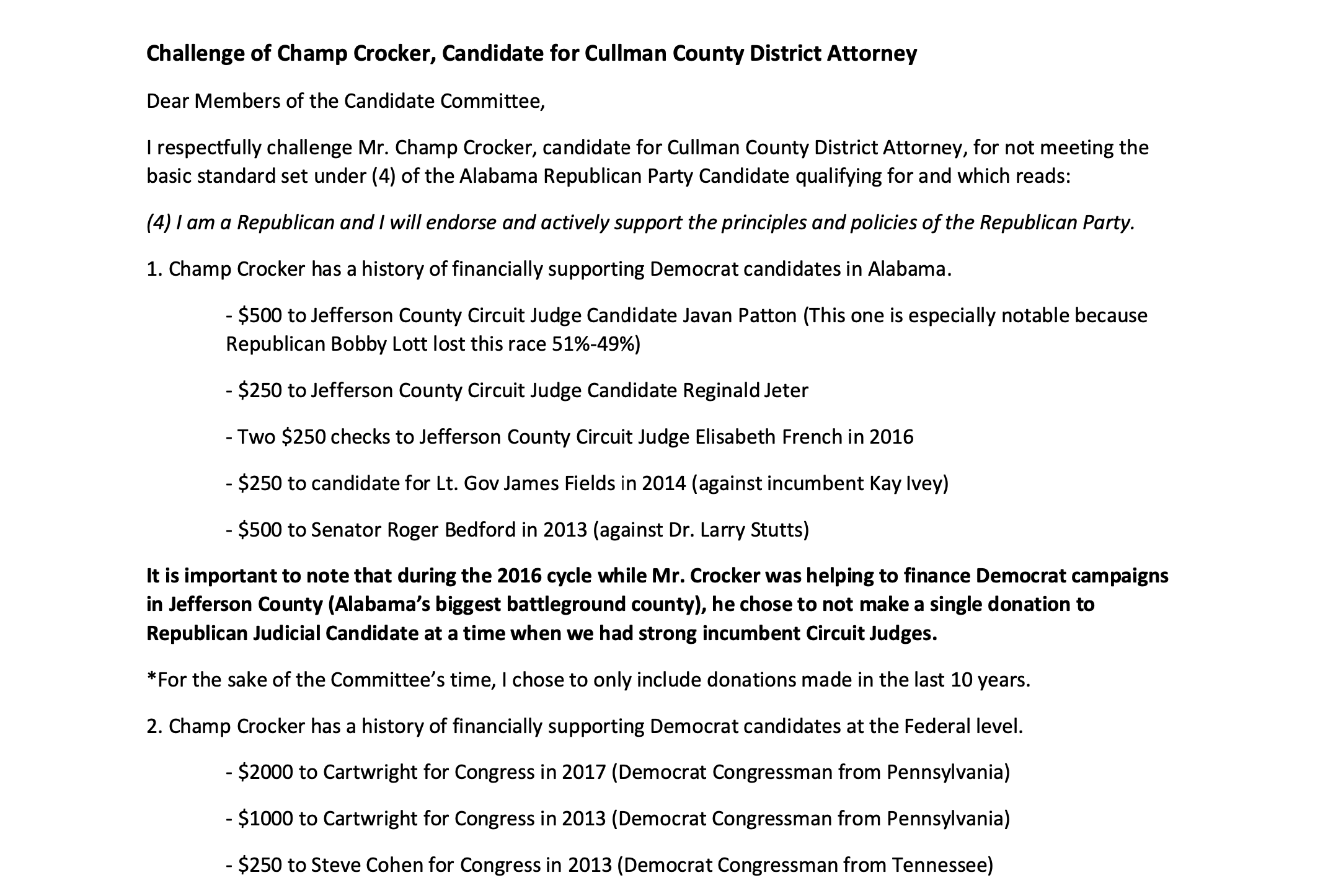
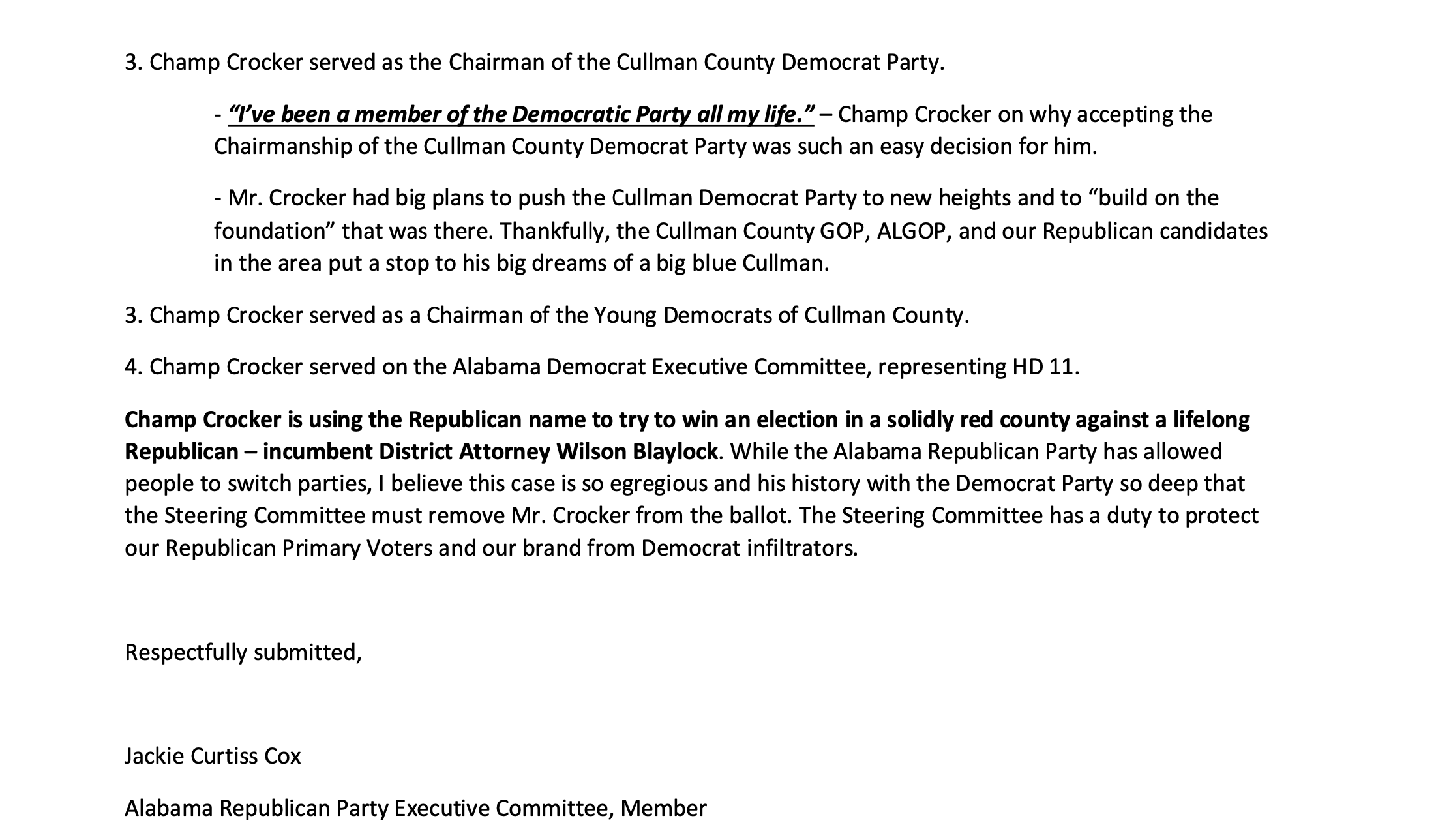
In a copy of her ballot challenge provided to Patch, Cox lays out more than a dozen concise accusations against Republican Champ Crocker for the District Attorney seat in her home county.
In fact, Crocker actually gave $750 to the campaign of Democratic President Barack Obama in 2012, which is more than Powell donated to the 2018 Democratic Primary campaign of Tuscaloosa Mayor Walt Maddox. As Powell has stated, while he did donate to Maddox's primary campaign, he still voted Republican in the General Election — a fact he argues is readily available through public voter records.
"There was a lot of evidence against [Crocker]," Cox told me. "I'm just not really sure why my challenge would have failed, but the one against Tripp had so much less [evidence]. They only had one donation, but for Crocker, he had at least 20 donations to Democrats. I even just stopped looking because I had so much evidence. And [Crocker] was not just donating, he was an activist."
The former chair of the Cullman County Democratic Party, according to Cox, Crocker also previously served on the Alabama Democratic Executive Committee representing House District 11.
Here's a look at the full challenge by Cox, with each individual allegation:
But as hopeful as Powell was in thinking he could fight the challenge during Saturday's meeting, Cox was equally as surprised when her efforts failed to receive the support of the Steering Committee. She then said Crocker will now be allowed to appear on the ballot, with nothing in the way of rationale provided by the committee members who voted down her challenge.
In baffling contrast, the decision relating to Powell saw the committee seemingly change a rule on the spot extending prohibitions on donations to opposing party campaigns from GOP elected officials to now include candidates who had never held elected office.
Here's a look at the full ballot challenge filed on Feb. 4, 2022 against Powell.
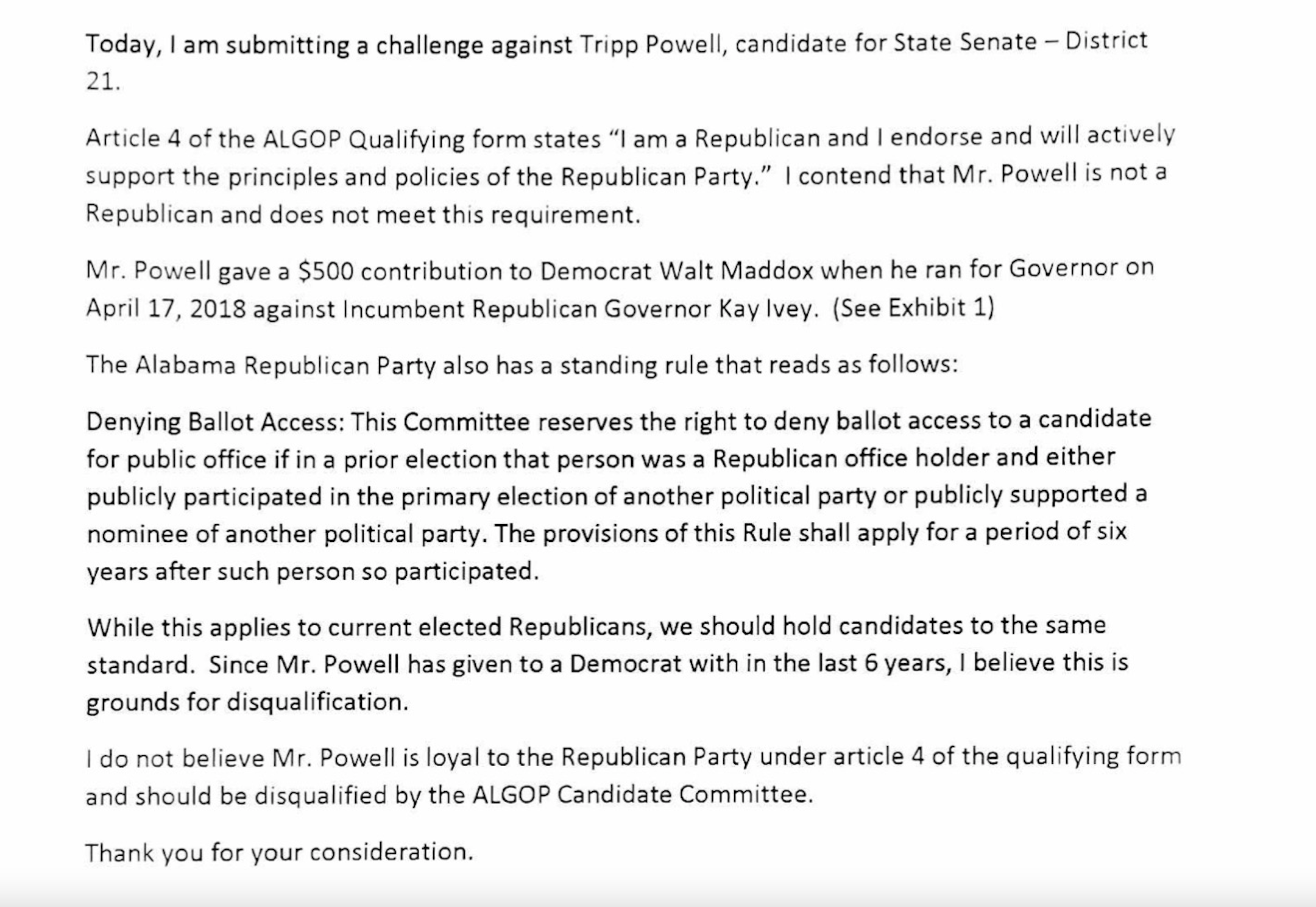
The challenge against Powell was made by longtime Republican insider Chris Brown — the owner of Red State Strategies and a bonus member of the Jefferson County GOP's Executive Committee.
"One of the things [Alabama GOP] Chairman John Wahl told me as the hearing began was that the committee’s job was to apply the rules fairly and uniformly to all candidates in order to protect the integrity of the party," Powell told me after receiving news of the conflicting decision in the Cullman District Attorney Republican Primary. "Hearing of this result compared to my own situation is extremely disappointing, to say the least."
Committee Vice Chair Josh Dodd in a statement to Patch on Sunday reiterated the Committee's right to deny ballot access, going so far as to say the party's approach should be expanded to include not just office-holders, but candidates — which is not the case in the party's bylaws, which explicitly take aim at elected officials donating to a opposing party.
"The provisions of this Rule shall apply for a period of six years after such person so participated," Dodd said. "In my opinion, we should hold candidates to that same standard."
Cox also provided an interesting bit of insight with respect to procedure, saying voting by the Committee is done with a remote or "clicker," so as to keep the decisions of committee members anonymous to the public and other party members. What's more, she said her closed-door challenge hearing was one of the first few following Powell's, underscoring how little time had gone by between the two drastically different decisions.
While Patch reported many insiders close to the situation cited a idealogical schism in the party resulting in increased paranoia and demands for absolute loyalty, Cox speculated that it was more likely the result of unseen influences over individual Steering Committee members.
"There wasn’t anything clear in terms of partisanship, like they were especially conservative or anything," she said. "It just seems like people lobbied the Steering Committee ahead of time, Champ Crocker had legal counsel, so maybe that helped."
Apart from losing a ballot challenge, Cox's sharpest critique circled back to the overall lack of transparency as it relates to the committee's practices and decision-making.
"What I don’t like is that the Steering Committee is hiding behind executive session," Cox explained, before arguing that closed-door sessions in meetings are typically reserved for matters of pending litigation or when the information discussed could potentially damage any of the parties involved. "These are big votes that have a big impact on people, and they don't want people to see how they vote."
She also provided additional context in the challenge against Tallassee Mayor and Public Service Commission candidate Johnny Hammock, another contrasting instance of a candidate being allowed to appear on the primary ballot, despite having much more evidence against them than Tripp Powell.
According to a story written in January by Sarah Stevenson of the Elmore Autauga News, Hammock not only faces a laundry list of serious allegations made by members of his own city council, but also a disturbing domestic violence arrest earlier this year while he was on the campaign trail in Orange Beach.
While the GOP Party bylaws explicitly cite "malfeasance" as a reason for dropping a candidate from the primary ticket, Cox said the challenge against Hammock was not voted on, due to the individual who filed the complaint failing to show up to argue the case.
"The lack of transparency with the steering committee in this process is a huge problem," she said. "It’s a major issue. If I was Tripp Powell, I would fight this."
It's unclear at this time just how Powell will approach the coming days and weeks, but it's worth noting that he does have options.
Cox is a lifelong conservative and has a nuanced understanding of how the Alabama Republican Party's different systems operate. Apart from having the ability to take the matter to circuit court, which Patch has previously reported, Cox explained that if a candidate dropped from a primary ballot can gather the signatures of 50 members of the state executive committee, then the chair of the party would be forced to call a special meeting.
If a quorum is reached at the special called meeting, then the appeal of the decision of the Steering Committee could be voted on. Timing presents an issue, however, with requirements for advertising the meeting that could prove a problem in a campaign where every day matters.
"It's kind of a mess but there is a process," Cox said. "It wasn’t consistent. If they had gone in and kicked off everyone [from the ballot] who had given money to Democrats, then that would have made more sense. The process was just not fair."
Have a news tip or suggestion on how I can improve Tuscaloosa Patch? Maybe you're interested in having your business become one of the latest sponsors for Tuscaloosa Patch? Email all inquiries to me at ryan.phillips@patch.com.
Get more local news delivered straight to your inbox. Sign up for free Patch newsletters and alerts.