Crime & Safety
Man Accused Of Killing Tuscaloosa Police Officer Takes Stand In Day Four Of Capital Murder Trial
Here's the latest on the capital murder trial for Luther Bernard Watkins, Jr.


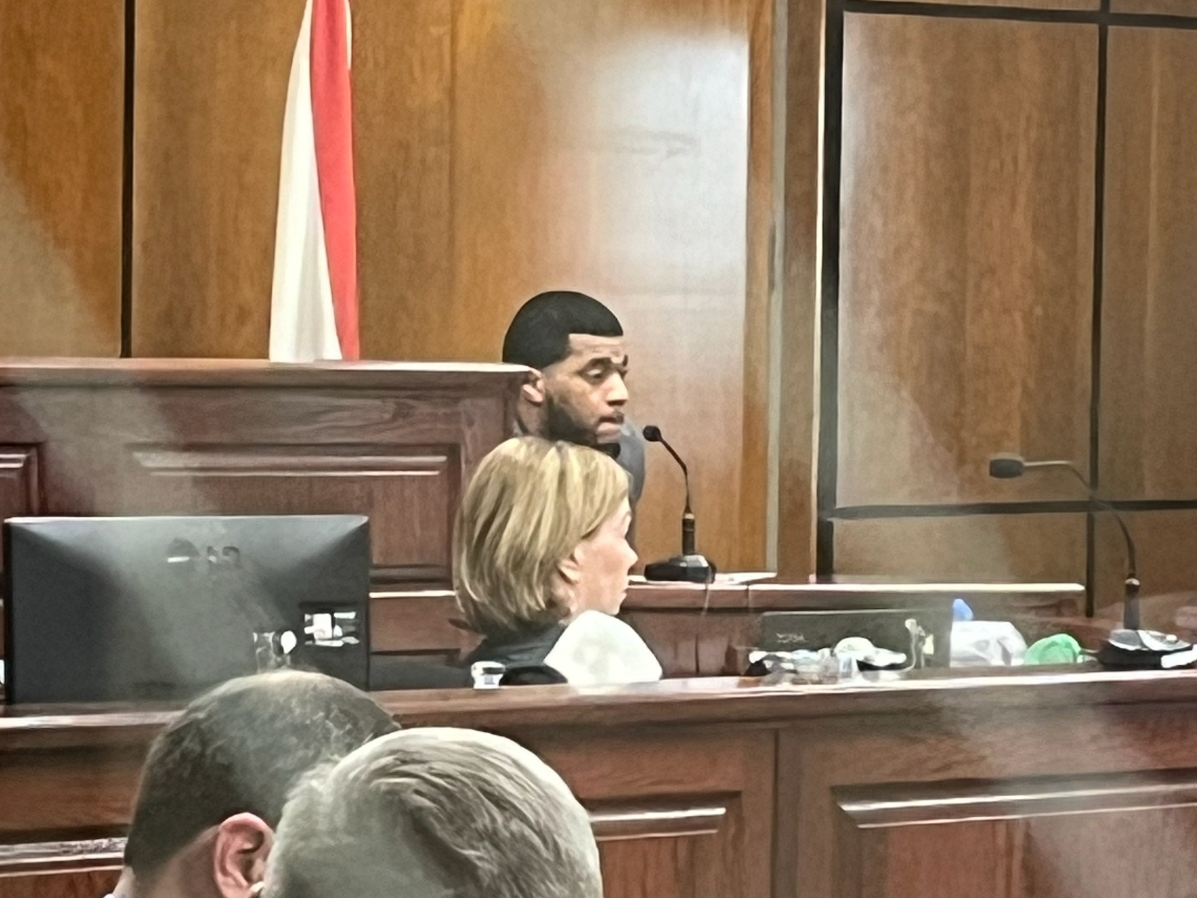
TUSCALOOSA, AL — In somewhat of a surprising turn, the man accused in the 2019 shooting death of Tuscaloosa Police Department Investigator Dornell Cousette took to the witness stand to testify Thursday on the fourth day of his capital murder trial.
Click here to subscribe to our free daily newsletter and breaking news alerts.
As Patch previously reported, a Tuscaloosa County jury on Wednesday heard additional witness and expert testimony as the prosecution rested on the third day of the trial for Luther Bernard Watkins Jr., who was 20 years old at the time of the fatal shooting.
Find out what's happening in Tuscaloosafor free with the latest updates from Patch.
He faces the death penalty if convicted.
Thursday saw several additional witnesses called by the defense before Watkins waived his right to remain silent and elected to take the stand.
Find out what's happening in Tuscaloosafor free with the latest updates from Patch.
Birmingham defense attorney Christopher Daniel during direct examination of his client asked him to walk him through his entire day on Sept. 16, 2019 — the day of the shooting at the home on 33rd Street.
Watkins said he was living in a tent behind the house because of his outstanding warrants for robbery and assault but said he started his day going to McDonald's for breakfast with Kevonte Chambers.
As Patch previously reported, Chambers testified on Wednesday and was one of the witnesses in the front yard when Cousette and bail bondsman Ed Giles pulled up in front of the house.
Watkins testified that he and his friends began playing cards around noon and did so until the events immediately leading up to the shooting. He also said his friends were aware he had a 9mm Hi-Point brand handgun in the waistband of his shorts, somewhat secured by the fanny pack around his waist.
Watkins then said the card game was broken up when two vehicles pulled up and he noticed the black Ford Taurus driven by Cousette, whom he said he knew as a police officer and as someone regularly seen in the neighborhood.
He claimed Cousette exited the vehicle and, consistent with other previous testimony, told Watkins "don't run."
"I knew I had warrants and when I saw the car I got scared and ran," he told the jury.
Running for the porch, Watkins said he pushed the door open with his left hand, stumbled into the living area and said he was knocked to the ground after being shot in the back by Cousette.
He went on to say his ears were ringing after the first shot was fired and he rolled over to see Cousette standing over him pointing his handgun.
"I got the chance to get my gun and to stop him from killing me I shot him," he said, before reiterating that he meant to shoot Cousette but did not mean to kill him.
Cousette was shot in the face and immediately incapacitated but not before getting off a shot "almost simultaneously" that struck Watkins in the chest.
Watkins testified he originally intended to exit the house through the front door but saw bail bondsman Ed Giles out front with what appeared to be a handgun, which Watkins later learned was a Taser.
After exiting the house from the back door, Watkins said he lost both of his shoes when he jumped a fence and tore his shorts on a gate, prompting him to discard them before making his way to the 18th Street residence where Kenclomisha Hughes lived.
As Patch previously reported, Hughes testified that Watkins indeed showed up at her house with visible injuries and asking for medical help. She then drove him to DCH's hospital in Northport and let him out in the parking out.
Watkins said he went to the house on 18th Street because it was the nearest house where he knew his friends would be. It was at this point that he admitted on the stand to going to the back of the house and hiding the handgun in a detached truck toolbox, where it was later recovered by Tuscaloosa Violent Crimes Unit investigator Marcus Bell.
Watkins said he chose to leave the gun in the toolbox because he knew he was going to the hospital and did not want to have a weapon on him. This also was his reasoning for discarding several bullets in the DCH Northport parking lot from his fanny pack.
He later testified he did not tell Hughes which hospital to take him to.
After entering the hospital through its emergency room, Watkins said he passed out while receiving treatment and woke up handcuffed to the bed in police custody.
Chief Assistant District Attorney Paula Whitley Abernathy then cross-examined Watkins and challenged him about his reaction when Cousette and Giles pulled up to the house.
"'Oh shit, there's Cousette' — is that what went through your mind?" she asked.
While he answered "No ma'am," Watkins also acknowledged that he didn't think to put his hands up to show he was not wielding a weapon.
Abernathy also asked him about the condition of his bond that prohibited him from possessing a firearm at the time of the shooting.
"It was so quick," Watkins said of the incident, which both sides agreed developed in roughly 8 to 10 seconds. "You have to think about how fast this happened, m'am."
Cross-examination then shifted to comments made by Watkins in a phone call from the Tuscaloosa County Jail to his family. As Patch reported earlier in the week, audio was played from a phone call after Watkins was booked into the Tuscaloosa County Jail on Sept. 21, 2019.
On the call, Watkins can be clearly heard saying "that bitch should've killed me."
Abernathy pressed Watkins about the comment, to which he initially denied having said it, before the prosecutor insisted that the court had already heard the audio. He eventually admitted to making the comment about the slain officer.
Abernathy also asked Watkins about telling his family on that same call to go get "his stick" — slang for a firearm — and how he told his family that he wasn't at the house when Cousette was shot.
The prosecution then wrapped up with showing Watkins photos he posted to Facebook in July 2019 that show his wielding a rifle and handgun.
Other Witnesses
While Watkins' testimony capped off the fourth day of trial proceedings, several other witnesses were called to the stand by the defense as they made their case for their client acting in self-defense.
The first witness called to the stand Thursday was bail bondsman Napolean McEwan of Tuscaloosa's ABS Best Bail Bonding Co., Inc
McEwan testified that the day of the shooting he met with Giles, who helped him with two violators, one in Northport and the other being Watkins.
He said the two met up at the Sonic on Martin Luther King Jr. Boulevard in the city's West End before going to Northport to pick up the first individual. The focus then turned to Watkins.
The pair then located Watkins at the house on 33rd Street before taking the other offender to the TPD headquarters, where Giles asked a desk receptionist for Cousette by name to help bring Watkins in.
McEwan went on to testify that Giles left TPD headquarters to meet Cousette and tell him where they could find Watkins. By his recollection, about 25-30 minutes later, he heard Giles over the radio shouting that an officer was down.
A large part of Thursday's testimony also focused on digital renderings of the home, which saw Certified Senior Crime Scene Analyst Jeff Goudeau and Joshua Cohen, the founder of Fat Pencil Studio, alternate on the stand to discuss the renderings and simulations of the shooting.
Much was debated about the images, particularly their evolution to their current incarnations, which was brought into question by District Attorney Hays Webb.
Circuit Judge Brad Almond also instructed the jury that the renderings were demonstrative in their courtroom use and would not be provided to jurors during their deliberations.
Perhaps the most turbulent testimony of the day apart from Watkins taking the stand came when the defense called law enforcement consultant and former Madison Police Chief Daniel Busken to the stand to provide insight into the 37-page report he made after being retained by Watkins' court-appointed defense attorneys.
Much of Busken's testimony focused on proper police protocol as compared to what he viewed as questionable policies within the Tuscaloosa Police Department.
Busken insisted that TPD's use of force policy was outdated and did not align with Tennessee v. Garner — a landmark case that saw the Supreme Court rule that under the Fourth Amendment of the U.S. Constitution, a police officer may use deadly force to prevent the escape of a fleeing suspect only if the officer has a good-faith belief that the suspect poses a significant threat of death or serious physical injury to the officer or others.
Former Tuscaloosa Police Chief and the City of Tuscaloosa's Executive Director of Public Safety Brent Blankley explained to Patch that the department's use of force policy is not available to the public to protect the safety of its officers and their tactics.
Still, audible laughs could be heard from the prosecution side of the courtroom, where numerous police officers sat observing the proceedings, especially when Busken was asked by Webb if offenses like robbery and assault were considered violent.
"It can be," he testified, before laughs could be heard in the audience when he was cross-examined by the district attorney.
After Busken testified to the dangers of officers making solo arrests, Webb also pointed out that TPD does not have a policy disallowing solo arrests.
Get more local news delivered straight to your inbox. Sign up for free Patch newsletters and alerts.