Community Corner
The Tuscaloosa Ripper? 1888 Murders Drew Comparisons To Infamous Whitechapel Killings
Old newspaper accounts detail four brutal Tuscaloosa murders over the course of 10 days.


TUSCALOOSA, AL — Few true crime cases have captured the imagination of the public like the bloody rampage that took place in the Whitechapel district of London's East End from 1888-1891 at the hands of a mysterious figure known today as Jack the Ripper.
Click here to subscribe to our free Tuscaloosa Daily newsletter and breaking news alerts
But at this same time, more than 4,000 miles and an entire ocean away, Tuscaloosa was gripped with fear amid its own eerie killing spree that left four Black men dead over the course of 10 days.
Find out what's happening in Tuscaloosafor free with the latest updates from Patch.
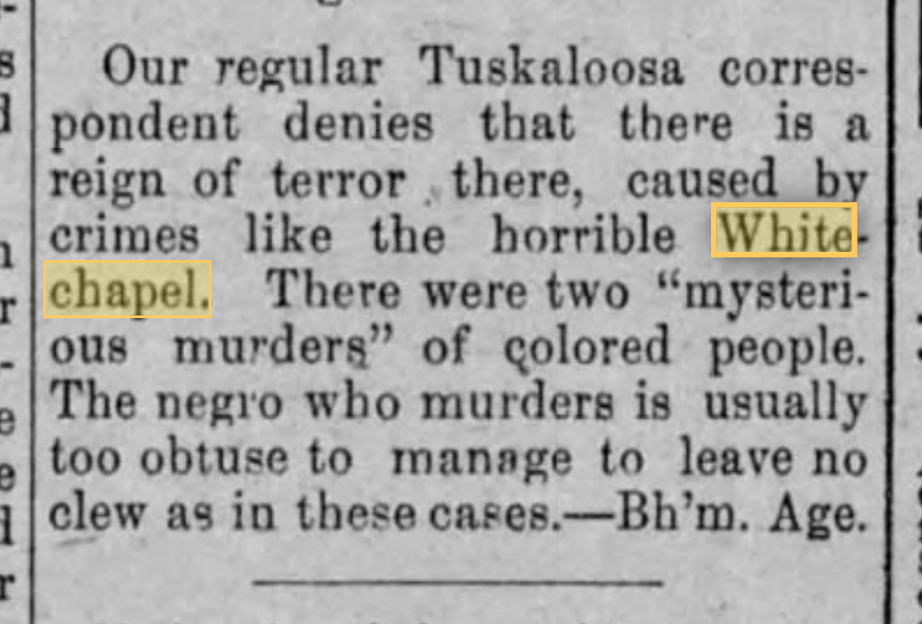
The cases were so brutal, in fact, that newspaper accounts from the time said "in mystery, they equal the Whitechapel crimes."
While it is highly unlikely — if not wholly impossible — the same individual responsible for the Whitechapel murders was behind the four similar Tuscaloosa killings in the fall of 1888, the sensationalism of the murders earlier that year in London was not lost on residents of Tuscaloosa and American newspapermen, who quickly drew parallels in a vain attempt to explain the violence.
Find out what's happening in Tuscaloosafor free with the latest updates from Patch.
Debate persists on the first of the Whitechapel murders, which are known to have started in August 1888, with Jack the Ripper claiming four victims by the time the violence in Tuscaloosa began to grab headlines the following October.
While Jack the Ripper killed White female prostitutes in some of London's most impoverished neighborhoods, it took the famous serious killer several months to achieve the body count reached by a potential counterpart in Tuscaloosa, who possibly killed four people in less than two weeks as Jack the Ripper terrorized London's red light districts.
In Alabama, the controversy and fear began less than a month after London police received the now famous "Dear Boss" letter from Jack the Ripper. The first brutal killing in Tuscaloosa was of John Hill, a well-respected Black mechanic on or about Oct. 13. He was also the only victim identified by name in the days and weeks following the string of murders.
Hill's body was found near a Black dance hall in the "suburbs" of Tuscaloosa with this throat cut and roughly 15 stab wounds to various parts of his body. A few days later, the decomposing body of an unidentified Black man was found in a wooded area near the city limits.
In a similar fashion, the second victim — who was never identified — was also found with his throat cut "from ear to ear," according to an account published in one Texas newspaper. After working two days to identify the second victim, it was reported that the local coroner had run out of leads in closing the case and could not pinpoint a name or any family in the area for the murdered man.
Two days later, though, newspapers reported that the body of another Black man had been recovered from the Warrior River near Tuscaloosa.
Also unidentified to the present day, the third victim had his throat cut and "his skull crushed in by a blow from some heavy instrument."
While the exact dates and locations remain fuzzy, one newspaper story said two days following the body of the man being found in the river, a fourth victim was discovered in a wooded area close to town, in an instance similar to that of the second murder.
Here's where more debate begins, in addition to some fascinating contrasts with how the killings were viewed locally and across the country.
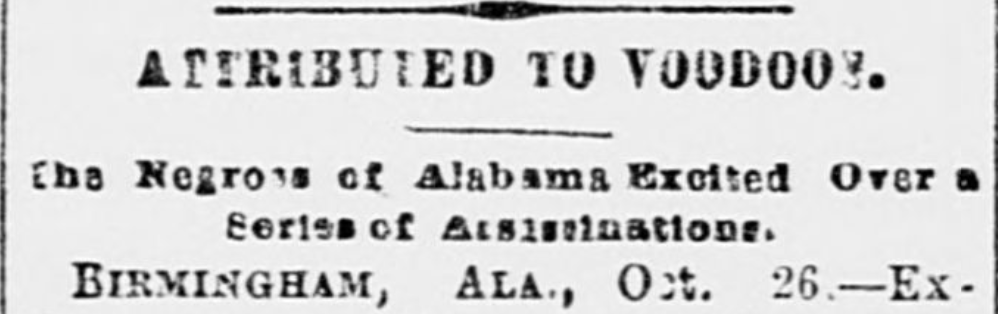
In newspapers outside of Tuscaloosa, reports of fear consuming the local Black population were numerous, as rumors swirling even included accusations of voodoo being involved in the murders.
One report said many Black residents had even left town, with the newspaper account claiming: "Not even the boldest can be induced to leave their house after night."
The rumors involving voodoo, according to one report, could be traced back to two weeks before the murder of John Hill, when two horses belonging to a Black woman in Tuscaloosa suddenly died in a mysterious fashion. The woman reportedly told a local doctor that the horses had been the victim of "voodoo" and requested the physician examine the stomachs of the dead animals.
The wire report, which appeared in numerous newspapers outside of Tuscaloosa and could be chalked up to nothing more than the rumor mill pandering racist stereotypes, said a small snake was found in the stomach of one of the dead horses, while a lizard was found in gut of the other.
These odd facts alone, the newspaper said, confirmed to the owner that the deaths of her horses had been the result of voodoo.
What is likely most illuminating, though, is the attitude taken by the paper of record for the city at the time, The Tuscaloosa Gazette — a since defunct periodical that was widely known for its white supremacist leanings and support of lynchings.
In other accounts I've reported on involving lynchings, the Gazette and other Tuscaloosa-based, White-owned papers, made no attempt to hide their support of lynch mobs and racially-motivated violence targeting the local African-American population.
In an article titled "Vivid Imagination," the unnamed writer of the Tuscaloosa newspaper column takes issue with one of the stories of the killings published by the Birmingham Age following the violence. With a strong tone of sarcasm, the Tuscaloosa Gazette downplays the hysteria in the local Black community and chides the more progressive Birmingham newspaper for apparently knowing something The Gazette's editors did not with regards to violence in their community.
The attitude is a similar one to others taken by the newspaper, which regularly denigrated outside opinion or outright defended White-on-Black violence.
The reporter for the Gazette even went so far as to quote a local Black pastor, who said that there was little to no fervor regarding the unsolved killings. In knowing what we do today, this was likely no more than an attempt by the newspaper's editors to show the outside world that all was harmonious in Tuscaloosa, despite public hysteria being at a fever pitch. The practice was a common one for the time and reads much like other published defenses of lynchings where, time and again, a murderous mob or individual was allowed to slink back to anonymity under the cover of darkness and with a blind eye turned by authorities.
"The writer of the special [correspondence] must have let his imagination get the better of him when penning his communication," the Tuscaloosa Gazette surmised, wholly unsure if the murders would continue.
But in another telling account by the Tuscaloosa newspaper, it's almost as if the editors tip their cap to the possibility of a White person being responsible for the murders.
One writer speculated that African-Americans who murder are usually "too obtuse" not to leave clues when they commit killings — an odd idealogical departure from most Southern newspaper accounts of violence perpetrated in the Black community. If you read coverage in regional and community papers from that time, there was little that Black criminals were not capable of, which makes this speculation by a White newspaperman in 1888 that much more interesting . Indeed, their reporting would typically serve as an indictment against African-Americans in the court of public opinion and often add fuel to public sentiment against the Black community.
But in putting the killings into context, the easy conclusion can be drawn to the possibility of White supremacist groups targeting the victims. To this reporter in the present day, this seems unlikely for two reasons, the first being that lynch mobs rarely went unreported.
These mobs were typically made up of movers and shakers in the local community, police, public officials and others. In more accounts than I can recall, even the smallest lynch mobs would somehow find their ways into the columns of local newspapers — likely because the newspaper staff also had players involved. For whatever reason, apart from spreading fear, mobs seemed to relish the recognition for their violent deeds.
The other factor that leads me to believe that one or a very small group of people, was responsible for the Tuscaloosa murders, is the fact that none of the four victims' bodies were put on public display. Lynch mobs would almost always use a racially-motivated killing as an opportunity to send a message to the Black community and, as far as I can tell, each of the bodies were discovered by passersby.
And while there is no evidence saying the four 1888 killings were not the result of White supremacists, the fact that all four had their throats cut in a similar fashion underscores a an oddly personal motive. As someone who has researched nearly every documented lynching in Tuscaloosa County, the method of execution was almost exclusively a gun in tandem with a noose or fire. In all of my research, I've failed to come across a single lynching in Tuscaloosa County involving a knife or blade.
Naftali Berrill, a forensic psychologist in New York City, told the outlet Seeker in 2014 that any time someone commits a murder or assault, either by choking, stabbing or making bodily contact, it always speaks to a certain degree of rage and potentially a personal connection to the victim.
"When you are stabbing someone, it's close and in your face," he said. "The experience is more visceral and more graphic, more provocative. It speaks emotionality, whether rage or paranoia."
But, after all, it's important to note that the aforementioned possibilities regarding the Tuscaloosa murders are merely unscientific speculations made by a journalist, with only context as my compass. It's equally important to acknowledge the nuances of the cases that have been lost to history that could otherwise provide additional answers.
Regardless of the debate, though, little in the way of progress would ever be made in bringing the killer or killers to justice in Tuscaloosa. Jack the Ripper would go on murdering in London's East End until at least 1891, becoming one of the most well-known true crime mysteries of all time.
In contrast, one newspaper story regarding the case in Alabama, which did not receive a fraction of the media coverage, spoke to the local attitude of the violence, which stood in stark juxtaposition to the outrage and fear that was widely publicized in London.
"In this section, the killing of a negro is regarded as a matter of little importance, so no very determined effort has been made to solve the mystery of those four bloody crimes," the Birmingham Age wrote.
While some researchers and sleuths have made well-founded claims to have found the man responsible for the Whitechapel killings, the one ageless link that connects the two cases can be seen in violence targeting the "less-than-desirable" elements of the society's they occurred in. The killing sprees were also likely protracted due to this notion, which underscores the brutal realities of how our world has evolved, resulting in more importance placed on investigative techniques and developing technology to solve the most complex crimes.
So what do you think?
Was one person responsible for the four murders?
Was it the work of the Ku Klux Klan?
What about road agents or highwaymen?
What if it was just coincidence during a most violent month in 1888?
What if it was Jack the Ripper?
Let us know what you think by emailing me at ryan.phillips@patch.com.
Enjoy this story and have a piece of local history you'd like to share? Please let me know!
Have a news tip or suggestion on how I can improve Tuscaloosa Patch? Maybe you're interested in having your business become one of the latest sponsors for Tuscaloosa Patch? Email all inquiries to me at ryan.phillips@patch.com
Get more local news delivered straight to your inbox. Sign up for free Patch newsletters and alerts.