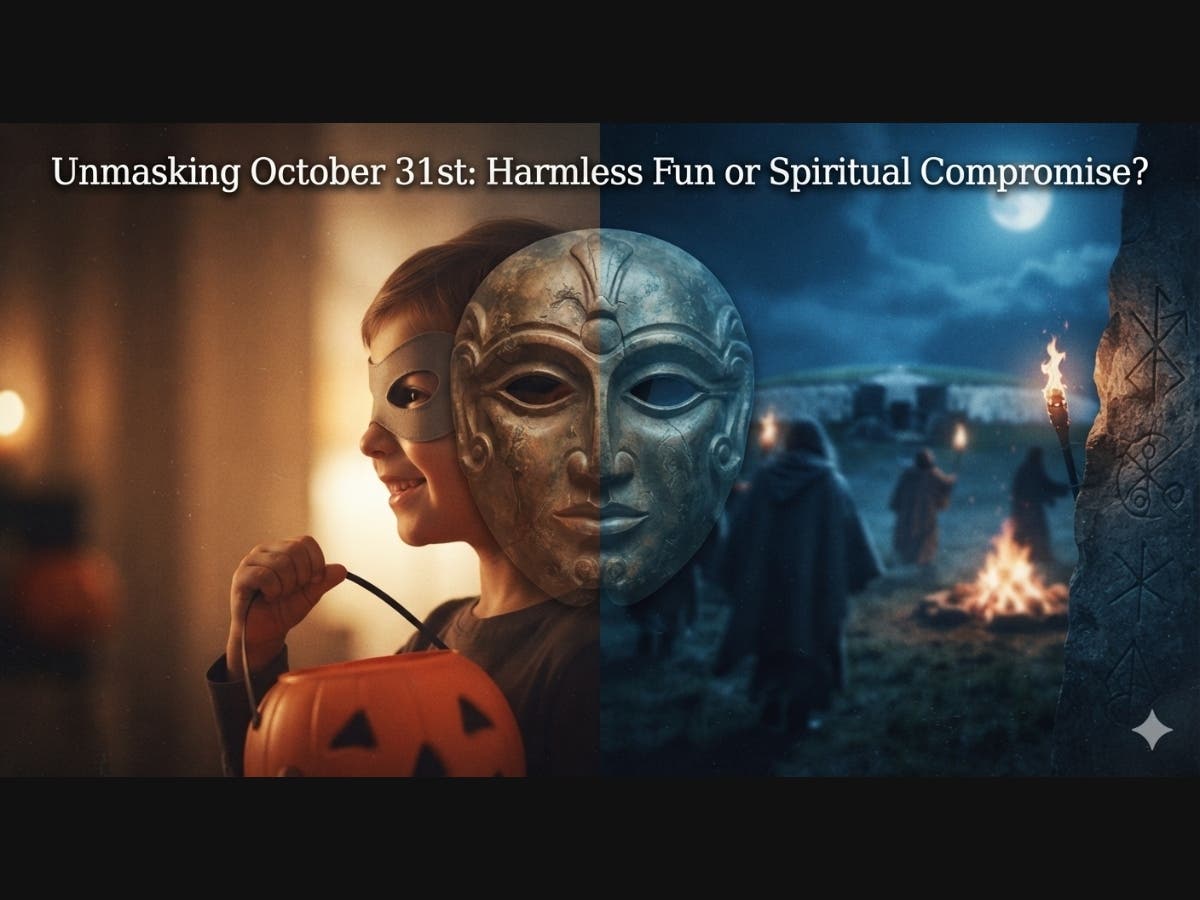
Every October, a familiar debate resurfaces in Christian circles: Should we celebrate Halloween, or should we walk away from it? It is easy to dismiss the holiday as harmless fun, wrapped in plastic costumes and fun-sized candy. However, wanting to move past superficial opinions, I decided to dig into the historical origins and spiritual symbolism of this season. What I found forces us to look past the modern storefronts and confront a much older reality.
The Thin Veil of Samhain
Long before it was a commercial juggernaut, Halloween began as Samhain (pronounced sow-in), an ancient festival practiced by the Celtic Druids in what is now Great Britain and Northern France. Celebrating from sundown on October 31st through November 2nd, the Druids marked this three-day period as their New Year.
Find out what's happening in Tuscaloosafor free with the latest updates from Patch.
But Samhain wasn't just a calendar change; it was a deeply spiritual event. The Druids believed that during these nights, the veil separating the physical world from the spiritual realm grew thinnest. This thinning allowed the souls of their dead ancestors to return to Earth—but it also opened the gates for malicious, evil spirits to cross over. As an article published by The Conversation highlights, these ancient Samhain rituals focused heavily on death, remembrance, and mourning. To appease these forces, the Celts engaged in rituals that worshiped both a pagan goddess and the dead. Because these traditions thoroughly predate Christianity, the holiday’s very foundations are entirely detached from the Christian faith.
The Modern Alignment: Wiccans and Satanists
Find out what's happening in Tuscaloosafor free with the latest updates from Patch.
The spiritual significance of Samhain didn't vanish with the ancient Celts; it remains a sacred cornerstone for other religions today, specifically Wiccans and Satanists.
According to the website Wiccan Holidays for Witches and Warlocks, New Year’s Day is still recognized as October 31st at sundown. The site explicitly states, “It is an evil and wicked night, a perfect night for a witch to celebrate New Year.”
Similarly, official resources from The Satanic Temple explicitly list Halloween as a "Blessed Satanic Holiday." They describe it as “a holiday to celebrate indulgence and embrace the darkness and its aesthetic,” adding that while “Halloween is consistently described as evil, demonic, and satanic… costumes, candy, and facing fears are to be embraced.”
Costumes and Trick-or-Treating
When we fast-forward to modern neighborhood celebrations, the core activities seem innocent enough: children dress up, ring doorbells, and collect candy. But where did these specific customs actually begin?
The Origin of the "Trick" and the "Treat"
“So long as the offering was forthcoming the ghosts were happy and benevolent, but if the offering was withheld another side of the ghosts' features were presented. Bad luck would descend on the household... Some vestiges of this tradition survived in the modern Halloween custom of 'trick or treat.' Children, dressed as ghosts and witches, invite the household to make a donation or face the consequences. The 'treat' may represent the ritual offering while the 'trick'... may have in antiquity, represented the malevolent consequences of inadequately appeasing the ancestral ghosts on this night.”
According to historical insights from Newgrange.com, Samhain was fundamentally a feast of the dead, requiring ritual offerings to appease roaming spirits. In other words, a "trick-or-treat" bag isn't just a modern invention—it is the direct evolution of an ancient pagan extortion ritual meant to pacify wandering ghosts.
Dressing Up to Hide from Spirits
The costumes carry a similar weight. Records from The History Channel reveal that during Samhain, villagers would disguise themselves in costumes made of animal skins. This wasn't for entertainment; it was for survival. The disguises were worn as a form of spiritual protection to drive away phantom visitors. The goal was to blend in with the demonic realm so that wandering spirits would mistake you for one of their own and pass you by, rather than recognizing you as human and attempting to claim your soul.
The Modern Danger: Physical and Spiritual
When we look at this history, a pressing question arises for Christian parents. Beyond the historical roots, what are we practically doing when we send our children door-to-door?
In today's world, sending children to the houses of strangers carries obvious physical safety risks. Statistically, you likely do not know the character or beliefs of 95% to 99% of the people living behind those doors. What if one of those homes belongs to an active Satanist, a witch, or a warlock?
Anyone handling the candy your child receives has an opportunity to interact with it spiritually. They can pray over it, or they can curse it. As believers, we rightly worry about physical contamination, but we must be equally vigilant about the spiritual poison we might be opening our front doors to—and allowing directly into our children's lives.
Jack-O'-Lanterns and the Legend of Stingy Jack
Walk down almost any street in October, and you will see glowing pumpkins carved with jagged smiles sitting on front porches. Like trick-or-treating, it seems like an innocent autumn pastime. But the history of the Jack-O'-Lantern reveals an origin story deeply rooted in deception, the demonic, and a desperate attempt to keep evil at bay.
The Tale of Stingy Jack
According to historical accounts from History.com, the practice originates from an old Irish folktale about a man nicknamed “Stingy Jack.” As the legend goes, Jack invited the Devil to have a drink with him. True to his name, Jack didn’t want to pay, so he convinced the Devil to turn himself into a coin. Instead of buying the drinks, Jack kept the coin in his pocket next to a silver cross, trapping the Devil.
Jack eventually freed him under the condition that the Devil wouldn't bother him for a year and would never claim his soul. A year later, Jack tricked the Devil again—this time trapping him up a tree by carving a cross into the bark. He forced the Devil to promise to leave him alone for another ten years.
When Jack finally died, God would not allow such an unsavory, deceitful figure into heaven. But the Devil, still upset by Jack's tricks yet bound by his word not to claim his soul, wouldn't allow him into hell either. Instead, he sent Jack away into the dark night with only a single burning coal to light his path. Jack placed the coal inside a carved-out turnip and has been forced to roam the Earth ever since. The Irish began to refer to this ghostly, wandering figure as “Jack of the Lantern,” which eventually became “Jack-O'-Lantern.”
Frightening Away the Darkness
How did this legend become a modern neighborhood decoration? History.com notes that in Ireland and Scotland, people began carving scary faces into turnips and large beets, placing them in windows or near doorways. This wasn't for seasonal aesthetics—it was done specifically to frighten away the ghost of Stingy Jack and other wandering evil spirits. When immigrants moved to the United States, they brought this vegetable-carving tradition with them, swapping the traditional turnips for native American pumpkins.
The Spiritual Counterfeit
As Christians, this forces us to stop and think about the symbolism we allow at our doorsteps. The Jack-O'-Lantern represents a soul denied by God, cast out by the Devil, and trapped in eternal wandering. Historically, carving these grotesque faces was an act of fear—a pagan attempt to scare away demonic forces using a physical object.
Scripture commands believers to put on the armor of God to stand against spiritual darkness, yet every October, millions of households place a pagan symbol on their porch that was explicitly designed to ward off evil spirits.
What Does the Word of God Say?
When confronted with the historical and modern dark roots of Halloween, the most common defense is often: “But I’m not celebrating those things. We are just doing this for fun.”
We tell ourselves that our personal intentions excuse our participation. But does Scripture support that mindset? If we look at the Bible (all passages taken from the New Living Translation), we find that God has a completely different standard for His people when it comes to dealing with darkness.
1. The Danger of the Shared Table
1 Corinthians 10:20-21, 23: “...these sacrifices are offered to demons, not to God. And I don’t want you to participate with demons. You cannot drink from the cup of the Lord and from the cup of demons, too. You cannot eat at the Lord’s Table and at the table of demons, too... You say, 'I am allowed to do anything'—but not everything is good for you. You say, 'I am allowed to do anything'—but not everything is beneficial.”
The Point: Whether we want to admit it or not, participating in pagan practices means aligning with them. Ignorance or a desire for "harmless fun" does not change the spiritual nature of a holiday. When we refuse to acknowledge the origin and meaning behind these rituals, we are walking in dangerous compromise. In the spiritual realm, compromise equals an open door to demonic attacks in our homes.
2. Rejecting Compromise and Exposing the Dark
Ephesians 5:7-11, 15-17: “Don’t participate in the things these people do. For once you were full of darkness, but now you have light from the Lord. So live as people of light!... Take no part in the worthless deeds of evil and darkness; instead, expose them... So be careful how you live. Don’t live like fools, but like those who are wise. Make the most of every opportunity in these evil days. Don’t act thoughtlessly, but understand what the Lord wants you to do.”
Isaiah 5:20: “What sorrow for those who say that evil is good and good is evil, that dark is light and light is dark, that bitter is sweet and sweet is bitter.”
The Point: Scripture does not allow us to straddle the fence. We cannot take a night historically and actively dedicated to darkness and rebrand it as "good" or "innocent" for our convenience. We are commanded to stay away from the darkness entirely, to carefully determine what pleases the Lord, and to actively expose worthless deeds—not dress our children up to participate in them.
3. Staying Alert to a Real Enemy
1 Peter 5:8: “Stay alert! Watch out for your great enemy, the devil. He prowls around like a roaring lion, looking for someone to devour.”
1 Thessalonians 5:21-22: “...but test everything that is said. Hold on to what is good. Stay away from every kind of evil.”
The Point: Satan’s ultimate goal is to destroy your soul. He rarely attacks with an obvious frontal assault; instead, he uses subtle invitations. When we open our doors to celebrate a night tethered to pagan gods, we are intentionally lowering our guard and providing the enemy with direct access to our lives. We are told to stay away from every kind of evil, not tolerate it once a year.
4. Changing Our Clothes: A Call to Purity
Romans 13:12, 14: “The night is almost gone; the day of salvation will soon be here. So remove your dark deeds like dirty clothes, and put on the shining armor of right living... clothe yourself with the presence of the Lord Jesus Christ. And don’t let yourself think about ways to indulge your evil desires.”
James 4:7-8: “So humble yourselves before God. Resist the devil, and he will flee from you. Come close to God, and God will come close to you. Wash your hands, you sinners; purify your hearts, for your loyalty is divided between God and the world.”
The Point: Halloween asks us to put on the clothes of darkness, fear, and the macabre—even if just for an evening. But the Bible tells us to cast off those dark deeds like filthy garments. A divided loyalty between the patterns of this world and the Kingdom of God only weakens our spiritual authority. True protection comes when we humble ourselves, resist the enemy, and purify our hearts.
5. Deceiving Ourselves with Empty Claims
Titus 1:16: “Such people claim they know God, but they deny him by the way they live. They are detestable and disobedient, worthless for doing anything good.”
John 3:19-20: “And the judgment is based on this fact: God’s light came into the world, but people loved the darkness more than the light, for their actions were evil. All who do evil hate the light and refuse to go near it for fear their sins will be exposed.”
The Point: Jesus made it undeniably clear: those who belong to the light love the light and draw near to it. It is a dangerous spiritual condition to claim we know God with our mouths while denying His holiness through our lifestyle choices. If we truly love the light of Christ, we should have no desire to flirt with, entertain, or celebrate the darkness.
The Testimonies, the Poison, and the Choice
When we stack up the ancient history of Samhain, the occult rituals still practiced today, and the clear warnings of Scripture, a stark picture begins to emerge. Yet, many believers still wonder: Can’t we just redeem Halloween? Can't we take what the world meant for evil and use it for good?
The Failed Attempt to "Christianize" Darkness
History shows us that this experiment has already been tried—and it failed. Centuries ago, the Roman Catholic Church attempted to absorb and sanitize this pagan holiday by placing "All Saints' Day" (All Hallows' Eve) on the exact same date. The hope was to ease the conversion of pagans into Christianity.
However, instead of converting the pagans away from their rituals, the church merely allowed pagan customs to put on a Christian mask. The core practices remained fundamentally occultic in nature.
Think of it through this vivid analogy: Attempting to bring a pagan holiday into the Christian faith is like pouring a drop of deadly poison into a perfectly good cup of tea. The tea itself is good, but its goodness does not make the poison any less lethal.
Voices from the Kingdom of Darkness
If you want to understand the true spiritual weight of Halloween, listen to the words of those who have operated at the highest levels of the occult.
Anton LaVey: “I am glad that Christian parents let their children worship the devil at least one night out of the year. Welcome to Halloween... by dressing up, either by wearing a costume or coloring oneself for Halloween, is tantamount to worshipping the devil.”
This sentiment is echoed by John Ramirez, a former satanic priest who was delivered by the power of Jesus Christ. In interviews with CBN News, Ramirez warned Christians explicitly about the dangers of playing on the enemy's turf. Having once referred to himself as a "general to the kingdom of darkness in witchcraft" and "Lucifer’s Son," Ramirez spoke openly about the dark sacrificial rituals performed on Halloween night.
Ramirez puts the compromise of the church into sharp perspective: For a Christian to celebrate Halloween is the spiritual equivalent of a Satanist celebrating Good Friday. You would never see a Satanist bow their knee to honor the crucifixion of Jesus Christ on Good Friday—so why do Christians willingly lower their guard to participate in a night dedicated to the kingdom of darkness?
My Final Conclusions
After digging deeply into the origins, symbolism, and modern reality of Halloween, my conclusion is clear: There is absolutely nothing related to this holiday that glorifies God. Its roots are entirely pagan, its modern fruit is occultic, and its spiritual climate is one of fear and compromise.
James 4:17: “Remember, it is sin to know what you ought to do and then not do it.”
Joshua 24:14-15: “So fear the Lord and serve him wholeheartedly. Put away forever the idols your ancestors worshiped... Serve the Lord alone. But if you refuse to serve the Lord, then choose today whom you will serve... But as for me and my family, we will serve the Lord.”
The Choice is Yours
What is the Holy Spirit speaking to your heart right now? In the Kingdom of God, we must remember a sobering truth: delayed obedience is still full disobedience.
I am not here to force a rule upon you. But if you have read this far, and you call yourself a believer in Jesus Christ, you can no longer claim ignorance. You now possess the truth about October 31st. Take this information, lay it at the feet of Jesus, and ask Him what He requires of you and your household. Step out of the compromise, close the open doors, and allow the Holy Spirit to guide your life into the light.