Politics & Government
Arizona Could Break ERA Stalemate; Ducey Calls It 'Unnecessary'
Only one more state must ratify the ERA for it to become part of the Constitution — in theory — but Arizona probably isn't going to be it.


PHOENIX, AZ — Arizona is one of more than a dozen states that have failed to ratify the Equal Rights Amendment to the U.S. Constitution. Gov. Doug Ducey wants to keep it that way, although technically he has no say because ratification is a matter for the state Legislature to decide.
When he was asked about the ERA on Monday, Ducey said he doesn’t think debating the ERA is “something that’s necessary for our state to be involved in at this time.”
When Illinois lawmakers ratified the ERA last month, Arizona emerged as one of the key states that could break the nearly 50-year stalemate over an amendment that ensures all citizens are equally protected under the law, regardless of gender. The others are Florida, North Carolina, Utah and Virginia, all of which have pending legislation that could tip the balance.
Find out what's happening in Phoenixfor free with the latest updates from Patch.
First introduced in Congress in 1923 but not approved until 1972, the ERA has now been ratified by 37 states, one state shy of the 38 needed to add it to the Constitution. The original 35 states that ratified the amendment did so by 1978. Since then, only Illinois and Nevada, which approved it in 2017, have ratified the movement.
The other hold-out states are Alabama, Arkansas, Georgia, Louisiana, Mississippi, North Carolina, Oklahoma and South Carolina. (Get Phoenix Patch's real-time news alerts and free morning news letters. Like us on Facebook. Also, download the free Patch iPhone app or free Patch Android app.)
Find out what's happening in Phoenixfor free with the latest updates from Patch.
Ducey said Arizona doesn’t need the ERA because the state is already a “land of opportunity for all,” including women, the Arizona Daily Star reported.
“I think if you look at the employment numbers, if you look at the number of legislators we have by percentage, the number of governors that we’ve had across the country, the success in income growth across all spectrums inside the economy and our population, you’d see positive trends,” he said. “And that’s something I’m going to continue to focus on.”
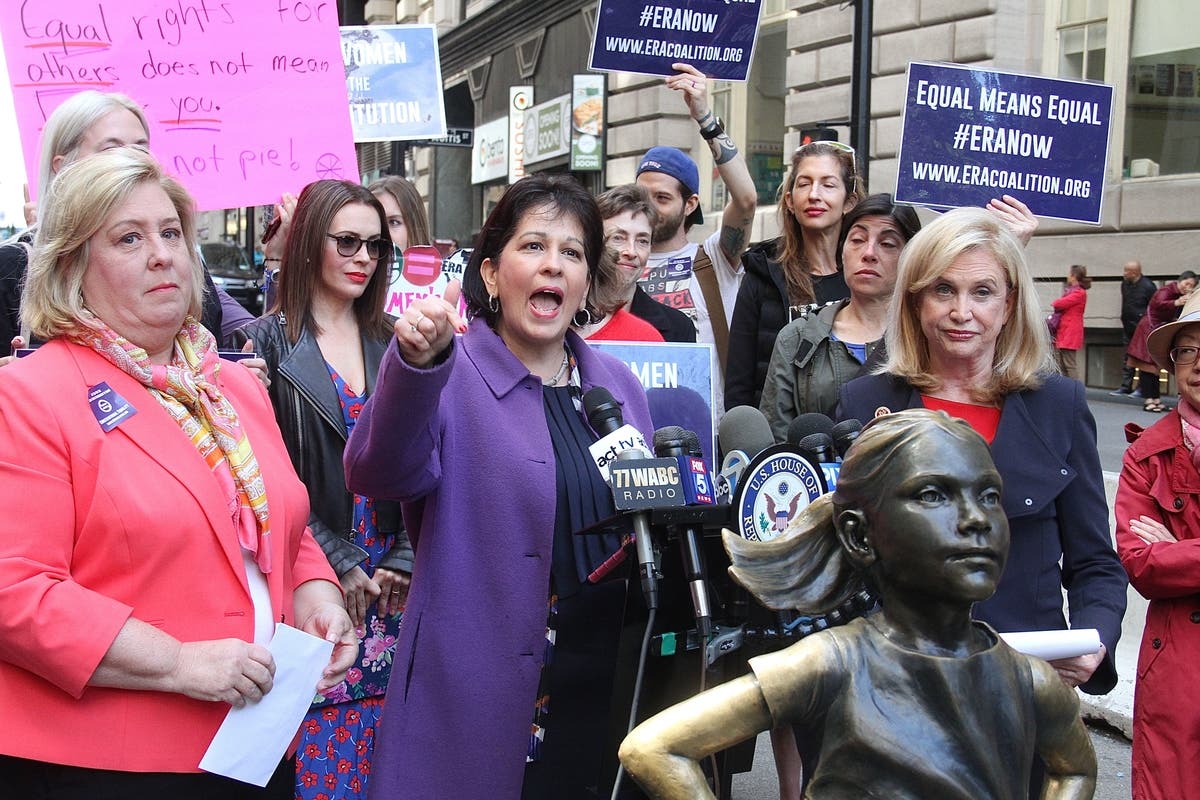
Earlier this month, New York Congresswoman Carolyn Maloney hosted a rally at Wall Street’s “Fearless Girl” statue to kick off a push to get the ERA ratified — though it’s possible the effort comes too late for the amendment to become a permanent part of the U.S. Constitution.
The deadline for ratification by three-fourths of U.S. states passed in 1982. Legal scholars argue Congress could retroactively extend the deadline, but the current political environment could be hostile to that.
Maloney, a Manhattan Democrat, has introduced the amendment in Congress 11 times, but it has yet to get a committee hearing.
“It’s time — long past time — to put equality of treatment [and] fairness in the Constitution for women,” she said at the June 4 rally. “The current crop of Congressional leaders have not only refused to do anything about it, they’ve refused to even talk about it.”
Actress Alyssa Milano, who joined Maloney at the rally, said “lack of recognition of women’s equality perpetuates the belief that women are less than, which leads to unequal treatment, abuses of power, sexual harassment, misconduct and assault.”
In Arizona, Ducey has the constitutional authority to call a special session and ask legislators to focus on the ERA or any other issue, but doesn’t plan to do so, according to the Arizona Daily Star report.
Democrats have tried to get hearings on the ERA, but have been out-maneuvered by key Republicans, who thwarted an attempt by Tucson Democratic Rep. Pamela Powers Hannley last year to put the issue to an immediate vote on the House floor. In a vote along party lines, the House voted instead to declare the chamber in recess.
The vote not only denied Democrats a hearing on the ERA, it meant Republicans wouldn’t have to say on the record if they supported or opposed it.
Rep. Isela Blanc, a Tempe Democrat, said failure to vote on the ERA sends the wrong message to young Arizona women.
“Do you want to go home and tell your daughters and granddaughters that you preferred to take a recess than actually have the opportunity to be leading and continuing to lead the state of Arizona?” Blanc said at the time, according to The Daily Courier.
Hannley’s motion for an immediate vote took Republicans by surprise. Rep. Kelly Townsend, a Mesa Republican who was only 4 when Congress passed the ERA, was taken by surprise by Hannley’s motion for an immediate vote and said she needed more time to study it. She doesn’t think employers should discriminate against women by paying them less, but said she does “have a problem with government telling businesses how to operate.”
The Arizona Constitution already prohibits discrimination or preferential treatment in public employment, public education and public contracting based on gender, race, color, ethnicity or national origin.
Image: Supporters rally at the “Mighty Girl” statue on Wall Street for passage of the Equal Rights Amendment, first approved by Congress in 1972. Only one more state needs to ratify the ERA for it to, theoretically at least, become part of the U.S. Constitution. (Photo by MediaPunch/REX/Shutterstock)
Get more local news delivered straight to your inbox. Sign up for free Patch newsletters and alerts.