Health & Fitness
Literature for Young Readers Today: Who is Writing It and Who is Reading It?
An old essay about children's literature poses a prescient question about where it was headed.
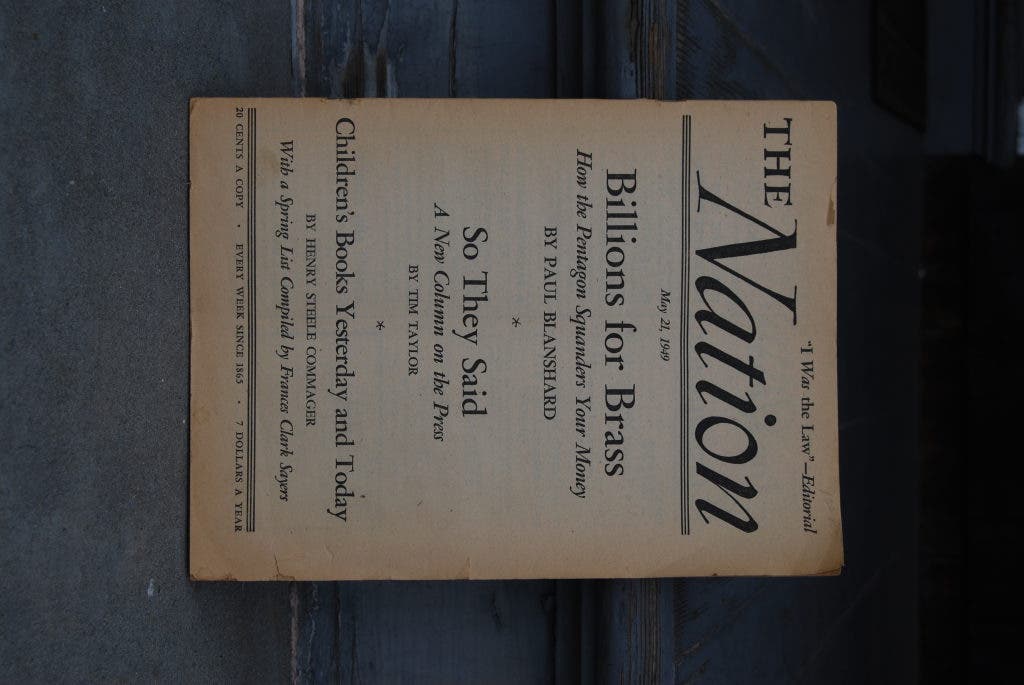
A couple of years ago I was walking past an antique store on Park Street and noticed a pile of old magazines, including a few issues of The Nation, a progressive weekly in publication since 1865. I bought a couple of copies for $1. Last week when I was cleaning my bedside table of a two-year accumulation of old New Yorker magazines I found one of these copies of the Nation, dated May 21, 1949. The lead article was Billions for Brass, How the Pentagon Squanders Your Money. I wondered if it had come from the estate of a former denizen of Alameda. On one hand that is entirely possible, but considering Alameda’s history as home to a naval base I sort of thought not. But without a search of subscription history it’s hard to know.
Anyway, there are a couple of coincidences related to this blog for Patch. One is that Frederick Law Olmsted, who was the partial subject of my last blog, was one of the founders of The Nation. The other is that this 1949 issue contained an article Children’s Books Yesterday and Today, by Henry Steele Commager, which relates to the subject of the two previous blogs.
This coincidence seemed like a good segue to another blog. After considering Olmsted, I’ve decided to go with children’s literature, though as it turns out in a loftier vein than previously discussed.
Find out what's happening in Alamedafor free with the latest updates from Patch.
The opening paragraph of Commager’s essay claims that most European visitors would comment “on the American indulgence of children. That Americans have, in fact, pampered and indulged their children, and that the United States has long been a children’s paradise is notorious.” I thought children at the low end of socio-economic scale might beg to differ. Even though these words were written before Uncle Walt even built Disneyland, I can see the point.
The article goes on to state that no contribution to the field of children’s literature has been more remarkable than in America, “and that America has been represented abroad by children rather than adults — by Little Eva, by Jo and Meg and Beth, Tom, and Huck Finn.”
Find out what's happening in Alamedafor free with the latest updates from Patch.
The author claims that almost every major American writer had written for children as well as for adults, going on to cite Irving and Cooper, Hawthorne, Alcott, Mark Twain, Crane and others. He further states, “Even Poe and Melville can be read with enjoyment by older children.” Charles Dickens and Robert Louis Stevenson are also mentioned. In fact, both of the latter were standards of my father’s reading as a youth. There was a full leather-bound set of Dickens’ work in our family home.
It seems Commager’s big point was to lament that major authors of the mid-twentieth century, including Thomas Wolfe, Hemingway, Faulkner, Joyce , Lawrence, Huxley , Waugh, etc. weren’t writing for kids, though earlier authors like “Hawthorne, Lanier, Crane did not think it beneath their dignity.” Steinbeck is his lone exception. He further laments that children’s writers had become didactic and that “the art of storytelling seems to have been lost.”
About this point in the essay I thought that while it may be interesting to review past viewpoints, it’s not always illuminating, and nearly tossed this blog idea. I wasn’t aware of Commenger before this article. His Wiki indicates he was a leading intellectual of progressive movement. Commager’s critique includes some English writers. Did such an intellectual regard The Hobbit as equivalent to what we broadly refer to as pop culture? The Hobbit was a critical success in its time and reached wide popularity with adults by the 1960s.
Commenger lived until 1997, so of course he missed Harry Potter and The Hunger Games, which also share audiences of mixed age rage, but perhaps would also be considered lowbrow by such a formidable critic.
In the closing paragraphs he states, “It is fairly safe prophecy that unless writers recapture the narrative art children will turn to movies and television for excitement.” Whether because of a lack of narrative art, Commager’s prediction about the impact of the screen medium seems dead on. One can only imagine his disappointment with video games.